
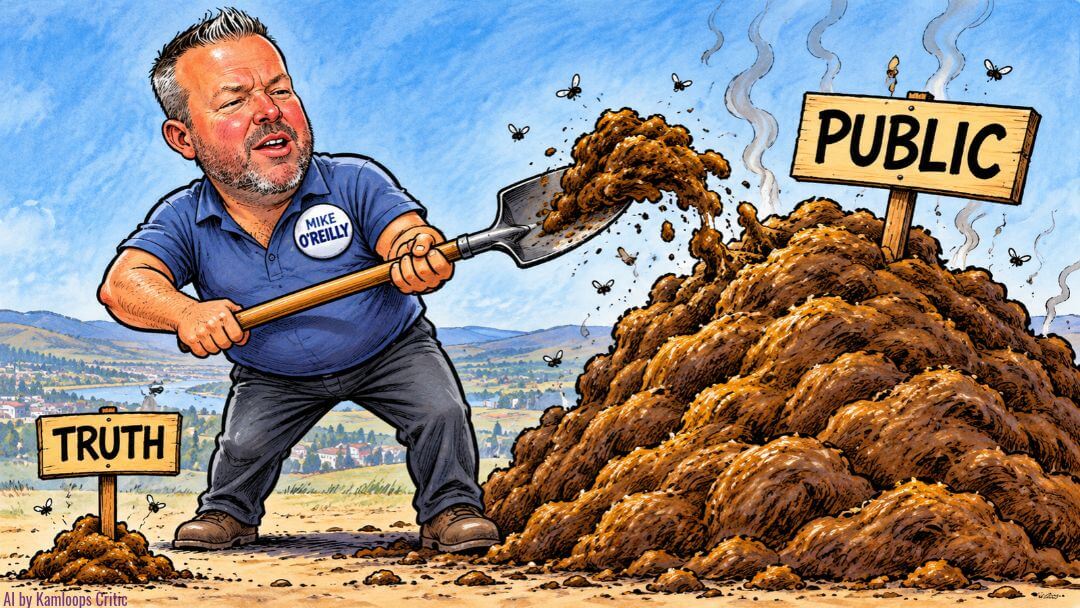
Mike O’Reilly made a promise during the mayoral campaign. If elected, he said he would bring Public Inquiries back at his first council meeting.
That meeting took place on November 2. It was the inaugural meeting of the new council, and it came and went without the promised motion.
I can't say I'm particularly surprised.
In a Castanet article titled "ELECTION 2026: Input, audits, ethics reforms pitched by Kamloops candidates", O’Reilly was quoted as saying he would table a motion to reinstate Public Inquiries at the first council meeting if elected.
He also offered an explanation for why Public Inquiries had been suspended in the first place. According to the article, he said the chair wasn't able to manage the podium and that the liability and risk to taxpayers had become too high.
Those are fairly significant claims. They also deserve to be examined.
The first meeting came and went
The November 2 inaugural meeting was O’Reilly's first opportunity to follow through on his campaign promise. The meeting agenda contained no motion to reinstate Public Inquiries, and no such motion was brought forward.
There was no indication that the new mayor intended to make good on what he had told voters.
Perhaps there is an explanation. Perhaps the motion is coming at the next meeting. Perhaps there is some procedural reason for the delay.
But O’Reilly didn't promise to look into it eventually. He said he would bring a motion at the first meeting.
That was a specific commitment, made publicly during an election campaign. It should be measured against what actually happened, not what he might do later.
If I have learned anything about O’Reilly, it's that I can generally trust there will be an explanation coming when his public statements don't quite line up with events. I suspect we'll hear one shortly.
The question is whether the explanation will be any more convincing than the original claim.
Was the chair really the problem?
O’Reilly's explanation for suspending Public Inquiries deserves just as much scrutiny as his failure to reinstate them.
He suggested that the chair couldn't manage the podium. But I don't recall Mayor Hamer-Jackson having difficulty managing the podium itself. What he had difficulty with was managing the behaviour of some of the people sitting around the council table.
There is a difference.
Hamer-Jackson's approach to chairing meetings was frequently criticized by councillors. They didn't always agree with how he exercised his authority, how he handled speakers, or how he maintained order.
But that doesn't mean he couldn't manage the podium.
The public record of those meetings showed a council that frequently struggled to conduct itself with decorum. Councillor Katie Neustaeter had her share of outbursts. Councillor Kelly Hall engaged in side conversations with Councillor Bill Sarai, and there were occasions when Hall made disparaging comments directed at the chair.
These weren't problems with members of the public appearing at the podium. They were problems with elected officials and their own conduct.
Blaming the chair for the suspension of Public Inquiries without acknowledging what was happening around the council table presents an incomplete account of events.
The chair has a responsibility to manage the meeting. Councillors have a responsibility to behave appropriately during it. Those responsibilities don't disappear simply because councillors disagree with the person in the chair.
The taxpayer liability argument
Then there's the claim that the liability and risk to taxpayers had become too high.
This is the part I'd particularly like to understand.
What liability? What risk? Was there a legal opinion identifying a specific exposure? Was there an insurance concern? Had the City received legal advice that continuing Public Inquiries could expose taxpayers to financial claims?
If so, where is that evidence?
I have yet to see anything that establishes that Hamer-Jackson's management of Public Inquiries created the kind of liability or financial risk O’Reilly described.
There is a considerable difference between saying that a process is difficult to manage, that councillors don't like how it is being managed, and that the process creates an unacceptable legal or financial risk.
Those aren't interchangeable explanations.
If there was a genuine liability concern, residents deserve to know what it was, who identified it, and what evidence supported the decision to suspend Public Inquiries.
Simply invoking taxpayer liability is not an explanation. It's an assertion. And one that should be backed up before it is accepted as fact.
A little problem with the Code of Conduct
There's another reason O’Reilly should be careful about the explanations he gives the public.
Council's Code of Conduct Bylaw No. 53, 2023, is quite specific about how elected officials are expected to communicate.
Section 3.11(a) requires members to ensure their communications relating to City, Council, or Committee business are accurate. It also prohibits them from issuing, or allowing to be issued on their behalf, communications they know or ought to have known are false or misleading.
That requirement applies to public statements, including statements made during an election campaign.
I'm not suggesting that every disagreement about how a council meeting was managed amounts to a Code of Conduct violation. Nor am I suggesting that a difference of opinion about liability automatically makes a statement misleading.
But when a mayor makes factual claims about why a public participation process was suspended, those claims should be supported by something more than his own characterization of events.
If the chair couldn't manage the podium, what specifically couldn't he manage?
If the process created unacceptable liability, where is the evidence?
And if O’Reilly intended to restore Public Inquiries at his first meeting, why didn't he do it?
These are reasonable questions. They aren't personal attacks. They're questions about the accuracy of statements made by the person now occupying the highest elected office in the City.
The public deserves more than campaign promises
I have written about O’Reilly before. His statements, his explanations, and the way he presents issues to the public have been recurring subjects of scrutiny at Kamloops Critic.
I don't expect everyone to agree with my assessment of him. But I do expect the mayor to be held to the same standard as every other member of Council.
O’Reilly was elected on October 17. By November 2, he had already missed an opportunity to deliver on a specific campaign commitment.
That doesn't mean he can never bring the motion forward. He still can. But the first meeting was the first meeting, and the promise was quite clear.
More troubling is the explanation he offered for why Public Inquiries were suspended. It places the blame on the chair and invokes taxpayer liability without, so far as I can determine, producing evidence to support either claim.
Perhaps O’Reilly has an explanation. I suspect we'll hear it soon enough.
In the meantime, residents might want to remember that there is a difference between being told something and being shown that it's true.
Public Inquiries were supposed to give residents an opportunity to be heard. The least they should expect from their new mayor is an honest account of why that opportunity was taken away, and whether he actually intends to restore it.
Campaign promises are easy to make. Keeping them, and telling the public the truth about what happened, is where accountability begins.
Editorial Disclosure: This article reflects the editorial opinions of Kamloops Critic. Kamloops Critic has previously written critically about Mike O’Reilly, and the suspension of Public Inquiries. Those previous articles inform the questions raised here, but the observations and conclusions in this article are based on O’Reilly's publicly reported statements, the November 2, 2026 council meeting agenda, the public record of previous council meetings, and the City's Code of Conduct Bylaw.
The purpose is to examine whether O'Reilly's campaign commitments and explanations stand up to scrutiny. Readers are encouraged to review the original statements and public records and reach their own conclusions.
I have attended many of the City Hall meetings in the last year. In my opinion without bias, O’Reilly will continue on his journey never really explaining anything in full
To me, he will always be an ynwducatwd narcissist nor do good at what he does
“What you do speaks so loudly I cannot hear what you are saying.”
If this continues to play out with O’Reilly, he might be in for a rough term in office.
This lack of follow through does not surprise me in the least. Campaign promises are just that …promises !
It won’t surprise me if this is the first of many to come.
We have let the weasel into yhe chicken coop.