
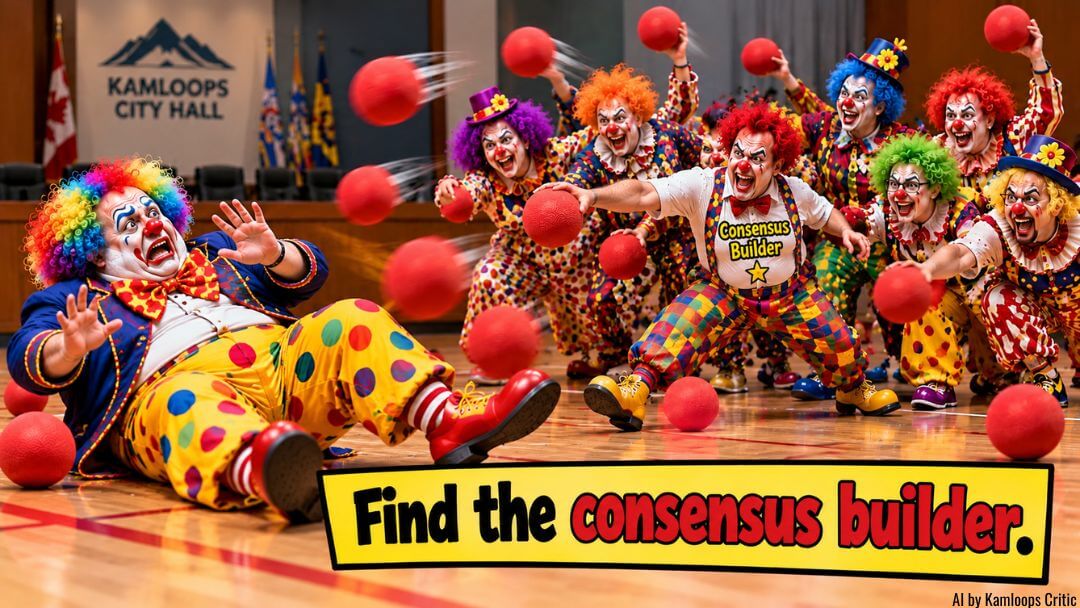
Let's give credit where credit is due. Mike O'Reilly says he's a consensus builder.
At the September 23 Chamber of Commerce/Castanet mayoral forum, candidates were asked: "What actions will you take to address or repair any damage done to relationships with our city's partners and stakeholders?"
O'Reilly began his answer this way:
"There's been a lot of talk about the dysfunction around City Hall, but you don't have to look very far but three blocks down the road of the TNRD, and seven of the eight councillors sit on the TNRD, and those meetings run just fine."
It's an interesting observation. Seven of Kamloops' eight councillors also sit on the TNRD board, so O'Reilly is right to point out that substantially the same group of elected officials works together in another setting.
But what does that tell us about the cause of the dysfunction at City Hall? And if O'Reilly believes he's a consensus builder, what responsibility does he accept for the behaviour we've seen over the past four years?
Does the mayor determine how councillors behave?
O'Reilly's comparison raises an obvious question. If Mayor Reid Hamer-Jackson were chairing TNRD meetings, would the board behave the same way? We can't know, because that isn't the situation we've observed. But the question illustrates why the comparison alone doesn't establish that the mayor is responsible for the difference.
There's another possibility we should consider. Perhaps the working relationships, expectations and circumstances differ between the two bodies. Perhaps the way meetings are conducted makes a difference. Or perhaps some combination of factors helps explain why the same councillors behave differently in different settings.
What we shouldn't do is assume that the mayor's presence explains everything while treating the other eight members as though they have no control over their own conduct.
The mayor has one vote. So does each councillor. The mayor has responsibilities for chairing meetings and helping council conduct its business, but councillors also make choices about how they respond to disagreement. They can challenge a proposal, explain their objections, seek a compromise or work with colleagues to find a way forward.
They can also choose not to.
What does a consensus builder do when consensus is difficult?
During this term, we've seen instances in which motions brought forward by the mayor failed to receive a seconder. Without a seconder, a motion generally cannot proceed to debate. There can be legitimate reasons for not seconding a motion, and no councillor is obliged to support every proposal. The question is whether the overall pattern of behaviour helped council work through its differences or made constructive discussion more difficult.
O'Reilly was one of the eight councillors who could influence how council operated. If he was able to build consensus among his colleagues, what did he build?
Did he try to bring councillors together around a commitment to respectful conduct, regardless of their differences with the mayor? Did he work to ensure that disagreements could be aired and considered on their merits? When relationships deteriorated, did he try to repair them?
I'm not suggesting that O'Reilly could have resolved every dispute, or that the mayor bears no responsibility for what happened. Consensus requires more than one willing participant. But that cuts both ways. If a councillor believes the mayor is making it difficult to work together, that doesn't relieve the councillor of the responsibility to try to improve the situation.
We all know what it's like to work with someone we find difficult. Someone might frustrate us, challenge our patience or make us angry. But while we can hold that person responsible for their own behaviour, we're still responsible for how we respond. We can try to resolve the disagreement, set reasonable boundaries or explain why we object. We don't get to blame someone else for every choice we make in response to them.
Why should elected officials be held to a different standard?
What about the public?
O'Reilly's record also raises questions about the relationship between council and residents.
Why didn't he build consensus around maintaining public inquiries, so residents could ask questions directly of council? Why didn't he work to establish a shared expectation that public concerns deserved a respectful and meaningful response, even when councillors disagreed with the people raising them?
In his October 8 candidate profile with CFJC Today, O'Reilly says he would bring public inquiries back at the first council meeting of the new term. He acknowledges that the previous process did not work as it should have, but attributes some of the problem to the chair's inability to manage speakers and the process effectively. He also says good communication requires the city to listen to residents, not simply tell them what it is doing.
Those are reasonable goals. But they raise a question about the past as well as the future: what did O'Reilly do during the term to advance them? If public inquiries weren't working, did he propose changes to make them more effective? Did he try to build agreement among councillors around a better process? Or did the issue remain unresolved until it became part of his mayoral campaign?
I'd like to know the answers. A candidate's proposed solutions tell us what they want to do. Their record can tell us whether they tried to address the problem when they had the opportunity.
He says elected officials should be held to a higher standard
There's another part of O'Reilly's CFJC Today profile that deserves attention. Asked how he would ensure civil discourse and good governance, he describes himself as having a "proven track record as a collaborator and consensus builder." He says elected officials should be held to a higher standard, that respectful disagreement can lead to better decisions, and that as mayor he would set the tone from the top.
He also says that once council makes a decision by majority vote, everyone has a responsibility to respect it and move forward as a team.
I agree that these are important principles. But they aren't just principles for a future mayor to impose on others. They apply to councillors too, including those who aspire to lead the organization.
If O'Reilly believes elected officials should be held to a higher standard, I'd like to know how he applies that standard to his own conduct and his participation in the current council. What does he believe he did well? What would he do differently? And what responsibility does he accept for the way council operated during the term?
I can't conclude that he encouraged or endorsed the dysfunction simply because he was a member of council. That would require evidence of his actions and statements. But I also don't think residents should accept a claim of consensus building without examining what the candidate actually did to build consensus.
What happens when the next council disagrees?
Suppose voters elect a councillor whom O'Reilly disagrees with, or whom the other councillors find difficult to work with. What happens then if O'Reilly becomes mayor?
Will he be able to work constructively with that councillor? Will he encourage the rest of council to do the same? If his proposals face opposition, will he look for common ground, or will he regard the disagreement as evidence that someone else is preventing council from functioning?
These aren't predictions about how O'Reilly would behave. They're questions his record and his stated approach to leadership should help answer.
If the explanation for the last four years is simply that the wrong person occupied the mayor's chair, then changing the mayor is supposed to solve the problem. But if the behaviour of councillors also contributed to the difficulties, electing a different mayor doesn't automatically change that behaviour.
A new term won't, by itself, establish better working relationships. That requires people to recognize their own part in the problem and make a conscious effort to do things differently.
The question behind the claim
Mike O'Reilly has spent eight years on council. He has chaired committees, served on regional boards and had opportunities to work with his colleagues. He now says he has a proven track record as a consensus builder and wants to set a different tone as mayor.
I'm interested in the evidence behind that claim. What disagreements did he help resolve? What changes did he persuade his colleagues to make? What did he do to improve council's relationship with the public? And when he found the working environment difficult, what responsibility did he accept for his own response?
Perhaps he has examples that would answer these questions. If so, I'd like to hear them.
But if he believes consensus building is something he can do as mayor that he couldn't do as a councillor, he should explain why. If he believes the other councillors need to behave differently, he should explain what he did to encourage that change during the term.
Consensus isn't tested when everyone agrees. It's tested when people disagree, when relationships are strained and when working together takes effort.
O'Reilly says he's a consensus builder. Before accepting that description, I'd like to know what consensus he built when he had the opportunity, what responsibility he accepts for the council we've had, and what he would do differently when the next disagreement inevitably arrives.
Other articles about Mike O'Reilly
- Nelly Kicks O’Reilly’s Rebuttal
- A Chance to Recognize Another Kamloops Business Person
- Calling Bullshit: O’Reilly and the Flowers
- Mike O’Reilly Invites Questions. I Have a Few More.
- Well Played, Councillor O’Reilly
- Council Won’t Say Who Owns Comet Shares
- Why the O’Reilly Case Matters to Kamloops Residents
- O’Reilly Breaches Code of Conduct with Mayoral Bid
- Status Quo Mike O’Reilly
Municipal Election 2026
It's important that we ALL vote. Please vote only for candidates you truly believe deserve to be at the council table. If that's only one or two candidates, those are the only ones you should vote for.
Editorial Note: This article contains factual reporting and editorial commentary. The reporting draws on publicly available council records, meeting proceedings, candidate statements and media coverage, including the September 23, 2026, Chamber of Commerce/Castanet mayoral forum and Mike O'Reilly's October 8, 2026, CFJC Today candidate profile. The questions and conclusions presented here reflect the author's analysis of that material. Readers are encouraged to review the original sources and reach their own conclusions. Kamloops Critic welcomes factual corrections and a response from Mike O'Reilly to the questions raised in this article.
I have a question pertaining to this. The Mayor wasn’t always in that seat. There were many times there were acting Mayors and in fact more often than not. So, with that being the case, why weren’t the public inquiries allowed at those times? Seems like a feeble excuse to me.
O’Reilly speaks of the TNRD and uses the term “dysfunction” which exists at City Hall but not at the TNRD. He speaks of 7 of the 8 councillors being at both places.
On March 17, 2023 there were 6 councillors at the TNRD strategic planning meeting. The 7th person in attendance representing Kamloops was the elected Mayor, Reid Hamer-Jackson. The 6 councillors in attendance got up and left the meeting. Our elected Mayor stayed behind because he was about to be blindsided in public and wasn’t invited.
Wasn’t O’Reilly one of the 6 councillors who were being paid to be at the TNRD meeting? Yet, the only one who stayed at the meeting was Mayor Hamer-Jackson. You see, O’Reilly didn’t invite Reid to come along. O’Reilly stood there with the rest of the loose pack of 7 misfits while Katie read a “statement”. O’Reilly knew what was about to happen and he just stood there with that stupid grin on his face.
Kamloops Critic, I hope that the citizens who vote in this election can picture what O’Reilly is truly like as a man of principles or rather, no principles. O’Reilly was elected to council, was being paid to attend an important meeting at the TNRD BUT HE DECIDED TO LEAVE!! He was part of the pack! In my opinion, he doesn’t deserve to be Mayor.