
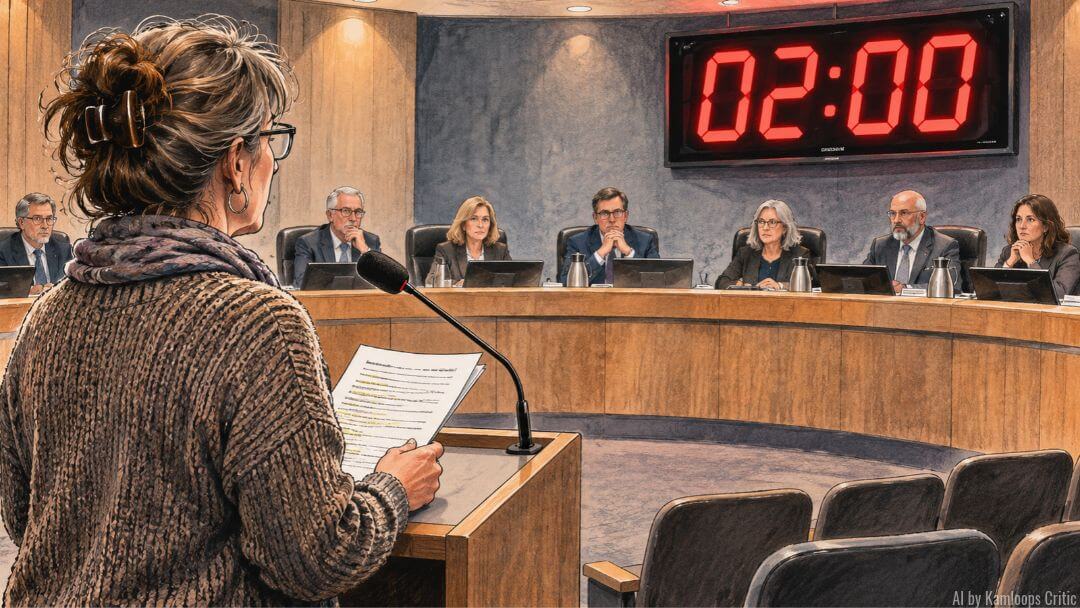
Mike O'Reilly promised to restore public inquiries at the first Council meeting. Instead, residents are being offered a limited opportunity to speak for two minutes, with no expectation of receiving an answer.
When O'Reilly was campaigning for Mayor, he made a fairly specific promise about public participation. He said he would move quickly to reinstate Public Inquiries, giving residents an opportunity to ask questions directly of Council and receive answers in a public forum. Calling Bullshit: O’Reilly and Public Inquiries
The November 2 inaugural Council meeting came and went without the promised motion. Now, with Public Input appearing on the November 10 Council agenda, residents might reasonably assume that O'Reilly's commitment has been fulfilled.
It hasn't.
Public Input and Public Inquiries are not the same thing. The City has brought back an opportunity for residents to speak about certain agenda items, but the process is considerably more restrictive than the public inquiry system O'Reilly said he wanted to restore.
What did O'Reilly actually promise?
During the election campaign, Castanet reported that O'Reilly intended to move quickly to reinstate Public Inquiries.
His commitment was quite specific. He said he would table a motion at the first Council meeting of the new term to bring the process back.
In his October 8 CFJC candidate interview, he repeated that commitment, saying he would put forward a motion to restore public inquiries at the first meeting. He described the purpose as giving residents a regular opportunity to ask questions directly of Council and receive answers in a public forum.
The November 2 inaugural meeting was the first meeting of the new Council. No motion to restore Public Inquiries was introduced.
Instead, the November 10 agenda includes Public Input.
How Public Inquiries became Public Input
On May 6, 2025, Council adopted Council Procedure Amendment Bylaw No. 59-3 and Council Policy GGL-32. The changes replaced the previous Public Inquiries process with a new system called Public Input.
The new process introduced advance registration, a two-minute speaking limit and restrictions on the subjects residents could address.
Council subsequently suspended Public Input on December 9, 2025, voting 7–2 to extend the suspension until the end of that Council term. That motion was moved by Margot Middleton, seconded by Katie Neustaeter, and supported by O'Reilly and Kelly Hall. Kamloops Council Suspends Public Input Again — Blame the Mayor
With the previous Council's term ending, that suspension expired. Public Input has now returned.
There is something important to note here. The new Council did not need to restore Public Inquiries for Public Input to resume. The suspension of the replacement system had simply reached its stated expiry.
That explains why Public Input is back. It does not explain why the incoming Council has not followed through on the commitment to restore Public Inquiries.
What does the City actually allow?
The City's Council Public Input Request page sets out the requirements for anyone wishing to address Council.
Residents cannot simply attend a meeting and ask to speak. They must first complete an online registration form during a limited registration period.
Registration opens Friday at 9 a.m. and closes Monday at noon before the Tuesday Council meeting. Applicants must identify the specific agenda item they want to address and provide a summary of their intended input.
The City then reviews the applications and confirms which speakers have been approved. Submitting the form does not guarantee an opportunity to speak.
Approved speakers receive up to two minutes to address Council.
There is also an important qualification in the City's instructions: input is provided without any expectation of a response from Council or staff.
Consider what this means for an ordinary resident.
They must identify an eligible agenda item, prepare a summary of what they intend to say, submit it within the registration window, wait for City approval and then deliver their remarks within two minutes.
Even after going through that process, they should not expect an answer.
Two minutes to explain a concern
Two minutes might sound reasonable if someone simply wants to make a short statement. But municipal issues are not always simple, and residents are not professional public speakers.
Someone wanting to explain a concern about a development proposal, municipal spending decision or change in City policy may need to provide some background before getting to the actual question.
Two minutes doesn't leave much room for that.
There is also the advance summary requirement. Residents must tell the City what they intend to discuss before they are approved to speak.
The City says applications are reviewed, but the public information does not clearly explain how competing applications are assessed or what criteria determine which residents are permitted to speak.
That leaves residents applying for a limited number of speaking opportunities without necessarily knowing how their applications will be judged.
The process may be manageable for someone who is comfortable speaking in public and can summarize a complicated issue quickly. For others, it creates another hurdle between having something to say and actually being heard.
Some subjects aren't eligible anyway
The November 10 agenda provides a useful example of another limitation.
The proposed appointments to the Thompson-Nicola Regional District Board appear under Item 14, the Mayor's Report. The agenda specifically states that the item is not eligible for Public Input under Council Policy GGL-32.
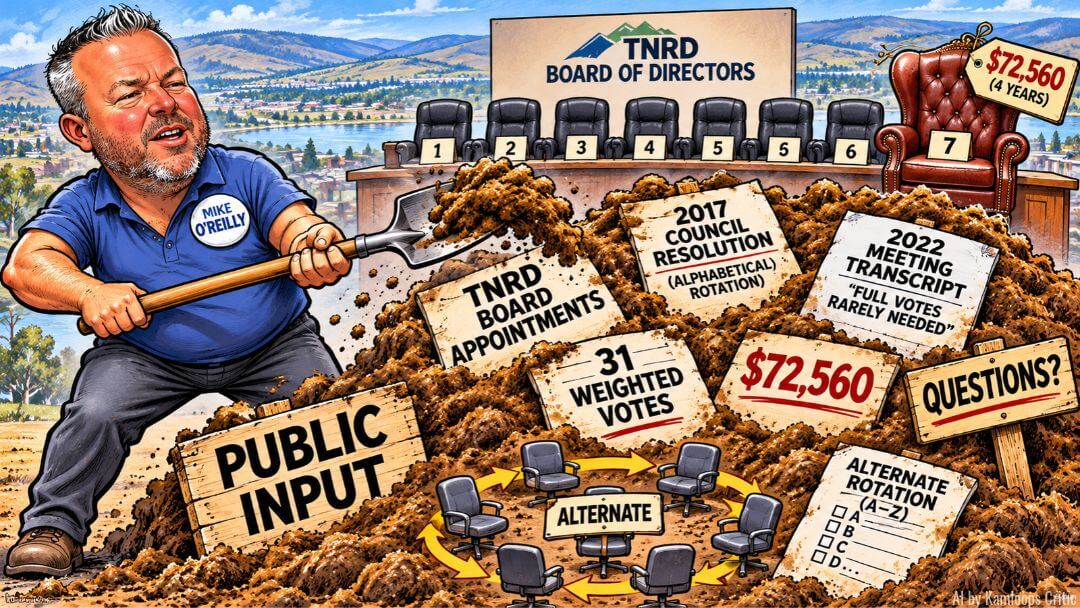
The TNRD appointments affect how Kamloops is represented on a regional board, including the allocation of weighted votes and the appointment of alternates. Residents might reasonably have questions about the Mayor's recommendations or the reasoning behind them. O’Reilly’s TNRD Appointments: More Seats, Fewer Answers
But because the appointments are included under the Mayor's Report, residents cannot use the Public Input process to address Council about them.
In other words, even if residents meet every registration requirement, they cannot necessarily speak about an issue simply because it is important to them or because Council is about to consider it.
The subject must first qualify under the City's rules.
Speaking isn't the same as being heard
Perhaps the most significant difference between Public Input and Public Inquiries is what happens after a resident finishes speaking.
The City's instructions make it clear that residents should not expect a response from Council or staff.
That is quite different from what O'Reilly described during the campaign. His stated objective was to give residents an opportunity to ask questions and receive answers in a public forum.
There is a difference between allowing residents to deliver prepared statements and giving them an opportunity to question their elected representatives.
A resident might have a legitimate question about a Council decision. They might want clarification about something in a staff report or an explanation for why Council is taking a particular approach.
Under the current Public Input process, there is no assurance that the question will be answered. There is not even an express provision for a question-and-answer exchange.
The resident gets two minutes to deliver their input, and Council can move on to the next item.
That may technically qualify as public participation, but it does not provide the kind of public accountability that comes from being able to ask a question and hear an answer.
What happened to the election promise?
I don't think it is unreasonable to expect a newly elected Mayor to follow through on a specific commitment made during an election campaign.
O'Reilly said he would introduce a motion at the first Council meeting to restore Public Inquiries. The November 2 meeting passed without that motion, and the November 10 agenda does not show a proposal to restore the former process.
Instead, Public Input has resumed under the rules established by the previous Council.
Perhaps O'Reilly considers the current system adequate. Perhaps he intends to introduce changes later. There may be reasons for not bringing forward the motion immediately.
But residents have not been given an explanation for the apparent difference between what was promised and what has happened.
I would like to hear O'Reilly explain whether he considers the current Public Input process to fulfil his election commitment. If it does, how does he reconcile the City's restrictions with his promise to let residents ask questions and receive answers? If it doesn't, when does he intend to bring forward the motion he promised?
What is the point?
There is nothing wrong with having reasonable rules for public participation. Council meetings need structure, and everyone should have a fair opportunity to participate.
But those rules should help residents engage with their elected representatives, not simply create a controlled opportunity to deliver a short statement.
When residents must compete for permission to speak, disclose their intended remarks in advance, restrict themselves to two minutes and do so without expecting an answer, it is reasonable to ask what the process is actually intended to accomplish.
Public Input is better than no opportunity to speak at all. But it is not the same as Public Inquiries.
O'Reilly promised to restore the latter. So far, Kamloops has only got the former.
The question is whether residents will eventually get the opportunity they were promised, or whether two minutes of pre-approved public input is as much access to their elected representatives as they can expect.
Editorial Disclosure: This article presents independent analysis and commentary by Kamloops Critic. It examines public statements made by Mayor Mike O'Reilly during the 2026 election campaign, City of Kamloops policies and procedures, Council agendas, and the City's current Public Input process.
The observations and conclusions reflect the author's interpretation of publicly available information. The article is intended to encourage discussion about public participation, transparency and accountability in local government. It does not represent the views or official position of the City of Kamloops or its Council.


Outside of City Hall, if I want to order a $3,000 set of tires or apply for a 25 year mortgage, hopefully I’m treated like a mature adult.
Is there a point I’m trying to make here, Kamloops Critic?