

Mike O'Reilly has only been mayor of Kamloops for a few days, but his first decisions already raise questions.
At his November 2 inaugural meeting, O'Reilly introduced his recommendation for the 2026–2027 Deputy Mayor Schedule. Rather than distributing the responsibility among all eight councillors, he proposed reserving the first year for the three returning councillors: Margot Middleton, Katie Neustaeter and Kelly Hall.
His explanation suggested that the five new councillors need time to learn and understand the job.
It may sound reasonable. But what exactly are the new councillors being excluded from, why is that responsibility being reserved for the incumbents, and does the arrangement reflect the intent of the City's own policy?
A rotation, with a few exceptions
O'Reilly explained:
"We have a recommendation in front of us for the 26-27 Deputy Mayor Schedule. The Deputy Mayor Schedule will be broken down the first year. It will be made up of the three incumbents, so the new counselors can really... learn and understand the job. At which point after the first year has passed, everyone will have the opportunity that still chooses to be a Deputy Mayor."
He then outlined the appointments:
- Margot Middleton: November 2026 to February 2027.
- Katie Neustaeter: March 2027 to June 2027.
- Kelly Hall: July 2027 to October 2027.
That leaves five newly elected councillors sitting out the entire first year.
Council Procedure Bylaw No. 59 calls for councillors to be appointed on an annual basis, on a rotating basis, in monthly increments. The wording does not expressly require every councillor to serve as Deputy Mayor during the year.
O'Reilly's recommendation may not violate the bylaw. However, there is a difference between following the wording of a policy and respecting its intent.
The policy establishes a rotating responsibility among councillors, rather than a position reserved for a select group. O'Reilly's recommendation takes that rotation and limits it to the three returning councillors for the first year of a new Council's term.
It may satisfy the technical requirements. But it is difficult to see how excluding five of the eight councillors reflects the spirit of a policy intended to distribute that responsibility among Council members.
What are the new councillors actually missing?
One of the functions of the Deputy Mayor position is representing Council when the Mayor is unavailable. It also provides an opportunity to represent the City, interact with residents and take responsibility for Council communications.
In particular, the handling of correspondence sent to citycouncil@kamloops.ca deserves attention.
Residents use that address to raise concerns, ask questions and provide feedback to their Council. The Deputy Mayor has an important role in responding to that correspondence on behalf of Council.
I've written several articles examining how that responsibility has been handled by the returning councillors. Unfortunately, the examples don't provide much reassurance that reserving the position for them is going to improve the public's experience.
In my March 2026 article, Worthy of Response?, I documented an internal Council email from April 2023. Middleton, who was then Deputy Mayor, explained that some emails might not receive a response because they didn't meet her personal threshold of being "worthy of response."
The exchange also showed that other councillors supported giving the Deputy Mayor discretion over whether correspondence deserved a reply.
In January 2026, my article Deputy Mayor Says Accuracy of Council Minutes Is Not "Legitimate City Business" examined Hall's response to concerns I raised about discrepancies between a Council meeting video and the official minutes.
Hall told me:
"Unless your concerns are related to legitimate city business (ie. land use, community planning, licensing, taxation etc.) I will not be responding to you further."
He also said he had advised staff to do the same and suggested that complaints about Council be directed to the Ombudsperson.
Apparently, concerns about the accuracy of official Council records didn't qualify as legitimate City business.
My November 2025 article, City Council Emails Ignored, documented another approach. After sending several follow-up emails over the course of a month concerning Code of Conduct complaints without receiving a substantive response, Neustaeter suggested that complaints about Council be directed to the Ombudsperson.
These are three different examples, but they share a common theme. Residents' concerns can be dismissed, redirected or left without a meaningful response.
There are legitimate reasons to disregard abusive, repetitive or irrelevant correspondence. But residents should reasonably expect legitimate questions about municipal governance to receive meaningful consideration.
The three returning councillors have had four years to develop their approach to this responsibility. The examples I've documented suggest there is considerable room for improvement.
So why should they be given exclusive responsibility for the first year of the new Council?
If anything, the new councillors should have an opportunity to demonstrate that they can do things differently. Residents might benefit from representatives who approach public correspondence with a fresh perspective.
Instead, they will have to wait.
A new council, or the same old inner circle?
During his inaugural speech, O'Reilly went out of his way to distinguish between the returning councillors and the newcomers.
He described Middleton, Neustaeter and Hall as providing "proven governance, leadership, fiscal clarity and steady hands."
He then described the five new councillors as bringing "vital fresh perspectives" to the table.
Those are generous descriptions of both groups. But the Deputy Mayor recommendation seems to place considerably more confidence in the returning councillors than in the fresh perspectives O'Reilly says he welcomes.
The three incumbents get the positions, the experience and the opportunity to represent Council. The newcomers get a year to learn from them.
Perhaps that was simply intended as a practical arrangement to help ease the transition. But it also establishes a hierarchy at the very beginning of the new Council's term.
The incumbents are positioned as the experienced leaders, while the newcomers are expected to learn how things work before being given the same opportunities.
I would have preferred to see a rotation that included all eight councillors. That would have allowed the new councillors to learn by doing, rather than being told they need another year before they are ready.
The mentoring question
O'Reilly's arrangement also means that the three returning councillors will have an influential role in mentoring the five newcomers.
There is nothing wrong with experienced councillors helping their colleagues understand municipal government. In fact, it would be irresponsible not to share institutional knowledge.
But there is a difference between helping someone become a better councillor and teaching them to become a more compliant member of an established group.
The new councillors need to develop their own judgment, ask their own questions and be willing to challenge decisions when they believe something isn't right. They should not feel obligated to adopt the habits, assumptions or political relationships of the people who have been at the table for the previous four years.
If residents are going to have confidence in this new Council, they need to see the five newcomers find their voices.
That includes questioning the Mayor, questioning their colleagues and occasionally disagreeing with the majority.
The mentoring relationship should help them become independent representatives, not protégés who learn that questioning the established way of doing things is somehow contrary to the interests of Council.
Healthy debate, or being contrary-minded?
O'Reilly spent a considerable part of his inaugural speech talking about the importance of disagreement.
"We will not always agree. In fact, I would be disappointed if we always agreed."
He continued:
"We are here to have healthy debates, different opinions, and constructive discussion. They are essential to good governance."
I agree with him.
But there is something else I've noticed in the language used by O'Reilly, and previously by former Mayor Ken Christian. When asking if anyone opposes a motion during a vote, they have a tendency to use the expression "contrary-minded."
Perhaps it seems minor, but I don't think it is.
Being opposed to something is a legitimate position. It means you disagree with a proposal, and you should be able to explain why. Being contrary-minded carries a different implication. It suggests someone is opposing something because they are inclined to be difficult or simply don't want to go along with the group.
That distinction is worth considering in light of a Candidate Information Session hosted by the City, and presented by Christina Benty.
While discussing contrarians, Benty displayed a slide illustrating the difference between what a contrarian thinks they are doing and what they are actually doing. In the top illustration, everyone is happily riding together on a tandem bicycle. In the bottom, one person is pedalling in the opposite direction.
Benty explained:
"Sometimes I think that, especially somebody who is a contrarian, they often feel like they're, I'm just making things better. I'm just pointing out, you know. I'm thinking outside the box, right?"
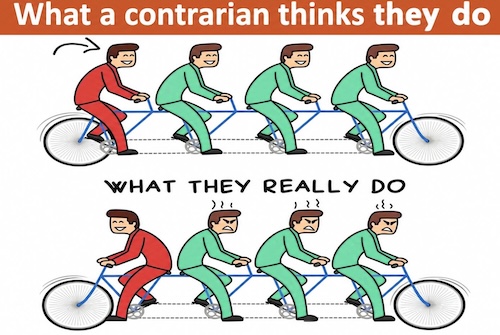
She went on to distinguish between what she called the "medicine side" and the "poison side" of tension and conflict, suggesting that mature adults should recognize when they are moving from one to the other.
I don't disagree. Not every disagreement is productive, and opposing every proposal simply because it comes from someone else isn't constructive governance.
But how do we distinguish between someone who is being deliberately obstructive and someone who is raising legitimate concerns that others would rather not hear?
A councillor who questions a proposal, challenges an assumption or asks for evidence shouldn't automatically be regarded as contrary-minded. Sometimes the person asking the uncomfortable questions is the one contributing the most to a better decision.
Consensus is not the same thing as good governance, and disagreement is not necessarily a sign that someone isn't being a team player.
If O'Reilly genuinely wants healthy debate, he needs to make sure that councillors who challenge his decisions are treated as contributing to the discussion, not as people who are simply being contrary.
Five new councillors, one unanimous decision
I was disappointed that none of the new councillors opposed the recommendation.
It was was approved unanimously. That means all five new councillors supported a schedule that excludes them from the rotation for the first year.
I don't know what each of them was thinking when they supported it. They may have accepted O'Reilly's explanation in good faith. They may have viewed the arrangement as a reasonable way to give themselves time to become familiar with the job.
I also recognize that they haven't had the benefit of observing the previous Council from inside the room for four years. They may not be familiar with the history of public correspondence, the relationships between councillors or the reasons why some residents have become frustrated with how Council operates.
After the vote, however, I came across an interesting exchange on a Facebook post by Councillor Randy Sunderman.
Resident Vicki Gehring expressed concern about the proposal to exclude the new councillors from the Deputy Mayor rotation for an entire year. She questioned why residents had elected councillors only to have them effectively placed in a junior or councillor-in-training role.
Sunderman responded:
"I did talk to Mike prior to this motion being put forward. We will all get equal opportunity to be deputy mayor over our 4 year term and I feel my time in this first year is best channeled to some of the key initiatives that I want to see set off to a strong start."
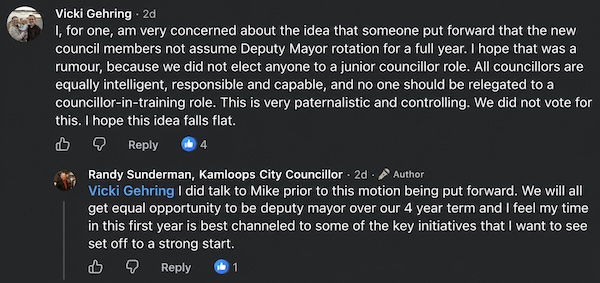
That tells us how Sunderman views the arrangement. It also tells us that he discussed the proposal with O'Reilly before the motion was introduced.
I don't question Sunderman's stated priorities. He may genuinely prefer to concentrate on other responsibilities during his first year.
But there are two separate questions here. One is whether Sunderman personally feels he needs the opportunity during his first year. The other is whether Council should have decided that none of the five new councillors would have that opportunity.
While Sunderman's explanation is useful, it also doesn't answer whether the arrangement reflects the intent of the City's policy or serves the interests of residents.
A unanimous decision doesn't necessarily tell us whether everyone independently considered the proposal or whether anyone was prepared to challenge the Mayor's recommendation. The next four years will tell us much more.
Is this really in the best interest of the city?
During his inaugural speech, O'Reilly made a point of reminding his fellow councillors that their responsibility was not to represent individual interests or political differences.
"Our responsibility is not to represent our individual interests or political differences. It is to make decisions in the best interest of the city," he said.
I agree with that principle. But it raises a reasonable question about the decision Council has just made.
Throughout the election campaign, one of the recurring concerns raised by residents was that they didn't feel heard. Candidates talked about transparency, accountability, public engagement and restoring confidence in City Hall.
O'Reilly himself acknowledged this in his inaugural speech:
"Residents want to see meaningful action and they want to feel heard."
He also promised to be Mayor for all of Kamloops, whether people voted for him or not. He spoke about listening to different viewpoints, constructive discussion and the importance of working together.
So how does reserving the Deputy Mayor rotation for three returning councillors for an entire year serve those interests?
The position carries responsibility for responding to correspondence addressed to Council. Yet I've documented examples involving all three returning councillors where residents' concerns have been dismissed as unworthy of a response, characterized as outside legitimate City business, or redirected elsewhere.
Those examples don't suggest that the existing approach to public correspondence is working particularly well. They also make it difficult to understand why the first year of the new Council should be reserved exclusively for the same three people.
Perhaps the arrangement is convenient for the councillors involved. Perhaps the new councillors genuinely believe they are better off concentrating on other responsibilities during their first year.
But convenience for councillors isn't necessarily the same thing as serving the best interests of residents.
Giving five new councillors an opportunity to participate in the Deputy Mayor rotation wouldn't guarantee that things would improve. But excluding all five certainly doesn't create that opportunity.
O'Reilly's promises will need to be measured against his decisions
In his inaugural speech, O'Reilly promised to be Mayor for all of Kamloops, including those who voted against him.
He recognized the importance of listening to residents and said that people want to feel heard. He also promised a Council that would welcome different opinions and engage in healthy debate.
Those are good promises. But they are easy to make during an inaugural speech.
The real test is what happens when those promises require decisions that aren't necessarily convenient or politically comfortable.
Restricting the Deputy Mayor rotation to the three incumbents may not be a violation of the City's policy. But it does raise questions about why the new councillors were excluded, why the incumbents were given preferential access to the responsibility, and whether this is the kind of inclusive leadership O'Reilly promised.
I don't expect the new councillors to agree with me on everything. Nor do I expect them to automatically oppose O'Reilly's recommendations. What I do expect is that they exercise independent judgment and remember that they were elected to represent residents, not simply to become part of an established political team.
O'Reilly has talked about the dangers of the phrase "we've always done it this way." I hope he remembers that advice when the new councillors start asking questions of their own.
A new Council should bring new voices to the table, not simply new faces around the horseshoe.
And if O'Reilly really wants healthy debate, he should welcome those voices rather than decide, before they've had a chance to demonstrate what they can do, that they need another year to learn how to do the job.
Editorial disclosure: This article examines a decision made by the newly elected Kamloops City Council and compares it with statements made by Mayor Mike O'Reilly about public participation, fresh perspectives and healthy debate. It also references my previous correspondence with three returning councillors. Those experiences inform the questions raised here, but the conclusions are based on the public record, the Council Procedure Bylaw and the statements and decisions discussed in the article.

“All animals are equal, but some animals are more equal than others.” (Chapter X, George Orwell’s ‘Animal Farm’)
There was a very good reason Mac and many others wanted “No Incumbents”. Are the newly-elected Councillors being bullied already and don’t realize it? A school bully is always a school bully is always a school bully is always a school bully. The school bully just changes tactics as he sees fit.
Voter regret is going to run deep, well before Christmas, that any incumbents were voted back into office.
1-I’m not aware of any newly elected Kamloops councillor abstaining from their responsibilities in this manner in the past let alone all 5
2-I’m also not aware of councillors in other cities abstaining from their responsibilities like this
3-shouldn’t they have learned this prior or over the next 3 months when the incumbent members take on these responsibilities and does it really take 12 months to learn, it’s not that complicated
4-this is a bad look for the 5 but you can’t blame the incumbents for the new members meekness
5-with an 8-0 vote, who didn’t vote?
I can’t say I agree or disagree with the decision to leave out the five from the Deputy Mayor lineup, but…I am greatly concerned at the power shift that is already starting to show its ugly head. Those incumbents didn’t do everything right. They were all part of the dysfunctional council we have had these last four years. By positioning them ahead of the newbies for Deputy Mayor duties is a manipulative power shift. The new councilors need to remember they are all equal in their seats. They are new but still equal. They also need to remember they represent the people of Kamloops and that those four incumbents were inapt in dealing with the public enquiries. Don’t be silently bullied into compliance.