
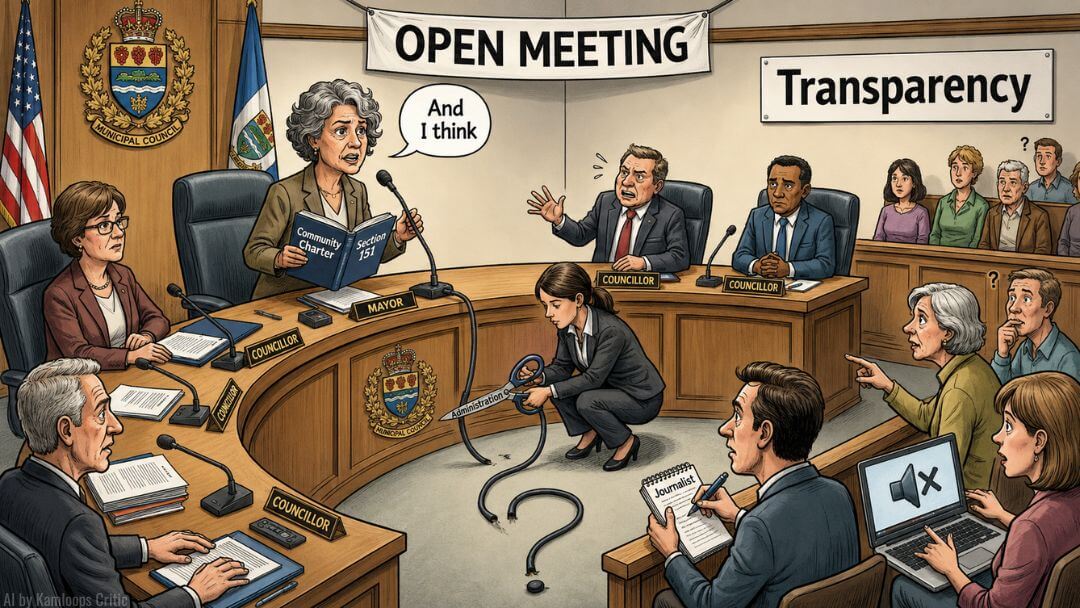
Corporate Officer Maria Mazzotta says she was authorized by administration to mute Mayor Reid Hamer-Jackson's microphone during Tuesday's council meeting. The incident raises broader questions about transparency, council procedure and the authority relied upon to mute an elected official's microphone during a public meeting.
"Please cut the Mayor's mic."
With those five words, Corporate Officer Maria Mazzotta changed the course of Tuesday's Kamloops Council meeting.
The Mayor raised concerns that administration had previously muted his microphone during public meetings. Within hours, much of the public discussion focused on allegations that the Mayor had threatened to suspend a municipal employee. Comparatively little attention was given to the sequence of events that led to that moment or to the authority administration relies upon when directing staff to mute the Mayor's microphone during an open meeting of council.
This article does not attempt to determine whether the Mayor's interpretation of the Community Charter is correct, nor whether his remarks ultimately constituted a threat. Instead, it reconstructs the chronology of the exchange, compares it with the City's own procedural rules and examines the authority City administration relies upon when directing staff to mute the Mayor's microphone.
The Mayor Raises a Concern
According to the Mayor, Tuesday's discussion did not arise spontaneously.
He says he had already determined that previous decisions to mute his microphone had originated with administration rather than council. The Mayor also says he is prohibited from communicating directly with the Corporate Officer outside council meetings. Instead, communications are to be relayed through the Deputy Mayor.
Hamer-Jackson told council that administration had been responsible for muting his microphone during previous meetings and asked that it not happen again.
"I just want to mention, I talked to the Deputy Mayor O'Reilly. There's been, my microphone has been getting cut off and I found out that it's not a councilor's resolution and it's administration so I'd like to make sure my microphone does not get cut off when I'm asking the council members a question. Corporate Officer Mazzotta, you were yelling at the IT department to shut my microphone off and that's an administrative decision from what I hear. I've been cut off at public engagements and I don't want it to happen anymore."
The Community Charter
The Mayor then began referring to Section 151(1) of the Community Charter, stating:
"I don't know if you know, but the mayor can suspend any municipal officer or employee. In accordance with section"
Before the Mayor could continue, Councillor Katie Neustaeter interrupted him.
Section 151(1) states:
"The mayor must suspend a municipal officer or employee if the mayor considers this necessary."
That provision also requires some legal context.
In 2024, Council adopted restrictions intended to remove the Mayor's authority to suspend certain senior municipal employees, including the Corporate Officer. Hamer-Jackson believes Council cannot override powers granted to the Mayor by provincial legislation and that Section 151 continues to provide him with that authority.
Whether council had authority to restrict the Mayor's powers under Section 151 is beyond the scope of this article. The issue examined here is what occurred during Tuesday's meeting and the authority relied upon to mute the Mayor's microphone.
The Discussion Changes Direction
Neustaeter's interruption immediately shifted the discussion away from the Community Charter and toward whether the Mayor's remarks constituted a threat.
The Council Procedure Bylaw establishes how debate is to be conducted during council meetings. Members wishing to speak are required to wait until they have been recognized by the Chair, and a member who is speaking may only be interrupted to raise a point of order. The meeting recording does not show Neustaeter first seeking recognition from the Chair, nor did she identify her interruption as a point of order.
The discussion never returned to the Community Charter.
Instead, the Mayor approached the matter from a different direction.
A Second Attempt
Rather than continuing his discussion of the legislation, the Mayor began explaining what he had intended to ask councillors during an earlier meeting when, according to him, his microphone had also been muted.
He stated:
"Well I'm telling you right now what I went to ask at the time that I got my mic cut off. I wanted to ask all of you to provide me with the dialogue, the statements that you gave to Peter Fassbender, Henry Braun, Terry Honcharuk and any other investigators. And I think"
Before he could finish the sentence, Mazzotta instructed staff:
"Please cut the Mayor's mic."
The exchange ended there.
The chronology is significant. The Mayor first raised concerns about previous decisions to mute his microphone. He then began referring to the Community Charter before being interrupted. Later, after the discussion had moved away from the legislation, he began explaining what he had intended to ask councillors during an earlier meeting before Mazzotta instructed staff to mute his microphone.
Those two events are distinct. The discussion of the Community Charter ended with Neustaeter's interruption. The later explanation concerning previous meetings ended when Mazzotta instructed staff to mute the Mayor's microphone.
Advertisement

Administration's Stated Authority
Following the meeting, Castanet reported that Corporate Officer Maria Mazzotta confirmed in an email that she had been:
"authorized by administration to ask for his microphone to be cut when he is speaking publicly about content that is deemed confidential under the Community Charter, protected under the Freedom of Information and Protection of Privacy Act, or subject to solicitor-client privilege."
That statement is significant because it identifies both the source of the authority—administration—and the circumstances under which Mazzotta says she has been instructed to exercise it.
Whether those circumstances existed on Tuesday is less clear.
Before his microphone was muted, the Mayor had stated that he wanted councillors to provide him with the statements they had given to Peter Fassbender, Henry Braun, Terry Honcharuk and other investigators. The investigations themselves have previously been acknowledged publicly, and the Mayor did not disclose the contents of any witness statements before his microphone was muted.
Mazzotta has not publicly identified which category of confidential information, FIPPA-protected information or solicitor-client privileged material she believed the Mayor was about to disclose before directing staff to mute his microphone.
The Context Behind the Headlines
By Wednesday morning, much of the public discussion had narrowed to a single question: did the Mayor threaten the Corporate Officer?
That was always likely to become the dominant narrative. A mayor publicly referring to the suspension of a municipal employee is inherently newsworthy. The difficulty is that focusing exclusively on that remark separates it from the sequence of events that immediately preceded it.
Before referring to the Community Charter, the Mayor had accused administration of muting his microphone during council meetings. He then began referring to the legislation before being interrupted. Later, after the discussion had moved away from the Community Charter, he began explaining what he had intended to ask councillors during an earlier meeting when, according to him, his microphone had also been muted. Before he completed that explanation, Mazzotta instructed staff to cut his microphone.
None of this establishes whether the Mayor's interpretation of the Community Charter is legally correct, nor whether his comments should ultimately be characterized as a threat. It does, however, provide chronology that is essential to understanding how the exchange unfolded.
The Mayor's Explanation
Following the meeting, Hamer-Jackson told Kamloops Critic that he had no intention of suspending Mazzotta, threatening her or even issuing her a written warning.
He said his reference to Section 151 was intended to highlight the legislation he believes governs the Mayor's authority, despite council's 2024 decision to restrict his ability to suspend certain senior municipal employees. He specifically pointed to the wording of Section 151(1), emphasizing that it states:
"The mayor must suspend a municipal officer or employee if the mayor considers this necessary."
The Mayor also reiterated that he is not permitted to communicate directly with the Corporate Officer outside council meetings except through the Deputy Mayor. He said that after Tuesday's meeting he received an email directly from Mazzotta and asked Deputy Mayor Dale Bass to have future communications routed through her instead. According to the Mayor, that request was declined.
Those statements do not resolve the issues raised by Tuesday's meeting, but they do provide context that was not available when the initial media reports were published.
Administration's Stated Reason
Mazzotta's email also provides the City's explanation for when the Mayor's microphone may be muted.
According to her statement, administration authorized the microphone to be cut when the Mayor is speaking publicly about information that is confidential under the Community Charter, protected by the Freedom of Information and Protection of Privacy Act (FIPPA), or subject to solicitor-client privilege.
Her statement naturally raises another question. Did the Mayor's remarks fall within one of those categories?
As discussed earlier, the Mayor had stated that he wanted councillors to provide him with the statements they had given to previous investigators. He did not disclose the contents of those statements before the microphone was cut, nor did he identify information that was obviously subject to solicitor-client privilege.
Likewise, the existence of investigations involving Peter Fassbender, Henry Braun and Terry Honcharuk has previously been acknowledged publicly. The fact that councillors provided statements during those investigations is not, in itself, a new revelation.
That does not necessarily mean administration acted improperly. It does, however, leave unanswered which category of confidential information, FIPPA-protected information or solicitor-client privileged material Mazzotta believed applied before she instructed staff to mute the Mayor's microphone.
If the Mayor was about to disclose protected information, the City should be able to identify what information it believed required immediate intervention. If a different concern prompted the decision, residents deserve to understand that as well.
Does Muting the Microphone Reduce Liability?
Following the meeting, CFJC Today reported that this month's Deputy Mayor Dale Bass defended the decision to mute the Mayor's microphone, stating that the action was intended to protect the City from potential liability.
"There is an obvious liability there because he is breaching privacy and breaching confidentiality – and that is not allowed."
If that is the City's position, residents deserve a fuller explanation.
Muting the Mayor's microphone does not prevent remarks from being made during a public council meeting, nor does it erase comments that have already been spoken. Depending on how the meeting audio is configured, muting the microphone may affect residents in council chambers, people watching remotely, journalists relying on the official recording and anyone reviewing the archived video afterward. The issue is not simply whether a meeting continues uninterrupted; it is whether administration can disable the official means by which an elected official communicates during a public meeting.
If the City believes that practice materially reduces its legal exposure, identifying the legal authority and reasoning supporting that conclusion would help residents understand why it has been adopted. Governments routinely make decisions based on legal advice and risk management. Public confidence is strengthened when those decisions are accompanied by a clear explanation of the authority being exercised.
What Authority Exists?
The Council Procedure Bylaw gives the Chair responsibility for preserving order during council meetings. It establishes procedures for points of order, rulings by the Chair and maintaining decorum throughout debate.
The bylaw does not obviously authorize administration to independently decide when an elected official's microphone should be muted during an open meeting.
Mazzotta's email confirms she acted under authority delegated by administration, but it does not identify the legislation, bylaw, council resolution or written administrative policy creating that authority.
If such authority exists, it should be straightforward for the City to identify.
Public meetings are governed by legislation, bylaws and formal procedures. Residents are entitled to know which of those authorities was relied upon when administration directed staff to mute the Mayor's microphone.
More Than One Council Term
It would be easy to dismiss Tuesday's events as simply another dispute involving Mayor Reid Hamer-Jackson.
That interpretation overlooks the broader governance issue.
Municipal elections determine who occupies elected office, but they do not automatically change the administrative practices that govern how council meetings are conducted. If administration has authority to mute an elected official's microphone under certain circumstances, residents are entitled to understand the scope of that authority before they elect the next mayor and council.
The questions raised by Tuesday's meeting therefore extend beyond one individual or one council term. They concern the relationship between elected officials and administration, the transparency of public meetings and the extent of administrative authority when disputes arise during council proceedings.
An Unusual Conclusion
The meeting itself also ended unusually.
After the Mayor's microphone was muted, councillors began leaving council chambers. The meeting does not appear to have been formally adjourned by the Chair before members departed.
The Council Procedure Bylaw contemplates adjournment by the Chair and further provides that if quorum is lost, the Chair is to adjourn the meeting. Whether those procedures were followed is another question arising from Tuesday's events.
Viewed on its own, that issue might appear procedural. Viewed alongside the interruption of the Mayor, the decision to mute his microphone and the unanswered questions surrounding administrative authority, it contributed to a meeting that left residents with considerably more questions than answers.
Who Decides What the Public Hears?
Whether readers ultimately agree with the Mayor's interpretation of Section 151 is a legal question that lies beyond the scope of this article.
The governance question raised by Tuesday's meeting is different.
Corporate Officer Maria Mazzotta has confirmed that she was authorized by administration to direct staff to mute the Mayor's microphone under certain circumstances. She has also identified the categories of information that, according to administration, justify taking that step.
The remaining questions are whether those circumstances existed on Tuesday and what authority administration ultimately relied upon.
The Mayor had not disclosed the contents of witness statements, confidential records or solicitor-client communications before his microphone was muted. Mazzotta has not publicly identified which category of confidential information, FIPPA-protected information or solicitor-client privileged material she believed the Mayor was about to disclose before directing staff to mute his microphone.
Equally important, the City has not publicly identified the legislation, bylaw, council resolution or written policy authorizing administration to mute the Mayor's microphone during a public council meeting.
Those questions matter regardless of who occupies the Mayor's chair after the October election. Administrative practices established today may become precedents for future councils. Before voters choose the next mayor and council, they are entitled to understand the extent of administration's authority to mute an elected official's microphone during a public meeting and the safeguards that exist to ensure that authority is exercised appropriately.
Until those questions are answered, Tuesday's meeting will remain about more than an allegation that the Mayor threatened a municipal employee.
It will also remain about transparency, accountability and who ultimately decides what the public hears.
Disclosure: This article is based on the council meeting recording, the Council Procedure Bylaw, the Community Charter and public statements made following the meeting. Should the City provide additional information regarding the authority relied upon to mute the Mayor's microphone, this article will be updated accordingly.

This is absolutely incredible. We elected our mayor, and we want to hear from him. Whoever asks to have the mayor’s mic cut off, should be required to leave the room. If it happens again, they should be fired. No ifs ands or buts. This is a breach of democracy! It is outrageous!
Administration and council are teaming up against our MAYOR. 4 years of this chaos. We need a shake up in city hall.
This is an example of poor voter turnout , they staked the deck..
There are a lot of good new faces willing to replace these councillors
Time to get out and vote.. this is our city. VOTE , VOTE
It’s the administration’s job to protect the city from liability. They mayor started talking about something that’s confidential. Cutting the microphone after the mayor violates the law is too late.
I would think the councilors got up and left the room so as not to give HJ an audience. Having an audience would have encouraged HJ to keep talking.
You raise valid points about where this goes under a different mayor, and the need to clarify the authority given to Corporate Officer Mazzotta. When it comes to council standing up and leaving, and whether it was procedurally correct, perhaps adjourning without making a motion to the chair can be explained by a lack of faith in the chair himself. He has in the past demonstrated an unwillingness to adhere to the rules as chair – for example, at one meeting where I was present and they were receiving public submissions regarding some development proposal or another, he would cut off speakers that said something that he interpreted as critical of himself, while letting supporters go overtime – especially if they were taking shots at the councillors. When councillors objected, or Mazzotta tried to get him to do his duties as chair, he would say they were out of order. There were plenty of examples of this. That is not to absolve council members of sniping at him largely out of earshot of the public and the microphones while he is trying to speak – but I’m just pointing out there is no trust in him as chair. I don’t think council, or Corporate Officer Mazzotta trust that if they make a motion to adjourn he’ll actually act on it without first airing as much of the material they believe he’s not supposed to talk about as he can. If they simply get up and leave, he no longer has a quorum and the adjournment is automatic. Anything he says after quorum breaks is then not reflected in the permanent record which in theory at least, reduces potential legal exposure.