
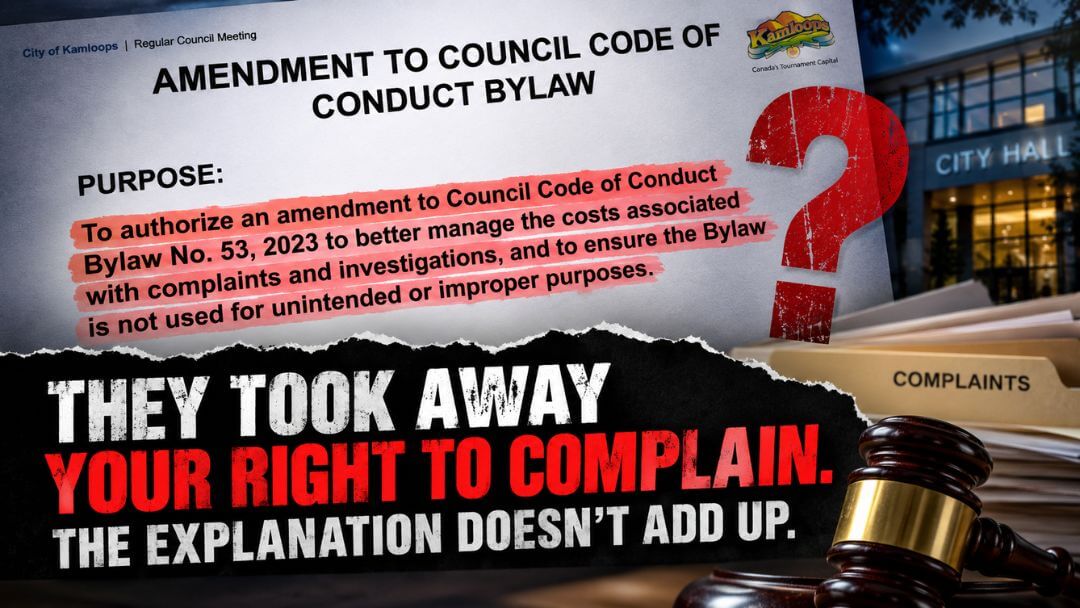
What did Council know when it took away the public's right to complain?
For the past couple of years, I've been writing about Kamloops City Council's decision to remove the public's ability to file Code of Conduct complaints.
Until now, one important piece of the story was missing.
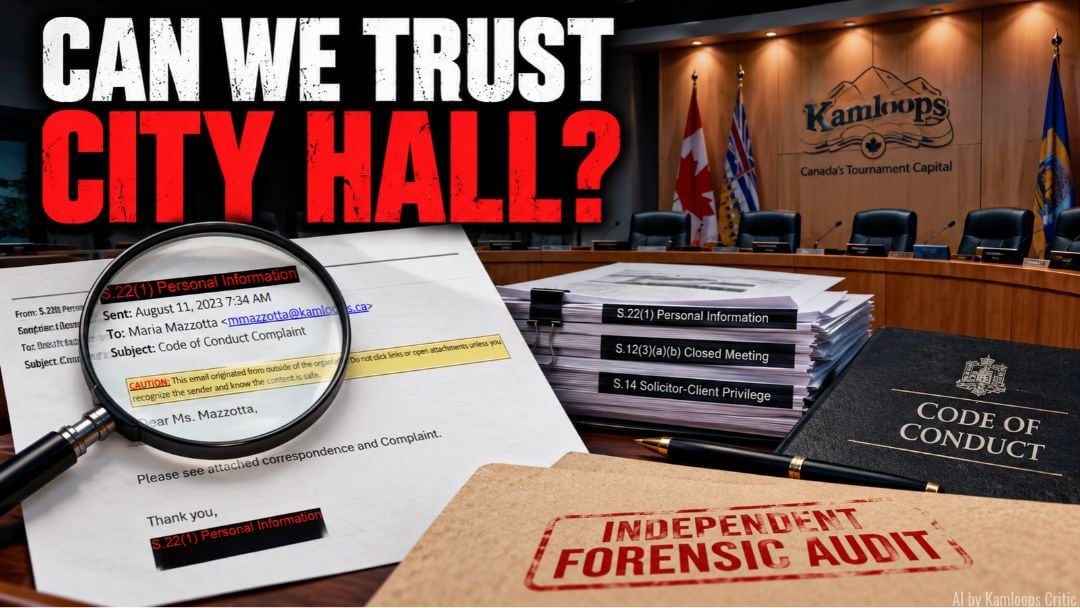
David McMillan, the lawyer who represented Mayor Reid Hamer-Jackson at the time, told me he submitted Code of Conduct complaint 2023-0007 to the City on August 11, 2023 — four days before Council voted to remove the public's right to file complaints.
That complaint named all eight councillors who voted for the amendment as respondents. Denis Walsh also had active complaints involving Councillors Stephen Karpuk, Katie Neustaeter and Bill Sarai.
So the question I started with has changed. What did the City and Council know when they voted to remove the public's ability to initiate Code of Conduct complaints, and was 2023-0007 connected in any way to that decision?
I don't know yet. I have found no evidence establishing that Council discussed 0007 or that 0007 caused the amendment. And the City publicly gave other reasons for making the change.
But if McMillan's account is correct and the City received a complaint naming every councillor who was about to vote on the amendment, residents should know whether that was considered before the vote. Instead, they were told the change was about cost, the number of complaints and concerns about misuse of the process.
After going back through the records, I think the bigger issue is whether residents were given enough information to understand why their ability to initiate a complaint was being taken away.
We now have enough information to ask whether the complaint was part of the discussion behind the change.
Complaint 2023-0007 is the piece I didn't have when I wrote my earlier articles. If McMillan's account is correct, the submission date puts the complaint just four days before the vote. I have McMillan's account of that date, not the original complaint itself, and I've asked the City for records that may help confirm it.
Having an active complaint against a councillor doesn't, by itself, establish that the councillor was prohibited from voting. The Code, however, does contain provisions dealing with conflict and bias.
Section 3.18 said:
“A Member shall rigorously avoid situations which may result in claims of Conflict of Interest, other pecuniary interest, or bias.”
Sections 3.19 and 3.20 dealt with disclosure and the duty of each member to assess whether they had a conflict in a matter before Council and seek independent legal advice if necessary.
So my question is straightforward: Did anyone consider the potential conflict or appearance of bias before eight respondents voted to change the rules governing future complaints?
Was 2023-0007 the reason for the amendment?
What I want to know is whether the complaint was discussed internally, whether anyone told the councillors about it and whether anyone sought legal advice about whether the respondents should participate.
The August 15 timeline raises a few more questions.
A closed Council meeting was scheduled for the morning of August 15. I don't know what was discussed at that meeting, and I'm not suggesting it was related to 0007.
There was also a history of agenda review meetings during former CAO David Trawin's tenure. From my understanding, those meetings were typically attended by Council. Again, I don't know whether 0007 was discussed at one of them.
Then there's the date on the Administrative Report to Council recommending the Code of Conduct amendment. The report attached to the August 15 agenda is dated August 15, 2023, the same day Council considered the amendment.
That doesn't establish when the report was actually prepared or circulated. But when a complaint was reportedly submitted four days earlier and all eight councillors named in it then voted on the amendment, I think the timeline deserves to be examined.
What did the Corporate Officer know?
McMillan told me the complaint was directed to the City's “Corporate Secretary,” as required by section 4.1 of the Code in effect at the time.
The bylaw actually identifies the Corporate Officer as the relevant official, so I am treating McMillan's reference to “Corporate Secretary” as referring to that position.
If McMillan submitted the complaint to the Corporate Officer on August 11, did anyone in Administration recognize that a complaint involving all eight councillors had been submitted while those same councillors were preparing to change the system?
The Mayor's response
On September 21, I asked Mayor Hamer-Jackson what he thought if McMillan's complaint had been received before the August 15 meeting. He said:
“I believe if all eight councillors had a code of conduct complaint against them, and they amended the bylaw to exclude the public from filing code of conduct complaints against council, then I believe they would be in a huge conflict of interest especially when councillor Karpuk signed the amended bylaw.”
I'm not relying on the Mayor's characterization of it as a “huge conflict of interest.” Whether a legal conflict existed would require a proper legal analysis.
The question is: Was the potential conflict or appearance of bias considered at all?
The August 15 explanation
On August 15, 2023, CAO David Trawin recommended amending the Code. The staff report said the purpose was to “better manage the costs associated with complaints and investigations” and ensure the bylaw wasn't being used for unintended or improper purposes.
During public inquiries, Denis Walsh asked how many complaints had been filed. Trawin initially tried to avoid answering because of privacy concerns, but after Mayor Hamer-Jackson pressed him, Trawin said:
"Right now. I believe we are going through six complaints, I believe."
Trawin said the complaints could all be valid or all be invalid at that stage. He also said investigators were professional lawyers and often cost more than $300 an hour.
Cost was one of the stated reasons for changing the system.
The lawyer question
Trawin also said:
“... the way the code of conduct is written that I have to get an independent person to investigate any complaint. And based upon that, that independent person has to be a lawyer ...”
But the Code doesn’t say an investigator has to be a lawyer.
That doesn't prove Trawin deliberately misstated the requirement. But if lawyer fees were a major reason for removing the public complaint process, the distinction matters.
Six complaints became eight
The City's Council Conduct and Investigation page lists complaints 2023-0001 through 2023-0008 from July and August 2023. That's eight complaints.
Trawin told Council they were “going through six.” Both the Mayor and I understood that to mean six complaints in total. Did Trawin really mean there were six public complaints?
At the time, we weren’t aware of complaint 2023-0007, or of 2023-0008, which was also submitted by members of the public. The City may have had a different way of counting or categorizing the complaints, but the public record doesn't explain the difference.
Complaint 2023-0008 adds another question
The City's records show no investigator, no investigation fee and no report. Yet the City lists the complaint as July 2023.
The amendment was adopted on August 29 and created a process under which the CAO or Corporate Officer could bring an apparently frivolous, vexatious, bad-faith or otherwise improper complaint before a closed Council meeting for summary dismissal.
The question is: When was 0008 actually dealt with, and under which version of the Code?
I don't have evidence that the complaint was deliberately held until after the amendment. But the timeline is unusual enough that the records should tell us when it was received, reviewed and dismissed.
The same records should also tell us how confidentiality was handled if the complaint was brought before Council.
What happened to the public's right to complain?
Bylaw 53-1 changed section 4.1. “Any person…” became “Any Member or Staff…” The public was removed from the list of people who could initiate a complaint.
The amendment also added section 4.2A, allowing the CAO or Corporate Officer to schedule a closed Council meeting when a complaint appeared on its face to be frivolous, vexatious, made in bad faith or unrelated to a Code breach. Council could then summarily reject the complaint or direct that it proceed.
So Council added another screening mechanism at the same time it removed the public's ability to initiate a complaint.
If screening was the problem, why not improve screening? If cost was the problem, why not change the investigation model? If particular complaints were causing problems, why remove the right from every resident?
The public was told something else
During the August 15 public inquiries, Walsh asked what recourse members of the public would have if they could no longer file a Code of Conduct complaint.
Trawin responded:
“Well, complaints can still be made, from what I understand, through a Council member, who can bring it forward on that or can be made through the Ombudsperson.”
Trawin's answer suggested that residents could still get a complaint before Council through a councillor, or take their concerns to the Ombudsperson. I wrote about that in Thou Shalt Not Complain.
Years later, the City said something very different
In January 2026, I attempted to submit a complaint of my own. I wrote about that experience in Kamloops Councillor Kelly Hall Faces Code of Conduct Complaint Over January 13 Council Meeting Conduct and later in Kamloops Citizens Shut Out of Council Accountability Process, City Confirms.
Although Trawin had indicated that a resident could bring a complaint to a councillor, I was met with firm resistance when I tried to do so. The City's position was that members of the public cannot submit complaints themselves, through staff or through a member of Council.
That conflicts with what residents were told in 2023. Trawin said complaints could still be made through a councillor, while the City later said they could not.
The 0007 report is still partly hidden
The 0007 investigation report doesn't identify the exact date the complaint was submitted. The reports for complaints 2023-0004 and 2023-0005, from the same investigator, do include the date the complainant filed the complaint with the City.
There is an email from IT near the end of the 0007 report under the heading “Attachment 5 - IT Staff Person Report (undated and redacted).” The sender's name and date are blacked out.
Other redactions in the report have a small explanation in red text indicating why the information was withheld.
I asked the City why the date was redacted and whether it could be disclosed. Privacy Officer Stephanie Nichols said the Code requires public investigation reports to comply with FIPPA and that the redactions protected witnesses' personal information.
I'm not sure how the date of an email is relevant to a witness's personal information, so I submitted an FOI request.
That request may tell us more about the timeline.
What about the Ombudsperson?
The Ombudsperson was one of the alternatives residents were told about in 2023, but it isn't a replacement for the City's Code of Conduct process.
In December 2025, I submitted a complaint to the Ombudsperson concerning Code of Conduct matters involving Councillors Sarai, Neustaeter and Karpuk. My complaint was accepted, but as of September 2026 it remains in the queue.
That doesn't mean the Ombudsperson has done anything wrong, but it does leave me questioning whether residents were given a realistic alternative when they were told they could take their concerns there.
If the City removed the formal complaint process while pointing residents toward another office, the question is whether that office could provide the kind of accountability residents were being told to expect.
Where does Mike O'Reilly fit?
When asked about Denis Walsh's active complaints against councillors who were voting on the amendment, Councillor Mike O'Reilly blamed Walsh for the change. I wrote about that in Mike O'Reilly Invites Questions. I Have a Few More.
The proposed provincial model is relevant here too. Bill 17 would establish a province-wide system in which members of the public could not initiate complaints, but screening and investigation would be handled through a separate process rather than giving the CAO and Council the same role in deciding whether a complaint should be dismissed.
That doesn't answer why Kamloops made its decision in 2023, but it shows there were other ways to address concerns about frivolous complaints, costs or misuse.
What about the cost?
A recurring argument on social media is that the Mayor is responsible for the legal costs associated with the Code complaints.
I've written separately about those costs in Weaponizing Accountability: How Kamloops' Code of Conduct Process Is Failing Taxpayers. That article looks more closely at where the investigation costs came from and who had control over the process.
Cost was one of the stated reasons for changing the system, but the existence of those costs doesn't by itself explain why the public had to lose its ability to initiate complaints.
What this changes
When I wrote about the 2023 amendment previously, I was asking whether Council's explanation made sense. Now I have a more specific question: What did Council know before it voted?
We have a complaint naming all eight councillors as respondents. We have McMillan's account that he submitted it four days before the vote. We have other active complaints involving Karpuk, Neustaeter and Sarai. And we have no public record I've found showing whether any of this was considered before Council changed the rules.
Maybe the councillors didn't know. Maybe legal advice confirmed they could vote. Maybe someone raised the issue and the answer is sitting in a record that hasn't been disclosed. What we need now is the evidence that tells us which one is true.
So were residents given the whole story?
I don't know yet.
But I think residents are entitled to ask for the records that would let them answer that question for themselves.
Who holds elected officials accountable when they change the rules for doing it?
Do you feel like a mushroom — kept in the dark and fed bullshit?
Municipal Election 2026
It's important that we ALL vote. Please vote only for candidates you truly believe deserve to be at the council table. If that's only one or two candidates, those are the only ones you should vote for.
Editorial disclosure: I have a personal connection to some of the events discussed in this article. I have submitted Freedom of Information requests to the City of Kamloops relating to Code of Conduct investigation records and have communicated with City officials about those records. I also submitted a complaint to the B.C. Ombudsperson concerning Code of Conduct matters discussed here.
I have spoken with Mayor Reid Hamer-Jackson for this story and have included his comments where relevant. I have communicated with David McMillan, whose account of submitting complaint 2023-0007 on August 11, 2023 is discussed in the article.
I also want to be transparent about something readers may consider relevant: I won't be voting for any of the eight councillors who voted for this amendment. I'm not suggesting that readers make the same choice. I'm telling you where I stand so you can judge the reporting with that information in mind.
The article distinguishes between documented facts, statements made by individuals, and questions arising from my review of the available records. Where I have not been able to independently verify a claim, I have identified it as such.

I do believe that this is definitely an issue that needs to be addressed to all those running in this election. Where do they stand on the issue in which residents cannot submit complaints regarding any members of city’s council. Are they willing to reverse this amendment thus allowing citizens the choice to complain or not?
It is my belief that this is the effort of council to reduce any accountability to our citizens.
Now I am concerned about my complaint that Stephanie responded to finding there indeed was a violation. Bass and Carmine Mazzotta were named in it and their names were left out of her letter regarding this finding.
It involved the sharing of my personal information and my account of others being mistreated at the hands of Ask Wellness. This was used by ask as evidence in an arbitration case involving my housing situation in an Ask facility .
Thanks for your work! Due to the contradictions built up by the seemingly unrelenting housing ponzi cult, i fear that voting at any level is basically pointless until we pass through the developing “storms” … (But, hey! Did you see the wonderful news that the big six banks are working on digital cash?! (Sarcasm over)
Kamloops Critic,
I see that you made it onto Levi Landry’s short list. Levi attempted to make an argument that you are telling people how to vote i.e. for which candidate(s).
Levi should be thankful that the Kamloops Critic does his homework and gives due diligence before sitting at the keyboard and posting it on line. Most of what Levi writes is shallow, has little meaning, is biased and often contains grammatical errors such as misplaced participles.
Thanks for your hard work, Kamloops Critic. The voters have much for which to be thankful. Levi has much to learn.