
What Did Kamloops Council Just Give Itself the Power to Do?
I wasn't surprised when I saw Kamloops City Council dealing with its own pay this week. After everything we've watched at City Hall this term, I'm now more of a "I wonder what they'll try next" person than an "I can't believe they did that" person.
When I started going through the report on Council Remuneration Bylaw No. 71, a few things stuck out. By the way, "remuneration" is just a fancy word used to describe what Council gets paid, including benefits. I'll just call it pay since that's easier for most of us to understand.
The first thing I noticed was that Council didn't create a new system of annual raises, as the existing policy already included that. They did, however, increase the annual expense allowance, from $5,000 to $8,000 for each Council member.
Then I got to what may be the most interesting part of the changes. The new bylaw gives Council a way to withhold money from a council member's pay if that person owes money to the City. And it specifically talks about recovering legal costs and expenses the City has paid on behalf of another council member.
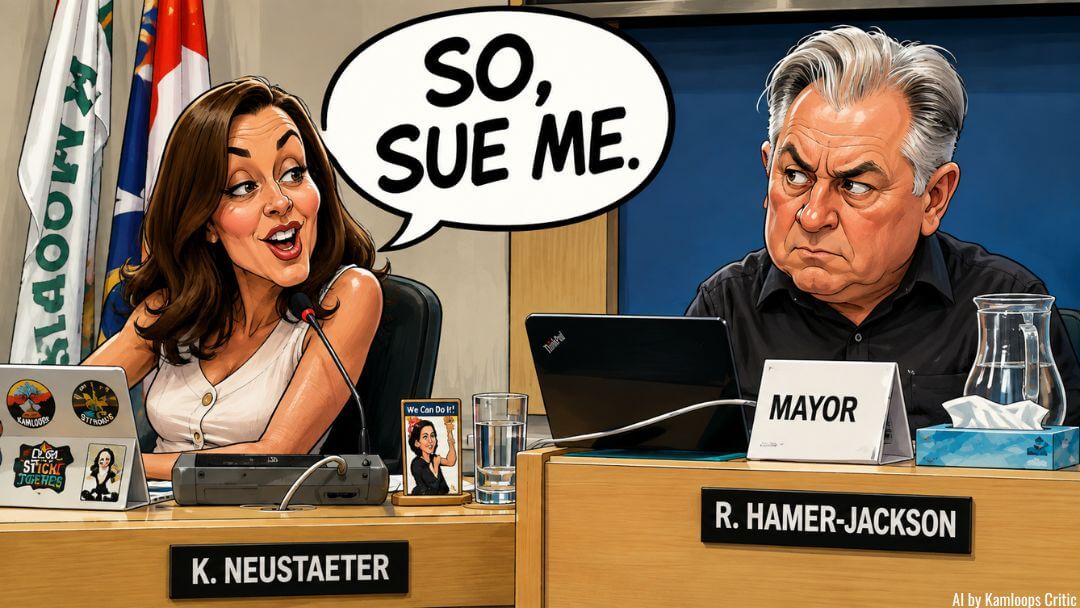
And the timing caught my attention. There is currently an unresolved legal-cost dispute between Mayor Reid Hamer-Jackson and Councillor Katie Neustaeter.
Since this subject didn't make it into the lengthy Council Highlights the City emailed to e-Newsletter subscribers for the August 11, 2026 regular council meeting, I'll give it some coverage here.
As a resident, I think we should understand exactly what Council just put into its new pay bylaw, especially with an election less than three months away.
The annual raises aren't new
I checked whether Council had actually created a new system of annual raises, and it hasn't.
The existing GGL-3 policy already calls for an annual calculation based on the pay received by mayors in 14 comparable BC communities. The highest and lowest amounts get removed, and an average is calculated from the remaining values. The Mayor's pay then gets adjusted according to how it compares with that calculated average.
If the Mayor's pay is below 90%, the increase is twice the applicable Consumer Price Index (CPI). If it's between 90 and 100%, the increase is whatever the CPI is. If it's already above the average, there is no increase. Councillors then get 40% of the Mayor's pay.
For example, given the initial Mayor's salary of $142,850.13, a 2% increase would add about $2,857 to the Mayor's annual pay and about $1,143 to each councillor's. A 3% increase would add roughly $4,286 to the Mayor and $1,714 to each councillor. That's probably easier to understand than simply saying "CPI."
What changes is that the system moves from a Council policy into a bylaw, with the new bylaw setting the Mayor's pay at 90% of the comparable average effective January 1, 2027.
Effective January 1, 2027, the Mayor's pay will be reviewed and adjusted each year using the calculated average and the B.C. Consumer Price Index (instead of the CPI for Vancouver).
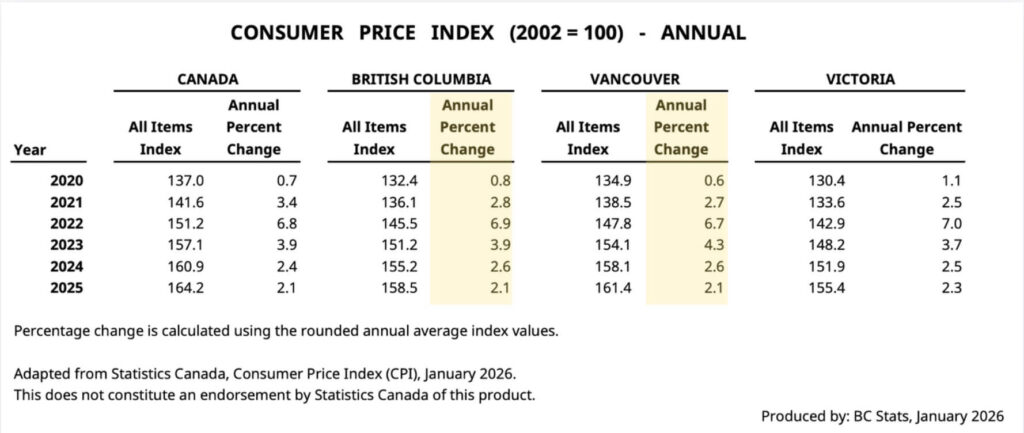
To me, that's a transparency issue, as I doubt the average resident knows how this formula works.
Most of us have heard of the Consumer Price Index, or CPI. We know it has something to do with the cost of living going up. But how many of us could explain what a one, two or three per cent CPI increase actually means in dollars for the Mayor and councillors?
Vancouver CPI becomes BC CPI
This change means the old policy used Statistics Canada's Consumer Price Index for Vancouver, and the new one uses the CPI for British Columbia. Looking at the chart, I can see those numbers vary, but I can't say whether one is better than the other.
The City's report says the purpose of turning the policy into a bylaw is to increase transparency, certainty and enforceability. If that's the goal, then explaining these kinds of changes in plain English would help.
Council gets a bigger expense allowance
The annual expense allowance is going from $5,000 to $8,000 for each Council member. The City says travel, accommodation, meals and conference registration costs have increased significantly since the $5,000 limit was established. That's a 60% increase.
I don't doubt that travel costs have gone up, and Council may have a reasonable case for increasing the allowance. But there's another question residents have been asking over the years. How many council members actually need to attend the same conference or event?
I wrote about this last year in Council Feeding At Public Trough after looking at Council's spending on conferences and other functions. UBCM and the Federation of Canadian Municipalities are obvious examples. Those aren't cheap trips once registration, airfare, hotels, meals and everything else are added together. And I'm not sure if the City has heard of Hotels.com or Trivago.
I don't dispute that conferences can be useful, but I question whether we need most of Council attending the same conference every year. When residents question this spending, we often hear that it is "in the budget." But being in the budget doesn't mean the money has to be spent.
A budget is a plan, not an instruction to spend every dollar that has been set aside. The new limit gives council members more room to attend conferences, meetings and training without going over their individual allowance. It doesn't tell us whether all those trips are good value.
There's another detail worth knowing. The $8,000 isn't an absolute ceiling on every travel expense. Section 6.7 says travel expenses incurred when a Council member represents the City on an external board, committee or organization aren't subject to that annual maximum.
This immediately reminds me that Councillors Bill Sarai and Stephen Karpuk sit on the Southern Interior Local Government Association (SILGA) board. From Code of Conduct Breach to SILGA President: Bill Sarai’s Uncontested Rise
If travel connected to an external board isn't subject to the $8,000 limit, then the actual amount a councillor can have the City spend on travel could be considerably higher than the headline number suggests.
The bylaw also allows Council to approve expenses above the $8,000 limit before they are incurred.
The new part
The old GGL-3 policy doesn't contain anything like the new debt-recovery provisions. The new bylaw does.
Section 10.1 says Council can, by resolution, withhold or reduce amounts payable to a council member when that member owes money to the City. Section 10.2 goes further. It includes debts such as taxes, fees and charges, court-ordered amounts and other amounts the City is legally entitled to recover.
Then it gets more interesting. Section 10.3 deals with a situation where the City has taken an assignment of an amount payable to or recoverable from a council member. It specifically refers to an assignment connected to the recovery of legal costs or indemnified expenses advanced by the City on behalf of another council member.
Section 10.4 then says Council can apply money withheld towards legal fees, costs, disbursements and indemnified expenses the City has advanced for another council member. Because of what's already happening between the Mayor and Neustaeter, I think it deserves a closer look.
There is already an unresolved dispute between two members of Council involving legal costs. The Mayor sued Neustaeter over statements she made in 2023. Justice Jacqueline Hughes dismissed the lawsuit in January 2026.
Neustaeter has sought legal costs plus $10,000 for damages from the Mayor. As far as I know, the judge has not yet ruled on that. The City has already indemnified Neustaeter in relation to the lawsuit, meaning the City has taken responsibility for her legal defence.
So when Council dealt with Bylaw 71 on August 11, there was no court-ordered costs debt against the Mayor. There was a claim for costs, but the judge had not yet ruled on that claim. And the Mayor has challenged the underlying decision.
It would be wrong to say Council has created a way to collect money the Mayor already owes Neustaeter, since he doesn't have a court-ordered costs debt at this point.
Could section 10.3 eventually apply?
The new bylaw appears to contemplate a situation where the City could take an assignment of an amount that is payable to or recoverable from a council member. If the assignment related to legal costs or indemnified expenses the City had advanced for another council member, Council could then potentially withhold money from the council member who owes the assigned amount.
I say potentially as I don't know whether that's what the City intends to do. I don't know whether a costs award in this particular situation could be assigned to the City. And I don't know whether anyone wrote this provision with the Hamer-Jackson-Neustaeter lawsuit in mind.
Maybe there is another situation the City is thinking about. The public report doesn't tell us, but the wording is there.
There is another question I haven't been able to answer. If the City eventually has a claim against a council member, does this bylaw allow the City to recover that money directly from the person's pay even when other creditors are also trying to collect from them? I don't know, and I haven't found anything in the report that answers it.
Where would the money go?
The bylaw doesn't say the City can simply take money from the Mayor and hand it to Neustaeter. Section 10.4 says Council can apply money withheld under section 10.3 toward legal fees, costs, disbursements and indemnified expenses advanced by the City to or on behalf of another council member.
So, as I read it, this is primarily a mechanism for the City to recover money it has already spent or is entitled to recover. Whether a future costs award in the Neustaeter case could actually be assigned to the City is one of the things I don't know.
There is a process before they can withhold the money
Section 10.5 indicates that Council can't simply decide one day to stop someone's pay. The bylaw sets out a process.
Before Council can withhold or reduce a council member's pay, the City has to give that person written notice explaining the amount allegedly owed, the legal basis for the debt and the proposed amount, method and timing of the withholding. The council member then gets an opportunity to make submissions to Council.
After Council makes its decision, the Employee Services Director implements it. The bylaw says Council's decision is final and binding, subject to whatever judicial review or statutory appeal rights may exist. It also goes out of its way to say the withholding is "administrative in nature" and is not a disciplinary sanction. The stated purpose is to secure repayment of money lawfully owed to the City.
So, the City isn't describing this as another punishment Council can impose on a councillor it doesn't like. It's describing it as a debt-collection tool. Whether the law actually allows the City to use that tool in every situation the bylaw contemplates is a different question.
The City's report points to the Community Charter as the authority for Council to establish its pay bylaw, but it doesn't point to a specific section of the Charter that spells out this particular withholding mechanism.
A Council Remuneration Select Committee — but who will be on it?
There's another interesting difference between the old policy and the new bylaw. The old GGL-3 policy already provided for a Council Remuneration Task Force to be struck when a full review of the policy was required. Interestingly, it doesn't say when that full review is required.
The new bylaw replaces that provision with a Council Remuneration Select Committee. The committee is supposed to conduct a comprehensive review of Council pay, benefits and expenses and make recommendations to Council.
But the bylaw doesn't say the committee has to include members of the public. It doesn't set out the membership at all. And there's some history here that most people who have followed Council this term will remember.
At the beginning of the term, Kamloops had standing committees. The Mayor determined their makeup and made changes to the committee assignments. The councillors weren't happy with those changes. Eventually, the standing committees disappeared and Council replaced them with select committees.
That changed something important. The makeup of the select committees is now determined by Council.
Councillor Kelly Hall has been presenting the recommendations for which councillors will sit on the various select committees during this term. So when I look at a new committee whose job is to review Council's own pay, I think the question of who gets appointed to it is worth asking.
What about members of the public?
The Mayor has repeatedly suggested that it could be useful to have members of the public involved in some committees. Council has taken a different position. The concerns raised have been about how the City could fairly choose which members of the public get appointed and about confidentiality if a committee needs to go into a closed meeting.
I get both concerns. If ten, twenty or fifty residents want one or two spots, someone has to decide who gets them. And if the committee receives confidential information, there have to be clear rules about what those residents can and can't disclose. But are those problems impossible to solve?
If confidentiality is the concern, couldn't a public member sign an oath or agreement requiring them to keep confidential information private? Maybe there's a good legal reason why that wouldn't be enough.
We know the City already uses members of the public on advisory and engagement groups. But those groups aren't the same thing as a select committee. An advisory group can make recommendations, but the select committee decides what ultimately goes forward to Council. A resident can provide input without actually having a seat at the table where the final recommendation is decided.
I'm not suggesting Council shouldn't have the final decision. I'm asking whether Council members should also control who gets to sit on the committee that reviews their own pay.
Given that Mayor-controlled standing committees have become Council-controlled select committees during this term, I think residents should pay attention to who gets appointed to this new committee.
The names at the bottom of the report
Another thing caught my eye in the report. Jennifer Howatt, the City's Employee Services Director, and Maria Mazzotta, the Corporate Officer, are listed as the authors. Dustin Rutsatz, the Planning and Procurement Manager, and Kristen Rodrigue, the recently promoted Communications and Strategic Partnerships Director, are listed under "Concurrence." CAO Byron McCorkell signed it as "Approved for Council."
I can't read anything specific into those titles, but it does raise some points of interest for me.
"Author," "Concurrence" and "Approved for Council" don't tell us who came up with section 10.3 or who first suggested that the City should have this power. Administration could have proposed it, or Council could have directed staff to develop it, or perhaps the City's legal counsel could have suggested it. It could also have been discussed in a closed meeting.
Mazzotta's name
Mazzotta's name caught my attention because I've recently written about her involvement in a dispute over what the public heard during a Council meeting. Who Decides What the Public Hears?
That doesn't mean there's anything improper about Mazzotta's role in the report. It identifies her as an author, and that may make perfect sense in her role as part of the legislative services department.
Kristen Rodrigue's name
Kristen Rodrigue's inclusion under "Concurrence" raises a different question. Her husband, Jovan Rodrigue, has publicly expressed strong views about the Mayor on Facebook.
In posts visible to the public, Jovan described the Mayor as a "child and bully," questioned whether he understands his job as councillor or mayor, criticized his conduct toward people who disagree with him and argued that the Mayor's supporters are simply louder than they are numerous.
Those are Jovan Rodrigue's comments. I have no evidence that Kristen Rodrigue shares her husband's views, and I can't assume that she does simply because they're married. But it is a matter of public record that a senior City employee listed as concurring with a report that deals with Council pay has an immediate family member who has publicly expressed strong opposition to the sitting Mayor.
That doesn't prove bias, or that Kristen Rodrigue had anything to do with creating the new debt-recovery provisions. But it does make me wonder what "Concurrence" actually means in this report.
What did Rodrigue review? What was she being asked to concur with? And what does the Communications and Strategic Partnerships Director have to do with a bylaw dealing with Council pay? The same can be asked about the Planning and Procurement Manager.
I don't think the Mayor was wrong to refuse to recuse himself
There will likely be more to hear on this one. When this matter came up at Tuesday's meeting, Neustaeter recused herself. Mazzotta then asked the Mayor whether he also wanted to recuse himself. He declined.
The Mayor's position was that he was suing Neustaeter, not the City. His refusal deserves a fair reading. Council wasn't deciding whether he owed Neustaeter money. And it wasn't deciding whether the Mayor should have money taken from his pay.
Council was considering a general pay bylaw that applies to every member of Council. At that point, there wasn't even a costs award. The judge had not yet ruled on costs, and the Mayor was challenging the underlying judgment.
The report says Council members are generally permitted to participate in decisions about their own remuneration because section 104 of the Community Charter excludes those matters from the normal statutory conflict-of-interest rules. It also says individual Council members still have to consider whether some other conflict exists in their particular circumstances.
That doesn't mean every future vote involving the Mayor's pay would automatically be free of a conflict. A future decision specifically directing the City to withhold a particular amount from him could be a very different question.
Taking that into consideration, I don't think it's fair to portray his refusal to recuse himself from Tuesday's general pay discussion as obviously improper.
Regardless, Mazzotta made a point of asking the Mayor on the record whether he was recusing himself. The Mayor had tried to cut her off when she tried to press the Mayor about his refusal to recuse. Councillor Hall quickly invited her to continue, though.
You're welcome to watch that section of the meeting, and decide what you think.
There's an election sitting in the middle of all of this
This is where the timing comes in. The municipal election is October 17, 2026.
There is a visible "No Incumbents" movement aimed primarily at the eight current councillors. Most are seeking another term, while Neustaeter has not publicly announced her intentions. Kamloops City Council: Should Voters Replace Every Incumbent in 2026?
The Mayor is in a different political position. He has significant public support, including on social media, and has said he intends to seek another term.
I don't think that political context proves anything about why Bylaw 71 was created. But it does affect the practical consequences of the new rules.
If the Mayor isn't re-elected, there won't be a future mayoral paycheque against which a new council could withhold money. If he is re-elected, there will be. And he already has pay reductions arising from Code of Conduct sanctions.
The new bylaw specifically says existing reductions imposed under the Code of Conduct continue unless Council changes or repeals them. So a re-elected Mayor could potentially start another term with existing reductions still affecting his pay while also being subject to the new debt-recovery provisions.
That doesn't prove anyone designed the bylaw to discourage the Mayor from running. But it does create a situation where the financial consequences of holding the office could look very different depending on the election result.
Could this discourage someone from running?
This question isn't limited to the Mayor. The new debt provision applies to any council member who owes money to the City.
Suppose a future candidate has significant unpaid property taxes. That person may not be prohibited from running for office simply because they owe money. If that person is elected, though, the new bylaw could potentially allow the City to recover that debt from their pay.
I could see that making someone think twice about running. So that's worth considering. Should someone who is otherwise eligible to run for office be concerned that a municipal debt could later be deducted directly from their council pay?
I don't have the answer to that, but I think voters should understand that this is now part of the rules. And it isn't only about property taxes. Section 10.3 specifically deals with assigned legal costs and indemnified expenses, so the new provision potentially reaches beyond the ordinary situation of someone simply falling behind on a City bill.
The Armchair Mayor noticed the timing too
I wasn't the only person who noticed Council was dealing with its own pay so close to an election.
In an August 8 editorial, Mel Rothenburger wrote about the awkward timing of bringing Council pay before the public with the civic election only a couple of months away. He also discussed the proposed councillor pay, the Mayor's pay, the increase in the expense allowance and the reductions currently affecting the Mayor's pay.
I agree with the basic observation about the timing. Where I think Bylaw 71 takes the issue further is that this isn't simply about how much Council members get paid. It's also about what can happen to that pay after the rules are in place.
So what actually changed?
After comparing the new bylaw to the old policy, I think there are four things residents should take away.
First, the annual pay adjustment isn't new. The old policy already provided for annual adjustments based on comparable mayoral pay and Vancouver CPI. The new bylaw formalizes that system, changes the CPI reference to BC CPI and puts the formula into a bylaw.
Second, the annual expense allowance is going from $5,000 to $8,000. That's a 60% increase and gives each council member another $3,000 of room for eligible expenses.
Third, the new bylaw creates a debt-recovery mechanism that wasn't in the old policy. Council can consider withholding pay when a council member owes money to the City, and section 10.3 specifically addresses legal costs and indemnified expenses advanced for another council member.
Fourth, the bylaw provides for a formal committee to review Council pay, but it doesn't require members of the public to sit on it. That means Council itself controls the membership of its select committees.
That last point is something worth watching. Council members are the people receiving the pay and they have the legal authority to set it. But a reasonable question is whether they should also control who gets to review whether the overall package remains appropriate.
What I don't know
There are still some gaps in the public record. I don't know who proposed section 10.3. And I don't know whether the provision was drafted because of the Hamer-Jackson-Neustaeter litigation. The report doesn't tell us what led up to this.
I also don't know whether the City has another situation in mind or whether this provision will ever apply to the Mayor.
What I do know is the old pay policy didn't contain this cost recovery method, and the new bylaw does. And the new provision specifically talks about recovering legal costs and indemnified expenses advanced for another council member.
At the same time, a costs decision involving two sitting members of Council remains outstanding, the Mayor has challenged the underlying judgment, and the Mayor is preparing to seek another term.

What did Council just give itself the power to do?
I can't say Council created Bylaw 71 to punish the Mayor, but I also can't say section 10.3 has nothing to do with the current litigation. The wording is specific enough that I think the possibility deserves to be considered.
What I can say is that Council has taken an existing pay system and turned it into a bylaw shortly before an election. It has increased the expense allowance by 60%, and it has put an existing annual pay adjustment system into a bylaw that many residents probably didn't realize was already there.
And it has added a new power to withhold an elected official's pay to recover money owed to the City, including a specific provision dealing with legal costs and expenses the City has advanced for another council member.
If the Mayor loses the election, this may have little practical effect on his future City pay. If he wins, the new provisions could become much more significant. Does that mean the bylaw was designed to discourage him from running? I don't know.
Does the evidence prove Council was trying to financially punish the Mayor? No.
But it does give Council a new way to recover money from an elected official's pay, and the timing means it's reasonable for residents to pay attention to how that power is used.
That's where I end up after going through the bylaw.
How much control should elected officials have over their own pay — and how much power should they have to take that pay away?
Disclosure: This article is based on publicly available City of Kamloops documents, the Council Remuneration Bylaw, Council meeting proceedings, court-related information and other publicly available sources. Where I discuss the possible application of the new debt-recovery provisions to the ongoing dispute between Mayor Reid Hamer-Jackson and Councillor Katie Neustaeter, I have clearly identified those points as questions or possibilities rather than established facts.
I do not know who proposed the new legal-cost provisions, whether they were drafted with the Hamer-Jackson–Neustaeter litigation in mind, or whether those provisions could ultimately be used in that particular case. No court-ordered costs debt against the Mayor existed when Council adopted the bylaw.
References to the actions or public statements of City employees and elected officials are included only where relevant to the issues examined in this article. Mentioning a person or raising a question about their role should not be taken as an allegation of wrongdoing, bias or improper conduct. Where information is uncertain or unavailable in the public record, I have said so.
This article is intended to examine the changes to Council's pay rules and their potential implications for public accountability and transparency. It is not intended to provide legal advice or to determine the legal validity of the bylaw.

Since city hall has released the particulars of the mayor’s back taxes, I’m hoping that the names of all people owing back taxes will be made public so we can shame them too. I’m kidding—I don’t think the city should be releasing any names associated with indebtedness to the city.
As for taxpayers covering Katie’s legal costs: The Local Government Act states that indemnity cannot be offered if the cause of action is libel or slander.
Coun. Neustaeter’s statements regarding alleged wrongdoing by the mayor also do not align with the Council Code of Conduct, which states that “(c) all communications by, and on behalf of a Member, including communications made via social media, are respectful and do not discriminate against, Bully and Harass, or defame any Member, Staff, or Volunteer.” Therefore, the councillors’ statement cannot be construed as “acting in a role as a councillor” since the statement she read out was in violation of the Code of Conduct.
On top of this, the city’s CAO stated at the April public council meeting that the March 17 statement event was not an official council event.
So how and why did the councillors decide to cover Katie’s legal costs?
Kamloops’ Indemnification bylaw states “The Corporate Officer shall make a determination as to whether the Municipal Official is entitled to indemnification pursuant to this by-law and shall report the entitlement or denial of indemnity to Council at a special Council meeting.”
Presumably, Corporate Officer Mazzotta informed the councillors that Katie was not entitled to indemnification. But even though they too were implicated in the proceedings, the councillors voted to pay her legal costs anyway, using the city’s contingency fund—likely the same one they’re now dipping into for the PAC overruns.
Imo, this is egregious use of taxpayer funds. How can it even be legal?
Thanks for this, Bronwen. You seem to know where to look for things and tie up the loose ends to make some logical points!
“It is no secret” is the title of one of my Mom’s favourite songs. Those four words could describe the way I feel about two young “journalists” whose individual fame is derived from local media outlets. Unlike in the old days, a person could go to the office of a local newspaper, for example, and buy space for an ad to sell something. Things have changed. A media outlet might have a small rented space for an office. The “journalist(s)” has/have a smart phone or a tablet or maybe a laptop. Through that conglomeration, a person can rip another person to shreds, publish stuff such as financial records and maybe even how many dollars in back taxes a particular person owes. On top of all of it, they seem to get away with it.
One might like to be able to publish the net worth of such journalists, their marital status, how much they owe on a mortgage (if they even have one) and how much they owe as far as overdue credit cards is concerned.
How easy would it be for a citizen to forward payment to a legal firm to pay for RHJ to sue such people for damages? I mean, some older people have socked away some money or maybe have a term deposit that is maturing and they wish to put an amount towards legal fees for another person. It might be wise for younger folks to realize that older folks think differently, develop loyalties to other people and aren’t afraid to use investments wisely.
Thanks again, Bronwen.