

On November 10, Kamloops City Council will consider its appointments to the Thompson-Nicola Regional District (TNRD) board. Among the recommendations, Mayor Mike O'Reilly wants to maintain 7 Kamloops directors, giving the City 31 weighted votes instead of 30.
The recommendation also names Councillor Kelly Hall as the sole alternate director.
The additional director carries a four-year baseline cost of $72,560. The proposed alternate arrangement also appears to depart from an existing Council resolution. The agenda offers little explanation for either proposal.
I went back through the original Council resolutions, the November 15, 2022 meeting transcript and the administrative report that supported the original decision. I also revisited my October 2025 investigation into the additional TNRD position.
How Kamloops ended up with 7 directors
The history goes back to October 24, 2017.
At that meeting, Council passed a resolution establishing an alphabetical rotation for the remaining councillors to serve as alternate TNRD directors.
The decision to add a 7th director
The next significant change came in 2022, following the 2021 Census and changes to Kamloops' population-based representation.
Council had to decide whether to appoint 7 directors instead of 6. The additional position would allow the City to retain 31 weighted votes rather than 30.
The issue concerned the TNRD's Letters Patent, which limited individual directors to 5 votes. 6 Kamloops directors could therefore exercise 30 votes. The existing arrangements required another director to distribute all 31 votes.
In 2022, there was an administrative report. What happened this time?
When Council considered adding the 7th TNRD director on November 15, 2022, the matter appeared under Administrative Reports.
Then-CAO David Trawin prepared a supporting report explaining the population changes, the increase in weighted voting strength and the five-vote limit in the TNRD Letters Patent. It also presented alternative ways to distribute the 31 votes among 7 directors.
Both proposed allocations retained 7 directors, but Council at least received supporting information explaining the recommendation.
A very different approach in 2026
The November 10, 2026 recommendation takes a different approach.
It appears under the Mayor's Report, without an accompanying administrative report or an explanation of why Council should continue with 7 directors.
O'Reilly played a direct role in the original decision.
On November 15, 2022, O'Reilly moved the motion to approve the 7 appointments. Bill Sarai seconded it. Dale Bass received the 7th appointment but recused from the vote. O'Reilly, Sarai and Bass had all been re-elected for the 2022–2026 term.
I'm not suggesting that anyone passed the motion specifically to benefit Bass. But the circumstances deserve attention when we examine who supported the additional position and who received the resulting appointment.
The extra vote was rarely needed
During the November 15, 2022 discussion, CAO David Trawin explained the problem with the TNRD's Letters Patent.
He said that if Council appointed only 6 directors, Kamloops would have 30 votes until the TNRD amended its Letters Patent to allow one director to carry 6 votes.
Councillor Katie Neustaeter then asked how long such an amendment might take.
Trawin said the estimate he had heard was 7 to 8 months.
What Council already knew
Neustaeter followed up with a particularly relevant observation:
"My understanding is that this Council, the Kamloops City Council has never had to exercise that authority, has never actually needed that number of votes. So the likelihood that there'd be significant implications are fairly low, right, in the 6 to 8 months bracket?"
Trawin responded:
"I would say based upon past things, based upon the past, yes. I can't speculate kind of what's moving forward, though."
Council knew that the City had not historically needed its full weighted-voting allocation. The additional director therefore served, at least partly, as insurance against temporarily losing one vote while the TNRD considered an amendment.
Has anyone established whether the 31st vote has ever changed the outcome of a TNRD decision? Did anyone pursue the proposed amendment to the Letters Patent? If so, what happened?
I haven't examined the complete voting history, so I won't claim that the additional vote has never made a difference. But Council should have that information before approving another four years of appointments.
This isn't the first time these questions have been raised
I wrote about this issue on October 5, 2025, in an article titled Council Bloats TNRD Board.
I questioned the need for another director, the lack of financial analysis and whether O'Reilly had followed through on his stated intention to examine the TNRD's Letters Patent.
The November 10 recommendation doesn't answer those questions.
What O'Reilly said in 2022
During the November 15, 2022 meeting, O'Reilly offered a fairly straightforward justification for supporting the 7th director. He argued that the population calculation produced a particular number and questioned where Council should draw the line if it chose to disregard that number.
O'Reilly said he believed the TNRD Letters Patent deserved examination to keep the regional district board manageable. He indicated that they should bring the issue forward to the TNRD.
The City still proposes 7 directors. Has O'Reilly brought the Letters Patent issue to the TNRD? Has the board considered changing the five-vote limit? Did anyone request or discuss an amendment?
What does the extra director cost?
My previous article also pointed out that neither CAO Trawin nor anyone else discussed the financial implications of adding another director.
The TNRD remuneration bylaw provides an annual remuneration of $18,140 for a municipal director, using the 2025 rate.
The additional director therefore represents:
- Annual remuneration: $18,140
- Four-year remuneration: $72,560
The four-year figure is a baseline using the 2025 annual rate. Annual CPI adjustments could increase the actual cost.
I'm not suggesting that $72,560 would break the TNRD's budget. The question is why taxpayers should continue paying for an additional director when Council has not established that the 31st vote provides a meaningful benefit.
The November 10 recommendation contains no financial analysis to support continuing the arrangement.
What happened to the alphabetical rotation?
The proposed appointment of Hall as the sole alternate appears to depart from the October 24, 2017 Council resolution, which established an alphabetical rotation for the remaining councillors.
When Council considered the additional director position on November 15, 2022, Corporate Officer Maria Mazzotta specifically addressed that existing arrangement.
She explained:
"...we do have a 2017 Council resolution in place that's outlined in the report regarding the rotation of alternates on an alphabetical basis. If Council wishes to reinforce that for the purposes of this new structure, then absolutely a motion could be passed today. If it isn't, then we would be going on that 2017 Council direction regarding an alphabetical rotation of alternates."
Mazzotta confirmed that the 2017 resolution remained in effect unless Council passed another motion to change it.
Yet the November 10, 2026 recommendation identifies Hall as the alternate director without explaining why the City should replace the existing arrangement.
Has Council passed another resolution rescinding or changing the 2017 direction? If so, when?
Who gets to serve as alternate?
The proposed change would concentrate the opportunity to serve as an alternate in one councillor rather than distribute it among the remaining councillors.
There is also a practical concern. Kamloops has experienced occasions when multiple TNRD directors were absent from the same meeting. What happens when that occurs under the proposed arrangement?
The recommendation names only Hall. It doesn't explain how Council would handle two or more simultaneous absences or whether another councillor could step in.
The legislation allows multiple alternates
Section 200 (3) of the B.C. Local Government Act provides two options when a municipality has multiple regional district directors.
Council can appoint an alternate for each director. Alternatively, it can appoint several alternate directors and establish a system to determine which alternate acts when a director cannot attend.
The legislation doesn't require Kamloops to appoint only one alternate. Council can establish a system involving several councillors, yet the recommendation doesn't explain why it names only one.
The alternate's remuneration
One financial detail needs clarification.
An alternate receives remuneration for qualifying meetings, but the TNRD deducts that payment from the remuneration of the director who missed the meeting. The alternate's payment therefore doesn't simply add another meeting payment to the absent director's compensation.
The issue isn't that the alternate arrangement necessarily creates another expense for taxpayers. It's why the City is concentrating the opportunity to serve as an alternate in one councillor when an established shared system already existed.
Why is this recommendation buried in the Mayor's Report?
Perhaps the most troubling aspect of the November 10 agenda is where the recommendation appears.
The TNRD appointments appear under item 14.1, within the Mayor's Report.
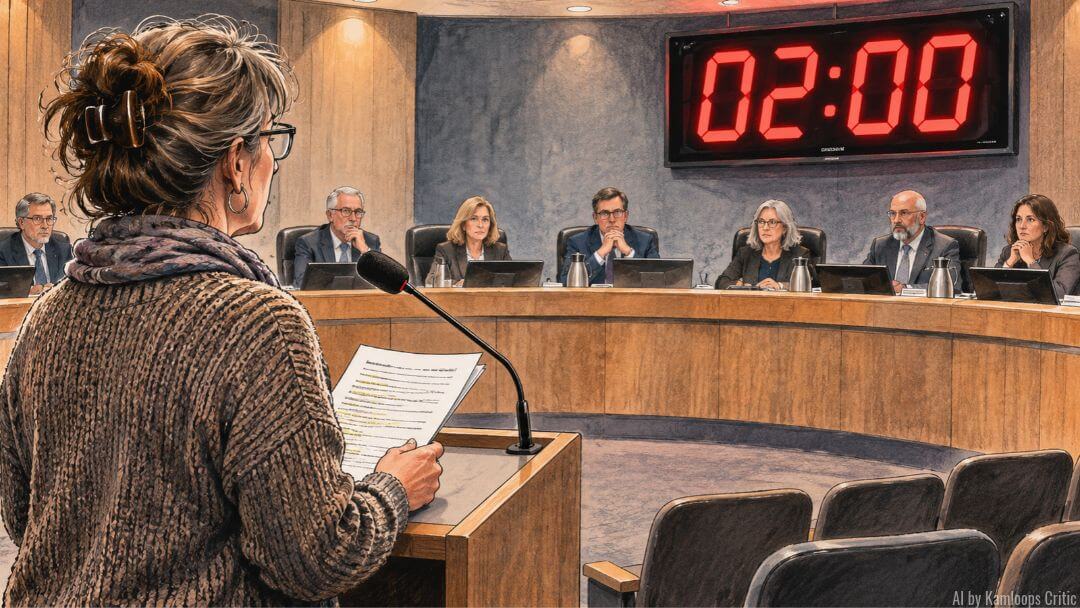
Council Policy GGL-32 excludes the Mayor's Report from public input. As a result, residents cannot register to speak about this recommendation during the public-input portion of the meeting.
Public input, with limitations
This is particularly difficult to reconcile with the City's renewed public-input process.
Public input is supposedly back, but its usefulness depends on where an item appears on the agenda. This recommendation involves regional representation, recurring public expenditure and a change to an existing Council resolution. Yet it appears in a section excluded from public input.
I don't know why the recommendation appears there, but the practical effect is clear.
If the City wants residents to believe that it has genuinely restored public participation, the placement of this item deserves an explanation.
Who prepared the recommendation, and what alternatives did they consider?
Who actually prepared this recommendation? Did O'Reilly initiate it? Did administration prepare it? Or did the new Council develop the proposal through discussions?
The recommendation concerns public appointments and recurring compensation. Residents should be able to see who proposes the arrangement and why.
The appointment decisions deserve scrutiny
Margot Middleton appears as the additional director in the recommendation. I have previously observed her campaigning alongside O'Reilly at events.

That observation doesn't establish that her appointment represents a political reward, and I won't claim that it does.
These appointments affect who represents Kamloops and who gets the opportunity to serve as an alternate. The selection process should be transparent.
The public shouldn't have to guess why certain councillors receive appointments while others lose an opportunity that a previous Council resolution extended to them.
O'Reilly said we should question established practices
At his November 2 inaugural address, O'Reilly spoke about the importance of questioning established practices.
He described visiting a director's office and seeing a sign on the wall. He quoted it:
"The most dangerous phrase in the language is, we've always done it this way."
He continued:
"And that is exactly what we should be asking ourselves in every aspect of the government that we have."
I agree that it's a reasonable principle. The November 10 recommendation provides an immediate opportunity to apply it.
Two decisions, two different standards
Council added the 7th director in 2022 to preserve the 31st weighted vote, even though the discussion acknowledged that Kamloops had not historically needed its full allocation. Four years later, the recommendation continues the arrangement without showing whether that additional vote has made a difference.
Meanwhile, the 2017 alphabetical rotation of alternate directors remained in effect when the Corporate Officer addressed it in November 2022. Yet the new recommendation appears to replace that arrangement with a single named alternate, without explaining why.
Why continue an additional director position without demonstrating its value, while apparently abandoning an existing rotation arrangement without explaining the change?
The new Council should examine the voting history, establish whether anyone pursued the Letters Patent amendment, clarify the status of the 2017 resolution and explain why it wants only one alternate.
The bottom line
The November 10 recommendation asks Kamloops Council to continue an arrangement that has not been adequately explained.
Here's what the historical record tells us:
- 7 directors instead of 6: The additional position came in 2022 to preserve 31 weighted votes rather than 30. During the discussion, CAO David Trawin acknowledged that Kamloops had not historically needed its full voting allocation.
- The alternative: Trawin estimated that changing the TNRD Letters Patent could take 7 to 8 months. The City should explain whether anyone pursued that alternative.
- The cost: One additional director represents $72,560 in baseline remuneration over four years, using the 2025 annual rate and excluding annual increases.
- The missing report: In 2022, CAO David Trawin presented a supporting administrative report containing the rationale and alternative vote allocations. The 2026 recommendation appears under the Mayor's Report without a comparable supporting report.
- The alternate arrangement: A Council resolution passed October 24, 2017, established alphabetical rotation among the remaining councillors. The Corporate Officer confirmed in November 2022 that it remained in effect unless Council passed another motion.
- The proposed change: The November 10 recommendation names Kelly Hall as the sole alternate without explaining why the City should replace the existing rotation or how it would handle multiple simultaneous absences.
- Public accountability: The recommendation appears under the Mayor's Report, a section excluded from public input under Council Policy GGL-32.
I raised these concerns publicly in October 2025. The November 10 recommendation still doesn't provide the missing analysis or explain why the existing alternate rotation should be replaced.
O'Reilly moved the original motion in 2022 and indicated he intended to examine the TNRD Letters Patent. He now has an opportunity to apply the principle he described in his inaugural address: question established practices rather than simply continue them.
The question is whether the new Council will examine the evidence and alternatives, or approve the arrangement simply because that's how it has been done before.
Editorial Disclosure: This article is an independent editorial investigation by Kamloops Critic. I previously questioned the decision to expand Kamloops' representation on the TNRD board and the associated expense in my October 5, 2025 article, "Council Bloats TNRD Board."
My assessment is that the additional director position has not been adequately justified and that the proposed appointment of a single alternate raises questions about transparency, consistency and the treatment of previous Council resolutions.
This investigation draws on City of Kamloops Council agendas, the October 24, 2017 Council resolution, the November 15, 2022 administrative report and meeting transcript, the B.C. Local Government Act, Council policies and TNRD remuneration documents.
The observations and conclusions are my own. Where I express an opinion, I distinguish it from documented facts. The article does not allege improper conduct by any individual. Its criticism concerns the decisions, supporting information, appointment process and opportunities for public participation.


Prior to the 2022 election the TNRD has no written record nor memory of ever conducting a weighted vote in its history (1967). I inquired about weighted votes 4 yrs ago and got this confirmed in writing by the TNRD. I also got into a discussion on FB with Barbara Roden about this after she stated that the weighted system gave Kamloops reps 1 extra vote each (12 of 32 as opposed to 6 of 26 on a regular vote which was incorrect as it gave Kamloops 22 extra votes or 28 of 52 total votes which is 53.8%). She stated that Kamloops doesn’t have the majority of votes in a weighted system, I was a little aggressive in my response stating words to the effect that she was incompetent for not knowing the rules whilst providing a copy of the weighted system from the TNRD’s own website. The next day she erased the entire discussion and since that time the TNRD has regularly used weighted votes for financial decisions.
November 1/22 the number of weighted votes changed to 31 which is 3 extra votes from the previous 28 (we now have 31 of 56 (55.5% whilst having slightly over 70% of the population) and Grasslands got an extra vote making 56 total from the previous 52. It was at this time that an additional director was added from Kamloops as the rules state that each director is limited to 5 votes maximum.
(https://www2.gov.bc.ca/assets/gov/british-columbians-our-governments/local-governments/governance-powers/voting_strength22_tnrd.pdf)
As a friendly critique, your blog posts/articles/editorials are far too long for today’s reader. I think your readership would increase if you kept things well under 1,500 words.
I want to thank you both Kamloops Critic and Mac Gordon for keeping on top of what is happening at City Hall. I’m expecting there to be a lot of unanswered questions to come. I truly hope I’m wrong but we’ll see.