
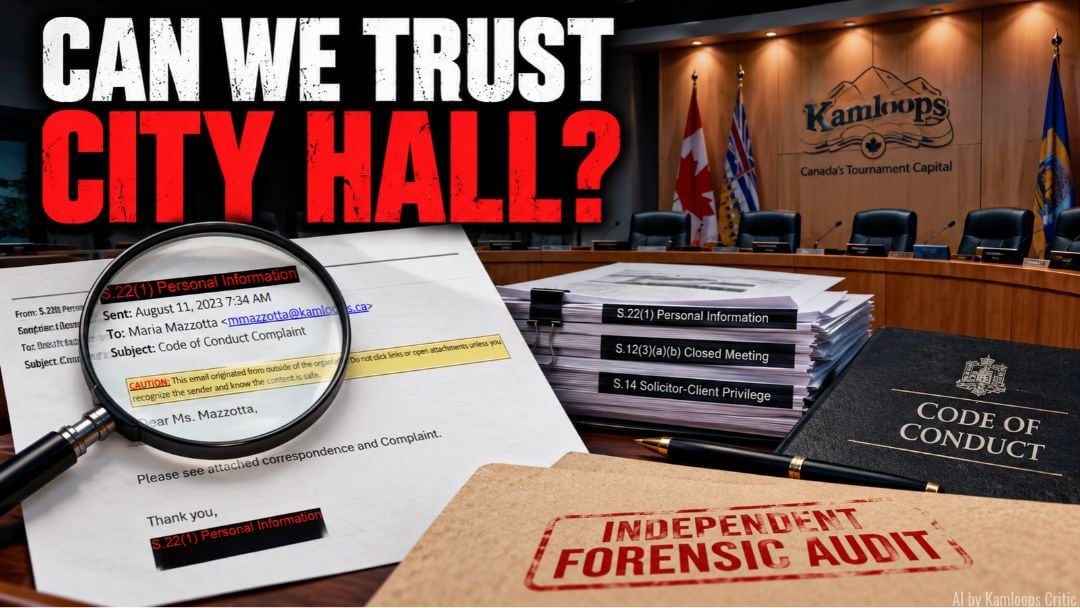
An FOI disclosure supports the timeline of a Code of Conduct complaint received four days before Council voted to restrict public complaints. I think it’s time for an independent forensic audit of the entire process.
I've been investigating something for over a year: Why did Council remove the public's ability to submit Code of Conduct complaints, and what did councillors know when they made that decision?
On October 15, I received a Freedom of Information response from the City of Kamloops. It contained an email dated August 11, 2023, addressed to Corporate Officer Maria Mazzotta. Its subject line reads “Code of Conduct Complaint,” and the message says, “Please see attached correspondence and Complaint.”
The sender's identity is redacted, however, the email supports David McMillan's account that he submitted complaint 2023-0007 on August 11, four days before Council considered the amendment. McMillan represented Mayor Reid Hamer-Jackson at the time, and the complaint he initially submitted named all eight councillors who then voted in favour of the change.
The City also provided four fully redacted pages, citing provisions of the Freedom of Information and Protection of Privacy Act concerning personal information, closed-meeting material and solicitor-client privilege.
A question remains unanswered: What happened after the complaint was received?
I can’t establish that the complaint caused the amendment, that councillors knew about it before the vote, or that the redacted pages contain evidence of wrongdoing. But the email does support the submission timeline, and I believe residents deserve to know whether the complaint was considered before Council changed the rules governing complaints.
Four days before Council changed the rules
On August 15, 2023, former CAO David Trawin recommended changing the City's Code of Conduct bylaw. The discussion focused on the cost of investigations and concerns about frivolous or improper complaints.
The public lost the ability to initiate complaints directly. Residents were told that alternative routes would remain available. Trawin said complaints could still be raised through a councillor or the Ombudsperson.
In my earlier article, They Took Away Your Right to Complain. The Explanation Doesn't Add Up, I looked at the timeline and asked what Council knew before the vote. At that point, I had McMillan's account of the complaint submission date, but not the email now disclosed by the City.
In an even earlier article, Thou Shalt Not Complain, I examined the meeting itself, and the reasons given for the change.
An active complaint against a councillor does not automatically establish that the councillor was prohibited from voting on a bylaw amendment. But it is reasonable to ask whether anyone considered the issue, particularly when the decision would change the rules governing future complaints.
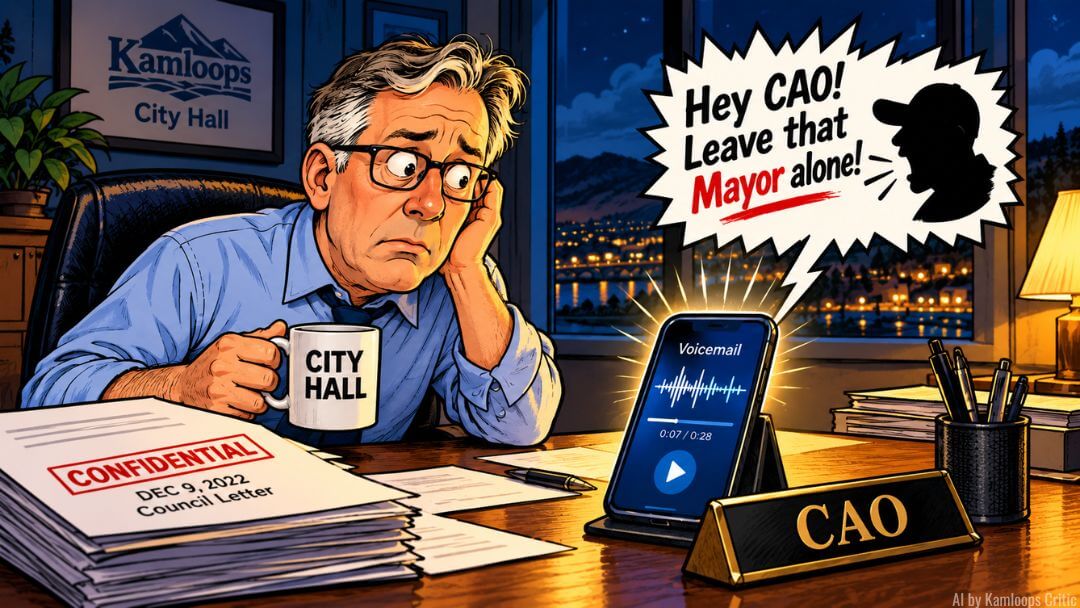
I don't know whether the complaint was discussed internally, whether councillors were informed, or whether the legal advice later mentioned to me by Councillor Stephen Karpuk addressed this specific issue. I also don’t know whether the complaint was considered in any meeting before the vote.
Councillors received legal advice. What did it address?
After the Farmers' Market candidate forum, I asked Karpuk why he voted in favour of the amendment despite the complaint naming him and the other councillors who supported it. He told me councillors had received legal advice.
I haven’t seen the advice and can’t say whether it addressed complaint 2023-0007, councillors' participation in the vote, or the appearance of a conflict. But there is also a question about what the public was told.
During the August 15 meeting, Trawin said residents could still bring complaints forward through a councillor. In January 2026, I tried to use that route by asking Mazzotta to submit a complaint, which I described in Kamloops Councillor Kelly Hall Faces Code of Conduct Complaint Over January 13 Council Meeting Conduct.
Mazzotta subsequently advised that residents can’t submit complaints directly, through staff, or through a member of Council. I reported this in Kamloops Citizens Shut Out of Council Accountability Process, City Confirms. The City's current position is difficult to reconcile with the assurances residents received in 2023.
I don't know how that position was determined, but the City should be able to explain the discrepancy. If residents were told they could bring complaints through a councillor, why does the City now say they can’t? If the route was never available, why was it presented as an option?
The Kelly Hall example shows why this matters. Whether Hall's conduct breached the Code is a separate question that would require a fair assessment of the evidence. The immediate obstacle was that I couldn’t get my concerns into the formal process at all.
A fair system needs safeguards against frivolous or politically motivated complaints. It also needs a meaningful way for residents to bring documented concerns forward. The next council should reconsider whether the current rules strike the right balance.
If the public can weaponize complaints, what about the system itself?
Council's concerns about weaponization deserve consideration. Investigations can be expensive, and complaints can impose substantial costs even when they do not result in findings of misconduct.
Councillor Mike O'Reilly claimed the amendment was prompted by former councillor Denis Walsh's use of the process. In Mike O'Reilly Invites Questions. I Have a Few More, I found that his claim didn’t make sense to me. On the other hand, if Walsh’s complaints were a significant concern, the same scrutiny should apply to complaints initiated by councillors and staff.
In Weaponizing Accountability: How Kamloops' Code of Conduct Process Is Failing Taxpayers, I examined investigator selection, costs and the repeated use of Reece Harding. I also questioned how challenges to investigator impartiality are handled.
The City describes investigator selection in one manner, while CAO Byron McCorkell described it differently. That process should be transparent enough for residents to understand how it works.
The questions include:
- How are qualified investigators identified and selected?
- What role do costs play in the selection?
- How are challenges to impartiality assessed independently?
- What safeguards ensure that complaints initiated by insiders receive the same scrutiny as complaints initiated by members of the public?
My reporting raised questions about the way a challenge to Harding's impartiality was handled. It raises the question whether an independent review would inspire greater confidence than having an investigator assess a challenge concerning himself.
If Council was concerned about the public weaponizing complaints, it should also be willing to examine whether the process itself has adequate safeguards against misuse, inconsistent treatment or unnecessary expense.
Why an independent forensic audit is necessary
I no longer believe that another routine review conducted within the existing system would be enough to answer the questions raised by these records. I believe the next council should commission a fully independent forensic audit of the City's Code of Conduct system and the decisions surrounding the August 2023 amendment.
By forensic audit, I mean a structured examination of the records, timelines, communications, decisions and administrative procedures. The purpose would be to establish what happened, not to begin with an assumption of misconduct.
The audit should examine:
- Complaint 2023-0007: When it was received, how it was recorded and processed, who was informed, and what records exist of decisions made about it.
- The August 2023 amendment: What information was available to Council, whether the complaint was considered, and what advice or procedural safeguards were sought before councillors voted.
- The public record: What residents were told about alternative complaint routes, how those assurances compare with the City's later interpretation, and whether the public was given an accurate explanation.
- Investigator selection and costs: How investigators are chosen, how impartiality is assessed, what the investigations cost, and whether the selection process offers adequate independence and value for taxpayers.
- The use of the process: Whether complaints initiated by councillors and staff have been handled consistently, with safeguards against improper use and appropriate opportunities to challenge decisions.
- Administrative responsibility: The respective roles of the CAO, Corporate Officer, Council and legal advisers in administering the system and communicating decisions to the public.
The review should be led by a reviewer independent of the City, Council, the investigators involved and the decisions being examined. Given my concerns about previous investigations, I would not consider Reece Harding an appropriate choice.
The terms of reference should be public, and the reviewer should publish findings and recommendations wherever the law permits. If some information must remain confidential, the public should still receive a clear explanation of the process, the conclusions that can be disclosed and any recommended changes.
This is not a demand that the audit find wrongdoing. It is a demand that the questions be answered by someone whose independence can withstand scrutiny.
The question of legal representation
The audit also needs independent legal oversight. That brings me to Denise McCabe, who represents the City of Kamloops and the Thompson-Nicola Regional District.
On October 15, CFJC Today and Castanet reported on TNRD Chief Financial Officer Carla Fox's court petition seeking reinstatement. Fox alleges that she faced obstruction and intimidation after raising concerns about financial management and attempting to enforce financial controls. These allegations have not been proven in court, and the TNRD has said it would respond through the legal process.
The allegations do not establish that McCabe acted improperly, nor does representing two public bodies automatically create a conflict of interest. But where allegations involving one client could raise questions about the interests or legal exposure of another, the independence of legal advice deserves careful attention.
I believe the next council should obtain an independent assessment of whether the City's existing legal representation creates an actual or perceived conflict in relation to this audit. I would like to see the City appoint separate, independent legal counsel for the review and its related decisions, rather than rely on counsel whose other client is involved in a separate but potentially relevant dispute.
That would not presume wrongdoing by McCabe or the TNRD. It would help ensure that the City receives advice focused solely on its own interests, that any potential conflicts are properly assessed, and that the review is not undermined by doubts about the independence of the legal advice supporting it.
The same principle should apply to the selection of the forensic reviewer. Independence should be real and demonstrable, not simply asserted.
What does the Mayor's experience have in common with Carla Fox's?
Fox's allegations also raise a broader question about how public institutions respond when someone challenges how they operate.
Mayor Hamer-Jackson has repeatedly raised concerns about his treatment by councillors and senior staff, the handling of complaints against him, and the fairness of City processes. His disputes with Council have also resulted in formal investigations and findings against him. Those findings must be considered alongside his criticisms.
Fox's case is different. She is a senior public servant alleging that resistance to her financial oversight responsibilities led to obstruction and exclusion from her workplace. The Mayor's situation involves an elected official, political disputes and formal findings of misconduct. It would be misleading to treat the two cases as equivalent.
But it is fair to ask a common question: when someone inside a public institution challenges decisions or raises concerns about accountability, does the institution address the substance of those concerns through a fair process?
Similar allegations do not prove similar motives, and the existence of conflict does not establish retaliation. Fox's allegations must be tested through the court process, just as the Mayor's conduct must be assessed against the findings made about him.
I am not suggesting that the TNRD dispute proves anything about Kamloops City Hall. The comparison highlights why independent oversight matters. Public institutions need fair procedures for examining concerns, protecting legitimate confidentiality and ensuring that people can challenge decisions without the process itself becoming a source of distrust.
What should the next council do?
Provincial reform may not arrive soon enough to resolve these questions. Castanet reported on October 15 that the provincial election had effectively ended the progress of Bill 17, which proposed mandatory provincewide codes of conduct for municipal and regional district elected officials. The bill had not progressed beyond first reading before the election was called.
A future government could reintroduce legislation, but there is no guarantee of its timing or final form. Unless Kamloops amends its bylaw or new legislation supersedes it, the existing local rules remain the relevant framework.
The next council should therefore be prepared to act locally. I believe it should:
- Commission the independent forensic audit described above.
- Obtain independent legal counsel for the review and any related decisions where necessary to ensure the City's interests are represented independently.
- Review whether the public should regain a meaningful way to submit Code of Conduct complaints, with appropriate safeguards against frivolous or vexatious complaints.
- Review the roles of the CAO and Corporate Officer in administering the process and communicating its rules to residents.
- Consider changes to senior administrative leadership if an evidence-based review finds they are warranted.
- Publish the audit's findings and report on the actions taken in response.
These steps should not begin with predetermined conclusions about individuals. They should establish what happened, identify any failures and provide a credible path to restoring public confidence.
How can I trust a council that has, and continues to mislead us?
I recognize that the word mislead carries an implication about what people knew and intended. I have not established that every incumbent councillor knowingly gave the public false information. The available evidence does not justify that claim.
What I can say is that residents were told in 2023 that complaints could still be raised through councillors, while the City later confirmed in writing that this route was unavailable. The City holds an email addressed to its Corporate Officer, referring to a Code of Conduct complaint, dated four days before Council voted to remove public access. Four pages of related material remain fully redacted.
Karpuk has told me that councillors received legal advice, but I have not seen it and do not know what it addressed. The new disclosure does not prove that the complaint influenced the vote or that councillors knew about it. It does give us a stronger basis for asking what happened.
The questions about investigator selection, costs, impartiality and the administration of the bylaw add to my concerns. I do not believe those questions can be resolved simply by asking residents to accept the explanations already provided.
Trust is earned when elected officials answer difficult questions, acknowledge mistakes and make their decisions understandable. It is also earned when senior staff explain how rules are administered and when public institutions are willing to examine their own procedures rather than defend them automatically.
I believe the next council should commission a fully independent forensic audit and ensure the City has independent legal representation for that work. If the audit finds that the process operated properly, that should be reported. If it identifies weaknesses, the City should acknowledge them and act on the recommendations.
As for my own vote, I have reached a decision based on what I have observed and documented during this council's term. I have watched how public concerns have been handled, how the Code of Conduct process was changed, and how difficult it has been to obtain clear answers to important questions.
Based on what I have seen of City Hall and Council during this term, I will not be trusting my vote to any of the incumbent councillors.
That is my decision as a voter, informed by the record I have examined and the questions that remain unanswered. Readers should examine the evidence and reach their own conclusions.
I am not asking anyone to accept my interpretation without question. I am asking for an independent examination of the records, a clear account of how the decisions were made, and a commitment from the next council to correct any failures that the evidence establishes.
Trust has to be earned. The people who exercise public power should be willing to show us how they have used it.
Municipal Election 2026
It's important that we ALL vote. Please vote only for candidates you truly believe deserve to be at the council table. If that's only one or two candidates, those are the only ones you should vote for.
Editorial Disclosure: I have written several articles criticizing the City's Code of Conduct process, the removal of public access to complaints, and the conduct of incumbent councillors.
This article distinguishes documented records, statements made by others, unresolved questions and my own editorial conclusions. I welcome factual corrections and substantive responses from the City, councillors and other parties discussed.

0 Comments