
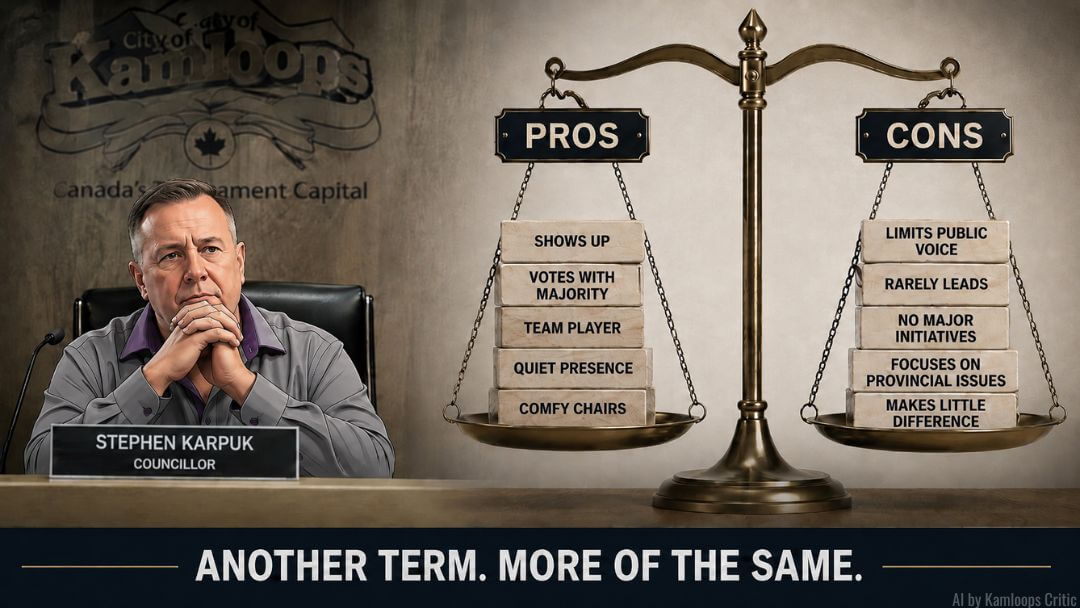
An incumbent profile for the 2026 Kamloops municipal election
When Councillor Stephen Karpuk announced he's seeking another term on Kamloops City Council, he described himself in a way that was maybe more revealing than he intended.
"I'd rather be the team player... I'd rather be the supportive cast."
Karpuk may have intended those words to communicate humility. Instead, they may have unintentionally summarized his entire first term.
Looking back over the past four years, it's surprisingly difficult to identify a defining initiative, a significant policy championed, or an issue where Karpuk changed the direction of council. Instead, his record is characterized by something else: being a dependable member of the council majority.
That may be exactly what he intended. This October, voters should ask whether it's enough to earn another four years.
A Supporting Role
Incumbents seeking re-election should be able to point to accomplishments that made Kamloops better. Some councillors become associated with major infrastructure projects, financial reforms, improved governance, or advocacy for specific neighbourhoods. Others become known for consistently challenging assumptions or providing independent oversight of staff recommendations.
Karpuk's campaign, however, seems to focus less on what he has accomplished and more on what he hopes to continue doing.
Like every councillor, Karpuk regularly moved and seconded routine motions involving development permits, staff reports, meeting minutes, and other administrative business. Those responsibilities are an essential part of municipal governance, but they're also shared by every member of council. It's more challenging to determine what distinguishes Karpuk's record from that of his colleagues.
To Karpuk's credit, one improvement is hard to dispute: councillors now have better chairs. As a chiropractor, perhaps he was uniquely qualified to recognize the importance of proper lumbar support.
Beyond that, identifying a defining accomplishment becomes a little harder. That's not to suggest he's been inactive.
He has attended meetings, served on committees, represented the city on outside boards, and generally fulfilled the responsibilities expected of a councillor. The tougher question is whether he's left a lasting mark on council's direction or simply helped maintain the course set by the majority.
His own description as part of the "supportive cast" suggests he may not see that as a criticism. For voters, however, it raises an obvious question: if a councillor chooses not to lead, what exactly are they asking voters to renew?
Being Part of the Team
Karpuk describes himself as someone who prefers working as part of a team rather than taking centre stage.
There is value in that approach. Municipal government depends on cooperation, and councils can't function effectively if every member is determined to oppose colleagues for the sake of appearing independent.
The challenge is finding the balance between collaboration and accountability. An effective councillor should be willing to support the majority when it's right, but also willing to question it when circumstances demand.
Looking back, examples of that independence are difficult to pinpoint. The concern is what happens when teamwork becomes conformity. On several of council's most controversial decisions, Karpuk voted with the majority.
Over this council's term, it approved record borrowing through Alternative Approval Processes, restricted opportunities for residents to participate in meetings, removed the public's ability to submit Code of Conduct complaints against elected officials, sanctioned the Mayor, and consistently voted as a bloc on many of the most controversial issues before council.
Those decisions reduced opportunities for residents to engage directly with their elected representatives and narrowed the avenues available for raising concerns about councillor conduct.
Supporters might describe Karpuk’s voting pattern as stability. Critics would likely call it predictability. Either way, it leaves relatively few examples of Karpuk breaking with colleagues to champion a principle, defend transparency, or offer an alternative course.
That pattern is even more significant when viewed alongside his comments about communicating with residents.
Public Engagement
At the January 14, 2025 regular council meeting, I addressed council regarding concerns about public engagement. Among other issues, I explained that emails sent to citycouncil@kamloops.ca often went unanswered. I noted that emails I had sent in September and November had received no acknowledgement, and that of eight emails sent during December, only one had been acknowledged by Councillor Margot Middleton while she was serving as Deputy Mayor—and that acknowledgement was simply to advise that it had been forwarded to staff.
Later in the meeting, Karpuk responded.
"To the point about answering emails – I mean, someone sends us eight emails in a month. There are 108,000 people that live in this community. They're not the only ones sending us emails. So if we get the first one answered, you're going to the bottom of the pile when I'm the Deputy Mayor, and there's a lot more to come before I get back to yours, chances are."
No one expects councillors to respond immediately to every email they receive. They are part-time elected officials balancing council responsibilities with their careers, families, and other commitments.
There's nothing unreasonable about reminding residents that councillors receive correspondence from many people. That's part of public office. What's more difficult to understand is the suggestion that continued engagement should move a resident's future emails to the bottom of the queue.
The concern raised during Public Inquiries was not that one resident's emails should receive priority, but that multiple emails had received no acknowledgement at all. Rather than addressing that concern, Karpuk explained why someone who sends multiple emails should expect slower responses.
Those comments become more significant when viewed along with his voting record. Together, those decisions raise a broader question: does Karpuk view public participation as an essential part of representative government, or as something that should be managed, limited, and, when it becomes too persistent, pushed to the bottom of the pile?
That question is even more relevant in light of comments Karpuk made when announcing his bid for re-election.
Radio NL reported that Karpuk acknowledged there were times he questioned whether he wanted to seek another term, describing the role as demanding and noting that elected officials are frequently scrutinized by the public.
Public office is demanding. It's also accountable. Scrutiny isn't an unfortunate side effect of elected office—it's one of the responsibilities that comes with it. Residents have every right to question decisions, challenge priorities, and expect meaningful responses from those they elect.
The issue isn't whether Karpuk found the scrutiny difficult. The issue is how he responded to it.
Civil Discourse
One of the more notable examples of Karpuk stepping outside his usual supporting role came on February 28, 2023. During debate on a motion before council, he proposed an amendment directing staff to develop a civil discourse statement.
Karpuk introduced the amendment after expressing concern about comments made by a member of the public during Public Inquiries at a previous meeting. Explaining his reasoning, he said he had "a big issue" with residents making what he viewed as attacks on staff or using the forum to "grandstand."
Although framed as a call for civil discourse, the context is significant. The amendment followed criticism of City staff by a resident during Public Inquiries, suggesting that Karpuk's concern was not simply with civility in general, but with how members of the public were using one of the few opportunities available to address council directly.
The amendment wasn't unanimously supported. Councillor Katie Neustaeter argued it unnecessarily expanded the motion and questioned whether it was an efficient use of council's time. Councillor Nancy Bepple and Mayor Reid Hamer-Jackson also opposed the amendment. Despite that opposition, council adopted Karpuk's amendment.
Ironically, the issue of civility would become one of the defining themes of the 2022–2026 council term. It was also a reminder that Karpuk was capable of leading when he chose to, although examples like this were relatively uncommon.
The Red Bridge Problem
One of Karpuk's headline campaign priorities for 2026 is replacing the Red Bridge.
There's just one complication. The Red Bridge is not owned by the City of Kamloops. It's provincial infrastructure.
Campaign priorities typically focus on things a councillor can actually influence through municipal government. Replacing provincially owned infrastructure is an unusual choice for someone seeking re-election to city council.
Replacing the Red Bridge may be a worthwhile objective, but it is largely outside the authority of municipal council. As a campaign priority, it raises questions about whether Karpuk's emphasis is directed toward issues council can actually resolve.
Fiscal Restraint—Until Lunch Arrives
During the 2022 election campaign, the Kamloops & District Labour Council asked for Karpuk’s thoughts on fiduciary responsibility.
Part of Karpuk's response caught my attention:
"Sitting at City Hall is not any reason to assume you are entitled to extras like working lunches and dinners all the time. I bring my own lunch to work and plan on it every day. I see no reason why that should change just because I am a city councillor."
Many taxpayers would probably agree.
Yet when the Mayor later introduced a motion to eliminate complimentary lunches for councillors and senior staff, the motion failed to receive even a seconder. Karpuk didn't step forward to support a proposal that reflected the position he'd expressed during the election campaign.
Campaign principles carry the most weight when they survive election day.
Removing the Chair
During the Mayor's Report on May 14, 2024, Karpuk invoked a rarely used procedural challenge to the chair immediately after the Mayor began criticizing aspects of the Braun report and discussing a disputed email from the CAO.
Following advice from the Deputy Corporate Officer, council voted not to sustain the chair, and the Mayor was removed for the remainder of his report. The meeting minutes state the removal was carried "as per section 132(2) of the Community Charter."
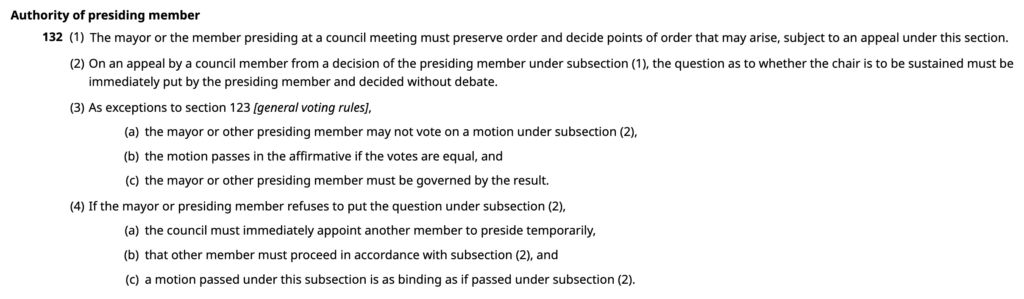
Karpuk later described section 132 as "a tool" for "simple civil governance" and said council had "unfortunately" needed to use it. However, the procedural basis for the challenge was questioned at the time.
Former Kamloops mayor Mel Rothenburger wrote that a challenge to the chair is ordinarily an appeal from a ruling by the presiding member and observed that, in this case, "Hamer-Jackson hadn't ruled on anything; he was attempting to make a statement." Rothenburger concluded that while the procedural steps were followed, the use of the provision was "a bit of a bum's rush."
Although questions were raised at the time about whether the provision applied in those circumstances, the procedure was subsequently accepted by City staff and repeated during later meetings, including another occasion initiated by Karpuk.
Now, I'm not a legal expert, but section 132 isn't that difficult to read.
- Subsection 2 relates to subsection 1, and the chair's decision on a point of order.
- A member can appeal that decision to determine if the decision is sustained (upheld).
- The chair is to put the question to a vote.
- Subsection 3 says the chair doesn't get a vote.
- Subsection 4 says if the chair refuses to put the question to a vote, council is to appoint another member to put the question to a vote.
- There is nothing suggesting the word "sustained" has anything to do with removing the chair.
Karpuk called out "Point of Order" and immediately launched into claiming he was challenging the chair.
Karpuk didn't wait for the Mayor to acknowledge him, listen to his concern, and then decide on it.
There was no prior decision for Karpuk to appeal. The Mayor was simply reading his report. There was no appeal for the Mayor to put to a vote, and he certainly didn't refuse to put one to a vote.
I welcome you to listen to the incident and judge for yourself.
A Public Accusation—and a Public Apology
No profile of Karpuk would be complete without mentioning what has become known locally as "Fartgate."
One of the more unusual moments of Karpuk's first term occurred during the June 27, 2023 council meeting. Speaking during Councillor Reports, Karpuk criticized Mayor Reid Hamer-Jackson over what he believed was an inappropriate comment made at a Canadian Home Builders' Association event.
Karpuk told council he'd been embarrassed when the Mayor asked whether everyone should "pass some gas as a way to generate more green energy."
The following day, Karpuk publicly apologized after learning that the remark had actually been made by someone else at the event, not the Mayor. In a statement reported by CFJC Today, he acknowledged that he'd relied on incorrect information and accepted responsibility for the accusation.
The incident demonstrated two different aspects of Karpuk's judgment. First, he was prepared to make a serious public allegation with considerable confidence despite the Mayor's immediate denial. Second, when it became clear he had been mistaken, he apologized publicly.
However, reviewing his apology, I found he also took that opportunity to blame the Mayor for his actions.
"Given the past months of stress, frustration and emotions that I have endured dealing with city business I became emotionally hijacked after the mayor’s comments about staff."
That immediately reminded me of Councillor Bill Sarai's public apology on December 3, 2024 where he also implied the Mayor was to blame.
"... I’ve made a decision to concentrate more on my mental health well-being, which has been profoundly affected from the ongoing stressful environment within and outside of this council chambers for the past two years."
A Code of Conduct complaint against Karpuk followed, although no sanctions were imposed because of his apology.
Mistakes happen. Public officials are human. But publicly accusing someone before confirming the facts is not generally regarded as best practice.
A Blind Eye
By August 2024, the need for a new RCMP detachment was well established. The City had long acknowledged that the existing building no longer met space requirements, and replacing it remained one of the municipality's major capital needs. Despite that, council had repeatedly delayed the project while advancing other large capital priorities, including the proposed performing arts centre and arena multiplex.
During his councillor report on August 27, 2024, Karpuk expressed frustration that the project appeared to have "been lost in the void" and made an unexpected comment regarding Protective Services Director/Fire Chief Ken Uzeloc.
"And I'm not sure whether Director Uzeloc turns a blind eye to staff inside the building for capacity, but I know we have some issues that we need to address there."
The interesting thing is that if the Mayor had made such a remark, there would have been an immediate reaction and mention of the civil discourse statement. In Karpuk's case, there was none.
Initiative
One of Karpuk's more meaningful initiatives came in August 2023, when he introduced a notice of motion proposing a Select Committee on Asset Management.
Council ultimately amended the proposal, directing staff to instead prepare a report on committee structures within the Governance and Service Excellence strategic pillar.
While the original idea did not proceed as proposed, it demonstrated that Karpuk occasionally initiated governance discussions rather than simply responding to staff recommendations.
Not Always with the Majority
Karpuk generally worked collaboratively with council and often supported the majority, but he was willing to break ranks on issues he considered important. The question is whether those moments of independence translated into a broader record of leadership.
One notable exception came during debate over a proposed multi-use pathway on Lansdowne Street. Karpuk supported the project even though he was not aligned with the majority of council.
During the 2022 election campaign, he described himself as an avid cyclist, making the issue one that may have reflected a long-standing personal interest. Whether motivated by that interest or by broader transportation policy, it was one of the clearer examples of Karpuk taking an independent position.
Karpuk also demonstrated a willingness to depart from the majority on fiscal matters. In December 2023, he was the only councillor to oppose a motion directing staff to initiate an efficiency review of the budget to identify functions that could be reduced or eliminated.
Explaining his vote, Karpuk cautioned against repeatedly deferring expenditures simply to find savings. "We can't keep going and chopping out what may be deferred," he said. He argued that council also needed to consider "what does this corporation need to succeed to go forward to meet the needs as the third fastest growing community in this country," adding that while he was "not against" looking for efficiencies, council also had to be "bold enough to say we still have to pay for what we need to go forward with."
Whether voters agree or disagree with that position, it demonstrated a willingness to stand alone when he believed the discussion had become too narrowly focused on finding budget reductions.
Karpuk consistently argued that a growing city should be willing to invest in infrastructure rather than focusing primarily on cost reduction. His opposition to a budget efficiency review in December 2023 was followed three months later by support for extending a sidewalk on Todd Road in Barnhartvale.
Staff reported that nearly two-thirds of the 194 survey respondents either opposed the sidewalk or believed it should be deferred. Council also heard that the planned road reconstruction already included a six-foot paved shoulder separated by a painted line.
Despite that context, Karpuk seconded and supported borrowing $1.7 million to construct the sidewalk. That motion however was defeated.
Additional Appointments
Karpuk currently serves on both the Southern Interior Local Government Association (SILGA) board and the Thompson-Nicola Regional District board. The TNRD appointment carries an additional annual remuneration of $18,140.
Ordinarily, the Mayor occupies one of Kamloops' seats automatically. Following council's sanctions against him, the Mayor was removed from the TNRD board, which allowed Karpuk to fill that seat.
A Curious Code of Conduct Vote
One of council's more controversial decisions was eliminating the public's ability to submit Code of Conduct complaints against elected officials.
That vote deserves scrutiny for another reason. Karpuk, who was at the same time the subject of of a Code of Conduct complaint, also voted to remove that avenue of accountability from the public.
There is no evidence that Karpuk's vote was motivated by the complaint against him, and council members publicly discussed broader concerns with the complaint process before making their decision.
Whether voters see that as a conflict of interest is a question only they can answer.
Conclusion
Karpuk describes himself as "one of the supporting cast."
After reviewing four years of council meetings, that may be the most accurate description of his first term. He attended the events expected of a councillor, participated in debates, occasionally introduced governance initiatives, and was willing to stand apart from the majority on selected issues. At the same time, little in the public record suggests he consistently shaped council's agenda or emerged as one of its principal leaders.
Karpuk’s record raises legitimate questions about his approach to public accountability, his willingness to challenge the council majority on the city's biggest decisions, and his judgment in several high-profile moments.
Whether that record warrants another four years is ultimately for voters to decide.
As voters prepare to cast their ballots October 17, 2026, they should ask themselves one simple question.
Can they point to a meaningful change in Kamloops that exists because Karpuk fought for it? Or has his greatest contribution simply been making council meetings a little more comfortable for his colleagues?
Editorial Note
Kamloops Critic publishes investigative candidate profiles based on council records, meeting transcripts, public documents, and candidates' own statements. The analysis above is intended to help voters evaluate each candidate's record. Readers are encouraged to review the original source documents and council recordings and to reach their own conclusions.
The following recommendation reflects Kamloops Critic's editorial opinion.
Kamloops Critic Recommendation: Not Recommended
Stephen Karpuk appears to have approached his first term with professionalism and genuine enthusiasm for public service. He attended community events, participated in council discussions, and occasionally advanced initiatives that reflected his interest in governance and municipal operations.
However, after reviewing four years of council meetings and public records, I do not believe his overall record justifies another four-year term.
Karpuk recently described himself as part of the "supporting cast." His time on council largely reflects that description. While he occasionally demonstrated independent judgment, his record is defined more by participation than leadership, more by supporting council's work than by shaping its direction.
Kamloops faces significant challenges in the years ahead, including infrastructure priorities, financial pressures, public trust, and governance. I believe residents should expect councillors who consistently demonstrate leadership, independent thinking, transparency, and measurable impact over the course of their term.
On balance, Kamloops Critic does not believe Stephen Karpuk has demonstrated that level of leadership during his first term, and Kamloops Critic does not recommend his re-election.
Candidate Response: Kamloops Critic welcomes factual corrections from candidates and will promptly correct any verified errors. Candidates who wish to respond to this profile are invited to submit a response of up to 750 words. Responses may be edited only for length, formatting, or legal considerations.


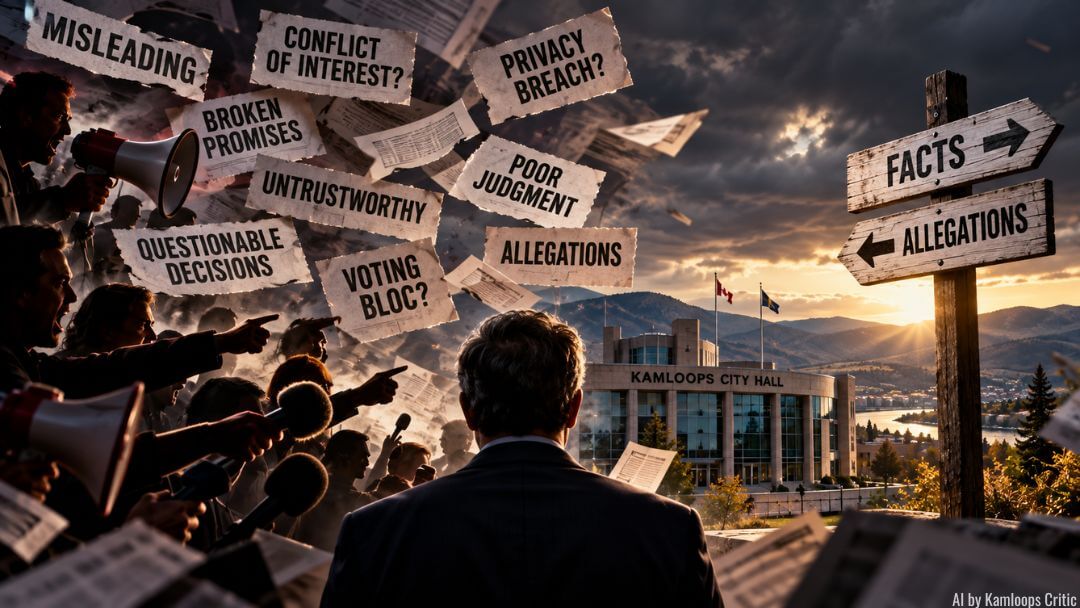
It’s Over in October
Here is the link to the SOFI report ending December 31, 2025
https://www.kamloops.ca/sites/default/files/Report%20-%202025%20Statement%20of%20Financial%20Information.pdf
I see a Karpuk K shown as Financial Coordinator. Remuneration $91,553 , taxable benefits $381 and expenses $5,797
Is this Councillor Karpuk’s spouse?
As Ian has suggested, “It’s over in October.”