
Public hearings are presented as one of the few moments when residents can directly influence municipal decisions. The City of Kamloops invites the public to “Have Your Say,” encouraging residents to review bylaws, prepare submissions, and appear before Council prior to a final decision.
However, what happens in the room — and immediately after — can tell a more complicated story.
At the March 10, 2026 public hearing for Zoning Amendment Bylaw No. 55-107, that process unfolded in a way that raises a simple question: what role does the public hearing actually play?
What the Hearing Was About
City staff proposed two changes to the bylaw. It would expand the range of one-person home-based businesses permitted to receive client visits, and it would remove restrictions on office use along the Notre Dame Drive corridor.
The proposal was first introduced to Council on February 3, 2026, when Community Planning Manager Stephen Bentley presented the staff report. A public notice inviting residents to participate in a hearing was later issued on March 3, 2026, with the hearing scheduled for March 10.
Questions Raised Before the Hearing
Before the hearing took place, questions about the proposed changes had already been raised with City staff. This reflects a level of review that extended beyond the formal public process.
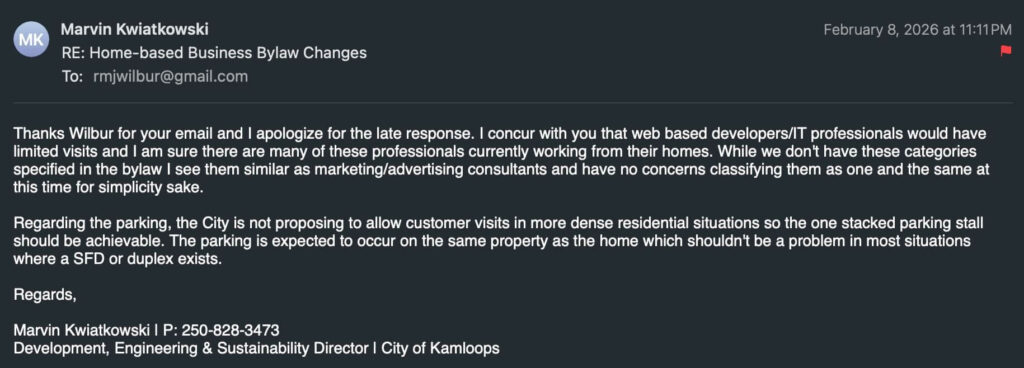
In a February 2 email, I asked whether web development and IT businesses — which typically involve infrequent client visits — could reasonably be included among the permitted home-based businesses. Given their limited impact, the question was whether they fit within the intent of the bylaw.
In a February 8 response, Development, Engineering and Sustainability Director Marvin Kwiatkowski acknowledged the point. He wrote that such businesses would likely have limited visits and could reasonably be treated similarly to marketing or advertising consultants. He also noted that the bylaw assumes customer parking would occur on the same property, typically in single-family or duplex situations.
At the Podium
The March 10 public hearing was chaired by Deputy Mayor Stephen Karpuk, with the Mayor not in attendance. After staff presented the bylaw and its rationale, I spoke via Zoom as the only public speaker.
I raised several points about both the structure and practical implications of the amendment. Web-based businesses, for example, involve minimal client traffic and could reasonably be included in the permitted categories. I also noted that enforcement of visit restrictions would be difficult, and that parking requirements may not align with increasing residential density.
I raised several points about both the structure and practical implications of the amendment. Web-based businesses, for example, involve minimal client traffic and could reasonably be included in the permitted categories.
I also noted that enforcement of visit restrictions would be difficult, and that parking requirements may not align with increasing residential density. In addition, I referenced the earlier correspondence with Director Kwiatkowski, noting that the concern had already been acknowledged within City administration.
During this time, Councillors Katie Neustaeter and Mike O’Reilly were engaged in a side conversation.
When I finished, the response from the chair was brief: “Thank you for that, Mr. Wilbur… duly noted.”
Council was then invited to ask questions. None were raised. No discussion occurred. The hearing was then formally closed.
Immediately afterward, the meeting reconvened into regular business.
From Hearing to Vote
Within minutes, Council proceeded to consider the same bylaw under Agenda Item 20.2. A motion was introduced to give Zoning Amendment Bylaw No. 55-107 third reading.
Councillor Nancy Bepple spoke briefly. However, her remarks did not address any of the points raised during the public hearing. Instead, she noted an outstanding Ministry of Transportation and Transit approval requirement and acknowledged Councillor Katie Neustaeter for her earlier role in advancing home-based business changes.
No reference was made to the public hearing. No reference was made to the speaker. None of the issues raised during the hearing were revisited.
Council then proceeded to vote. The motion passed.
Advertisement

Where the Public Hearing Fits
By the time the March 10 hearing took place, the bylaw had already received first and second readings. Council had reviewed the staff report, considered the policy rationale, and advanced the bylaw to the public hearing stage before any public input was formally received.
Following the hearing, Council proceeded directly to third reading. This is the stage at which the bylaw is formally approved, pending external requirements such as approval from the Ministry of Transportation and Transit.
From a procedural standpoint, the process worked as designed. The public was given an opportunity to speak, and Council fulfilled its obligation to hold a hearing.
However, the structure of the process raises a quieter question. If a bylaw has already been introduced, analyzed, and advanced through multiple readings before the public speaks — and if no discussion occurs when the public does speak — what influence is the hearing intended to have?
Listening, or Recording
Public hearings allow affected citizens to provide their views to their elected representatives on planning and land use bylaws. Even so, from the perspective of a resident, the experience can feel indistinguishable from speaking into a void.
The City invites participation. Residents prepare and present. The record reflects that they spoke. Yet whether that input shapes the outcome is difficult to determine from the proceedings themselves.
When Silence Carries Meaning
In Council procedure, a motion that receives no seconder quietly ends without debate. This is something Mayor Reid Hamer-Jackson has often experienced. He may experience that again on March 24, 2026 when he motions to Postpone/Delay Advancement of Major Capital Projects (Kamloops Centre for the Arts and Arena Multiplex).
At public hearings, something similar can occur in a different form. A resident speaks, the room pauses, and the meeting moves on without engagement.
Residents are given the opportunity to speak, but their input is not reflected in the proceedings that follow.
Editorial Disclosure: The author spoke at the public hearing referenced in this article.
Election 2026
The next election is October 17, 2026. If you were considering voting for Councillor Dale Bass, Nancy Bepple, Kelly Hall, Stephen Karpuk, Margo Middleton, Katie Neustaeter, Mike O'Reilly, or Bill Sarai, I urge you to reconsider.
It’s critically important for you to get out there and vote. Let’s vote for a Council that actually listens to its electors!

Due to the First Nation’s claim against the city. Why isn’t there an injunction filed against the city to stop borrowing until this action is clarified. The city has known for 10 years, and kept it silent from the tax payers. Think about it.