
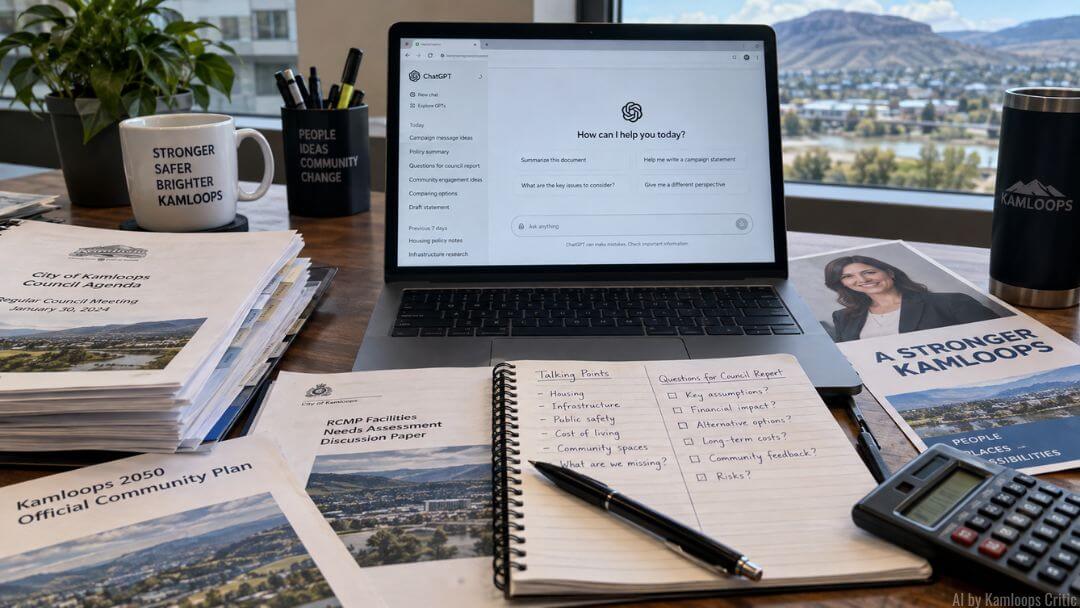
AI is already showing up in Kamloops' 2026 municipal election. Here's why voters should judge how candidates use it—not simply whether they use it.
That question came to mind after reading a recent Facebook post from Jesse Ritcey.
Jesse is running for Kamloops council again. He also ran in the last municipal election. In his post, he said he's already seeing campaign material that appears to have been produced with AI, including introductory statements, policy positions, candidate photographs and posters.
His concern is understandable. Councillors have to read a lot, understand complicated information, communicate with residents and make decisions based on what they learn.
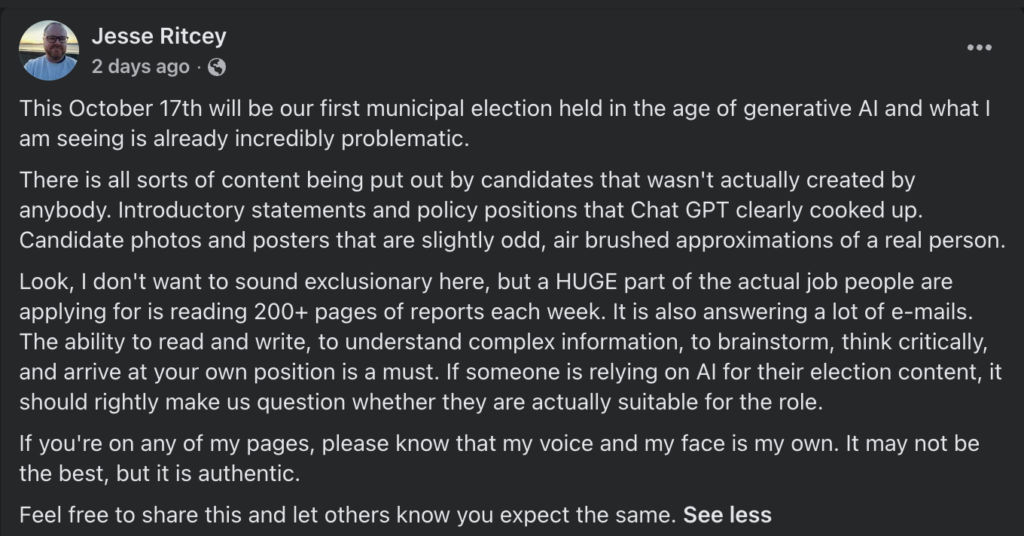
If someone simply asks ChatGPT to write their campaign platform and then puts their name on it, I'd have questions too.
Where I disagree with Jesse is the suggestion that using AI for campaign content should, by itself, make us question whether someone is suitable for Council.
I think we're going to need a better test than that.
A tool doesn't tell us who's holding it
Think about a skilsaw. It's a very useful tool that can make a job much faster and can handle all sorts of work that would take considerably longer with a hand saw.
It's also dangerous. Use it carelessly and you can get hurt, ruin the material you're working on or make one heck of a mess.
We don't solve that problem by deciding that nobody should use a skilsaw. We learn how to use it, understand what it can do, respect what it can't do and pay attention to what we're doing.
I think AI deserves much the same approach. It can save a lot of time, help organize information, improve writing, suggest ideas and point out things we hadn't considered.
It can also be confidently wrong. That's why the important part isn't whether the tool was used. It's whether the person using it understood what they were doing.
What does "using AI" actually mean?
This is where I think Jesse's argument goes a little too far.
If I write something myself and use AI to fix my spelling, have I relied on AI? What if I ask it to make my writing clearer?
What if I've read a 200-page City report and ask AI to suggest questions I should consider before a Council meeting, or to make the strongest argument against the position I've already taken?
All of those involve AI, but none of them necessarily mean I've stopped thinking for myself. In fact, the last example might do the opposite. One of the things I like about AI is that it sometimes suggests something I hadn't thought about.
That doesn't mean I believe it. AI can be wrong, and at times, very wrong. It can make assumptions and can easily lead you down a rabbit hole. But sometimes it makes you stop and look at an issue from another direction.
For me, I think that's useful.
Councillors could use this to ask better questions
This is where I think AI could actually make municipal government better.
Councillors may sometimes have to work through piles of reports and supporting documents. AI could help them find information, compare documents and identify questions worth asking.
A councillor could ask questions like: What assumptions does this report make? What information is missing? What's the strongest argument against the staff recommendation? What could go wrong if Council accepts it?
Those aren't questions that should be answered by AI and then blindly accepted. But they are questions that could help a councillor decide what they need to investigate further.
And yes, that could mean longer Council meetings and I'm okay with that.
If a meeting takes longer because councillors are asking more questions and examining a recommendation more carefully, I'd rather have that than a short meeting where everyone simply accepts the staff recommendation and moves on.
What if AI helps a councillor spot something important?
Consider the debates we've already had around major municipal projects.
Imagine a councillor asking an AI tool:
Does it make sense to ask electors to support borrowing for and building an arts centre and an arena multiplex before asking them to support borrowing for and addressing the requirements for an RCMP building that will meet the current and expected needs of Kamloops for the next 50 years?
I don't want an AI system deciding that question. I'd like it to help a councillor think about it.
The councillor would still need to look at the actual borrowing plans, the City's financial position, the requirements for the RCMP facility, the project timelines and all the other relevant information. But maybe the question would cause them to look at the issue differently.
That's not replacing judgment. That's using a tool to challenge your own assumptions. And I'd argue that's exactly what we want councillors to do.
AI could also make it easier to run for office
There's another side to this that I haven't seen discussed much.
Running for Council costs money. Candidates typically need photographs, graphics, websites, written material and social-media content. Some have access to people who can help with all of that, but others may not.
AI can reduce some of those costs. That could make it easier for someone without a large campaign organization or a lot of money to put together a credible campaign. This could also result in a larger candidate pool, which may appeal to some voters, and frustrate others.
There may even be an accountability benefit. If it costs less to run a campaign, a candidate may have less reason to accept money from somebody whose motives they aren't completely comfortable with.
AI obviously isn't going to eliminate the influence of money in politics. But lowering the cost of participating in an election isn't necessarily a bad thing.
There are lines candidates shouldn't cross
None of this means anything goes.
I have no problem with a candidate using AI to improve a piece of writing. I have a much bigger problem with a candidate using it to create something deliberately deceptive.
The rule I'd use is pretty simple: If your name is on it, you own it.
It doesn't matter to me whether you wrote every word yourself, whether a volunteer wrote it, or a consultant wrote it. And it certainly doesn't matter to me whether ChatGPT wrote the first draft.
If you publish it, you're responsible for it.
Maybe candidates should have an AI code of conduct
I'd actually like to see candidates establish some basic rules for themselves. Something along these lines:
- Use AI as a tool, not a substitute for judgment.
- Check factual claims against the original sources.
- Don't fabricate or impersonate.
- Don't use AI to create a false impression of a person, place or event.
- Be transparent about substantially altered or AI-generated photographs, video and audio.
- Protect people's private information.
- Take responsibility for everything published under your name.
And perhaps most importantly, candidates should be able to explain their positions without an AI assistant sitting beside them.
If someone can't explain their own platform when a resident asks them a question, that's a problem. But it's a problem whether the platform was written by AI or by a human.
I'm not going to try to figure out who used AI
There's another reason I'm uncomfortable with judging candidates this way. Can we actually tell?
Sometimes it's obvious that an image has been generated or heavily altered. Sometimes writing has the familiar bloated feel of AI. But neither is proof.
A human can write badly or write something that sounds like AI. AI can produce something that sounds perfectly ordinary. And a candidate can take AI-generated material and rewrite it until it sounds like them.
So I'm not particularly interested in playing AI detective. I'd rather ask candidates about the issues that matter to me and to the community. Where do they stand on those issues? What led them to that position? What evidence would make them change their mind?
Those questions tell me much more about a candidate than whether ChatGPT helped them write a Facebook post.
Let's not confuse AI with data centres
There's another issue that needs some separation in this election. AI data centres have become an important topic in Kamloops. That means we're likely to hear candidates talking about AI and data centres at the same time. They are related, but they are not the same thing.
A candidate can use ChatGPT every day and oppose a particular data-centre proposal. Another can avoid AI in their campaign and strongly support bringing data centres to Kamloops. Yet another can use AI and still be undecided about what rules should apply to them.
So I hope voters don't make the leap from: Uses AI → supports AI → supports data centres.
It doesn't work that way. If data centres matter to you, ask the candidate the questions that you want answers to.
What would you support and what would you require from a company wanting to build one? Who's paying for the infrastructure? What about electricity and water requirements? What does Kamloops get in return?
Those are questions worth asking a candidate. Whether they used AI to help write their answer isn't nearly as important as whether they can actually answer it.
I'm more interested in what happens after the election
AI isn't going away after October 17.
It's going to get better at reading documents, finding information, comparing material and generating text and images.
Councillors, residents, and journalists will use it. There isn't much point pretending otherwise. So I think we're better off figuring out what responsible use looks like now.
For me, that comes down to a fairly simple test. Did you understand what the AI gave you? Did you check it? Did you consider other possibilities? Did you make the decision yourself? And are you willing to take responsibility for the result?
That's how I'd judge a candidate. A skilsaw doesn't make someone a carpenter. And avoiding a skilsaw doesn't make someone a better one. The person using the tool still has to know what they're doing.
AI isn't the test. Accountability is.
Municipal Election 2026
October 17, 2026
It's important for all of us to get out there and vote. Please vote only for candidates you truly believe are deserving of a seat at the council table. If that's only one or two of them, those are the only ones you should vote for.
Editorial Disclosure
I use artificial intelligence tools in my own work, including for research, brainstorming, editing and exploring questions I might not have considered. I remain responsible for what I publish and check factual claims against source material.
This article was prompted in part by Jesse Ritcey's recent Facebook post about AI and political campaigns. Jesse says he hasn't used AI to write his post, and I have no reason or evidence to suggest otherwise. My comments about the timing and potential effect of his post are observations about the communication itself, not claims about his motives.
I also have views about a number of the municipal issues discussed in this article, including major capital projects and the proposed need for a new RCMP facility. Those views are separate from the broader argument being made here: that voters should judge candidates by their judgment, understanding and accountability rather than simply by whether they use AI.

Your argument about money is not realistic. If someone does not have a job and no income they are more open to suggestion. I would also question the credibility of someone who can’t show legitimate income or income that exceeds their current employment circumstances.