
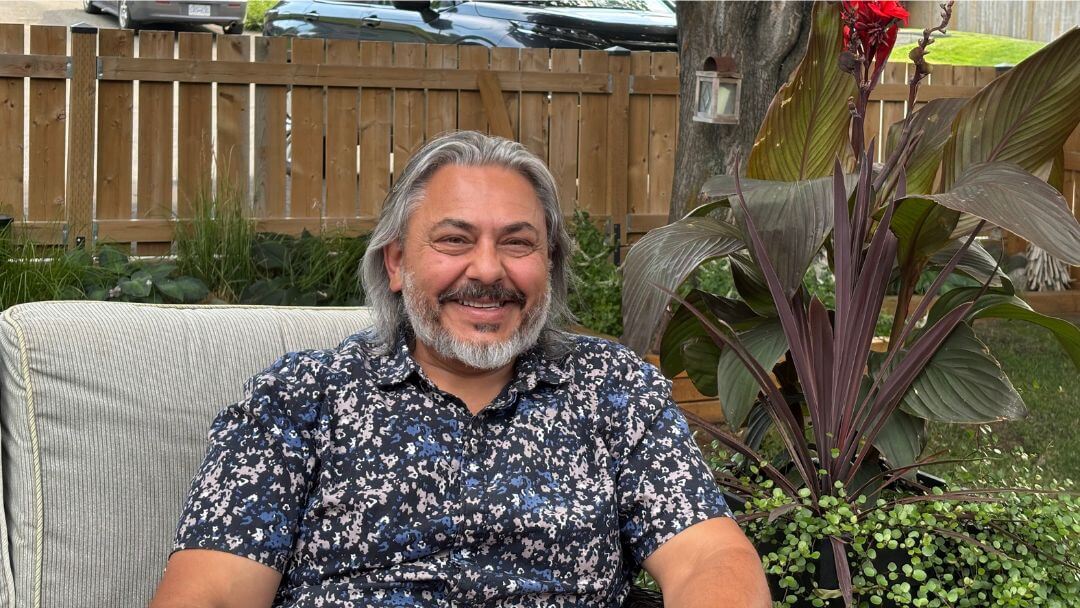
One of the questions I've been asked a few times lately is whether I'd actually vote for the candidates I'm writing about.
It's a fair question, but before I can answer it, I have to answer another one first.
Would I trust this person to make decisions that affect my family and my community?
That's really what being a councillor is about.
Council is responsible for spending hundreds of millions of taxpayer dollars, but it’s also making decisions about roads, parks, housing, public safety, bylaws and dozens of other issues that affect our daily lives.
Elections aren't just about choosing people who share our opinions. They're about choosing people whose judgment we trust when they're faced with difficult decisions that none of us can predict today.
That's the question I had in the back of my mind when I sat down with Christopher Mitra.
We spent a couple of hours talking about the city, his background, why he decided to run and how he sees his role on council. When I left, I did what I usually do. I went home and started digging.
I spent some time going through his Facebook page, LinkedIn profile, media interviews and campaign website. Since he'd taken the time to write several blog posts, I read those too.
I wanted to know whether the person I met was the same person voters were seeing everywhere else. So far, I think he is.
First Impressions Are Just The Starting Point
I'll admit it. Chris made a good first impression.
He's easy to talk to, but not because he's trying to impress you. He listens to the question, thinks about his answer and doesn't seem to feel the need to fill every silence. Our conversation never felt like a campaign speech, and at no point did I feel like he was trying to tell me what he thought I wanted to hear.
I've met people over the years who could leave almost anyone with a positive first impression. That's why I don't stop at the interview. Once I get home, I start looking for things that either reinforce my impression or make me question it. Sometimes the deeper you dig, the more the cracks start to appear.
That didn't happen with Chris. The more I read, the more comfortable I became that he was presenting himself consistently. The ideas he talked about during our meeting were the same ideas I found on his website, in his interviews and throughout his campaign material.
That doesn't automatically make him the right candidate, but I think consistency matters. If someone is putting on an act, it's usually pretty difficult to keep it going across interviews, websites and face-to-face conversations.
Why He's Running
One of the questions I always have is simple. Why?
Why put your name on a ballot? Why spend your time at meetings that can stretch on for hours? Why invite public criticism into your life when you already have a career and a family?
Chris already has work that he genuinely seems to enjoy. He's an executive coach, helping people around the world work through leadership challenges, career changes and professional development. When I asked him about that work, you could see how much satisfaction he gets from helping people succeed.
He told me he sees the council struggling and believes he has the experience needed to make a positive contribution. I didn't come away with the impression that he was chasing a political title or looking for recognition. I came away thinking he genuinely believes he can help.
Good Councillors Ask Good Questions
The longer I watch council, the less interested I become in candidates who promise to fix everything. What I want are councillors who ask good questions.
One of the things I've learned from spending years in software development is that good decisions usually come from asking better questions. In many cases, what a client asked for wasn't actually what they needed. The only way to discover that was to keep asking questions until you understood the real problem.
I think the same concept can be applied to governing a city. I've never been a big fan of the phrase best practice. Every time I hear it, I find myself asking the same question. According to who?
There's nothing wrong with looking at what other municipalities are doing. That's a smart place to start. But Kamloops isn't Kelowna, Victoria or Prince George. We have our own geography, economy, challenges and our own priorities.
Something can be considered a best practice somewhere else and still not be the best solution here.
That's one of the reasons I want councillors who are prepared to challenge recommendations from administration when it's appropriate. Not because I think staff don't know what they're doing, and not because every recommendation is wrong.
I want councillors who ask the questions that haven't been asked yet. Questions like:
- What other options were considered?
- Why were those options rejected?
- What happens if we do nothing?
- How will this affect seniors? Small businesses? Taxpayers?
- Is there another way to solve the problem?
To me, that's where council adds the most value.
Administration's job is to research issues, analyze options and make recommendations. Council's job is to test those recommendations before making a decision.
I don't want councillors who simply rubber stamp every report that lands on the agenda. I also don't want councillors who reject recommendations just to make a point. I want councillors who make administration bring their "A" game.
Looking Beyond The Slogan
One of the things I wanted to understand better was Chris's campaign slogan: Lead With Intent.
Campaign slogans are easy to write. Figuring out whether there's actually something behind them takes a little more work.
While reading through his website, I found a blog post where he explains what the phrase means to him. He writes that leading with intent means "having a plan, executing it, and taking absolute ownership of the results."
I like that explanation because it's straightforward. Whether you're running a business, coaching clients or serving on council, having a plan and taking responsibility for the outcome seems like a pretty reasonable philosophy.
Chris goes on to contrast that with what he calls "Leadership by Accident," describing it as waiting until something goes wrong and then pointing fingers afterwards.
What mattered more to me was that it matched the person I met. It didn't feel like a slogan someone dreamed up during an election campaign. It felt like a philosophy that's shaped the way he approaches leadership in other parts of his life as well.
More Than One Person's Ideas
One thought crossed my mind as I worked through Chris's website. If you only read his platform, you might come away thinking he believes he's got all the answers.
There are a lot of ideas, and if you didn't know him, it would be easy to wonder whether he expects to arrive at City Hall and start fixing everything himself.
That wasn't the impression I got at all. We never actually discussed his website during our meeting.
In fact, fairly early in our conversation, Chris pointed out that as a councillor, he can’t accomplish much on his own. He knows that council has to work together, and they have to do it constructively.
Hearing him say that told me he understands something that's easy to forget during an election campaign. No one councillor gets to implement their own platform. Council only works when people are prepared to work together.
Experience That Brings A Different Perspective
Chris brings experience that isn't common around the council table.
For fifteen years he volunteered as an Auxiliary RCMP member, seeing situations that most of us never will. That doesn't mean every opinion he has about public safety is automatically right, but it does mean those opinions come from firsthand experience rather than headlines or social media.
His background in software and technology also caught my attention.
I've spent most of my own career in software development, and I've long believed that organizations get the best results when technology is treated as a strategic partner rather than simply another department that reports through finance or corporate services. Treating IT as a strategic partner can take an organization from simply trying to keep up with the Joneses to using technology as a real competitive advantage.
Over the last few years I've watched a lot of Kamloops council meetings, and other than hearing about software licence costs, I honestly can't remember much discussion about how the City's IT department could help move the organization forward.
Maybe those conversations happen behind closed doors and I simply haven't been exposed to them. If they do, I'd genuinely like to learn more. Our conversation reminded me that Chris’s background could bring a perspective to council that I don't think is well represented today.
More importantly, I think people with his experience tend to ask different kinds of questions. They know the first solution isn't always the best one because complex problems rarely have simple answers.
Do organizations improve because everyone agrees with each other? I don’t think so. I think they improve because someone is willing to ask the question everyone else overlooked.
Whether Chris ends up being that person remains to be seen, but I think he has the background to contribute in that way.
Common Sense Isn't Always Common
One phrase that appears several times throughout Chris's campaign material is common sense.
I'll admit, that phrase has picked up a lot of baggage over the years. It won’t matter which candidate is being discussed, someone is almost guaranteed to roll their eyes when they hear it.
At the same time, I've watched enough council meetings to know there have been moments where I've honestly wondered where the common sense went. Maybe that's one of the reasons Chris keeps coming back to it.
I don't think he's using it as a political slogan as much as he's describing the kind of decision-making he'd like to see. Wanting more common sense in local government seems like a pretty reasonable goal.
He Doesn't Need To Be The Smartest Person In The Room
Chris never gave me the impression that he thought he already had all the answers, nor do I think he’ll attempt to convince others that he is the smartest person in the room.
That’s significant to me, since following council as closely as I have, I've seen plenty of examples where confidence has been in much greater supply than humility.
No councillor knows everything and they shouldn't pretend to. They should understand their own experience, recognize where someone else knows more than they do, and make decisions after listening to different points of view.
Chris struck me as someone who's comfortable doing that. He seems more interested in understanding a problem before deciding how to solve it. Personally, I think that's a healthier way to approach local government.
Where I Land
So... would I vote for Christopher Mitra today? Yes, I probably would.
Not because we got along or because I expect to agree with every position he'll take over the next four years. And certainly not because I think he'll solve every problem facing Kamloops.
I'd vote for him because, based on everything I've seen so far, I feel like I can trust his judgment. That's really what this comes down to.
When councillors are sitting around the table, they're going to be making decisions that affect my family, your family and the future of our city. They won't always have perfect information, and there won't always be an obvious right answer. Those are the moments when judgment matters most.
After spending time with Chris and then doing my homework afterwards, I came away believing he has the potential to be that kind of councillor.
Could my opinion change? Of course.
The campaign is just getting started, and there are still important issues I'd like to hear him speak about in more detail. I also want to see how he responds to the questions voters will be asking him about the things that matter the most to them.
If I learn something that changes my opinion, I'll tell you. That's only fair.
One conversation isn't enough to know whether someone will become a good councillor. But it is enough to decide whether they're someone I want to keep watching.
Editorial Note: Christopher Mitra hasn't served on city council before, so there's no voting record or council history to examine. Instead, this profile is based on my interview with him, his public statements, campaign material and the research I was able to complete before publication. As always, I encourage readers to do their own homework and reach their own conclusions.
The following recommendation reflects Kamloops Critic's editorial opinion.
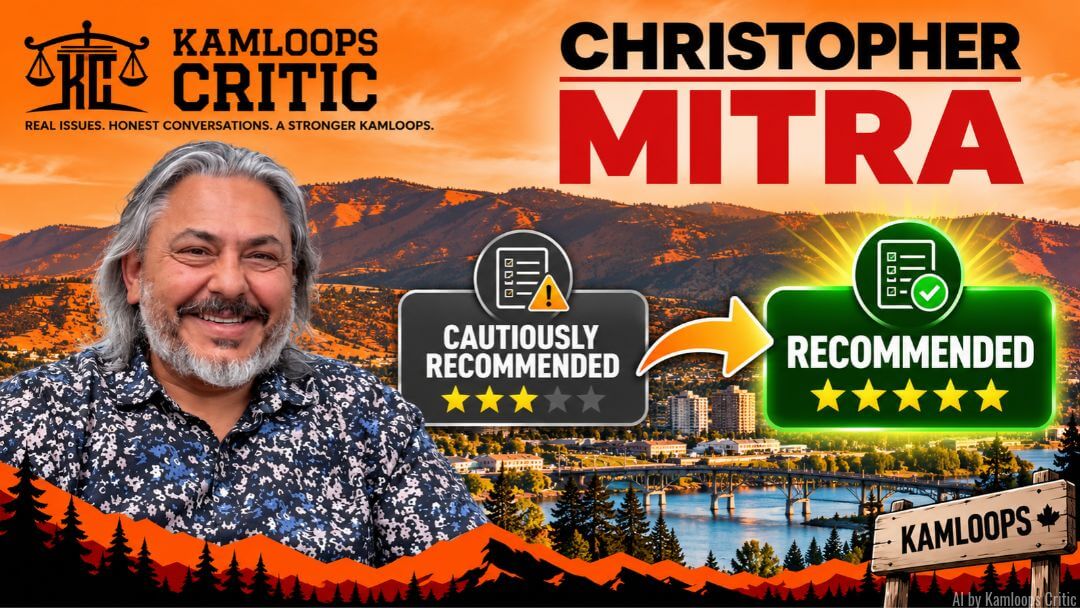
Kamloops Critic Recommendation: Cautiously Recommended
Christopher Mitra made a positive first impression. He appears thoughtful, grounded and realistic about what one councillor can accomplish. He understands that leadership isn't about having all the answers or getting your own way every time. It's about listening, asking good questions, working with others and taking responsibility for the decisions you make.
The campaign is still in its early stages, and there's plenty of time for new information to come to light. I'll continue paying attention, ask more questions when I think they're needed, and update this recommendation if my opinion changes.
Based on everything I've seen so far, I'd feel comfortable putting an X beside Christopher Mitra's name on October 17, 2026.
Candidate Response: Kamloops Critic welcomes factual corrections from candidates and will promptly correct any verified errors. Candidates who wish to respond to this profile are invited to submit a response of up to 750 words. Responses may be edited only for length, formatting, or legal considerations.
Thanks for this story, Kamloops Critic.
I think your readers would appreciate seeing some new faces and reading about our options for the upcoming civic election. We’ve already heard and seen WAY too much about the incumbent councillors who are going to try again.