
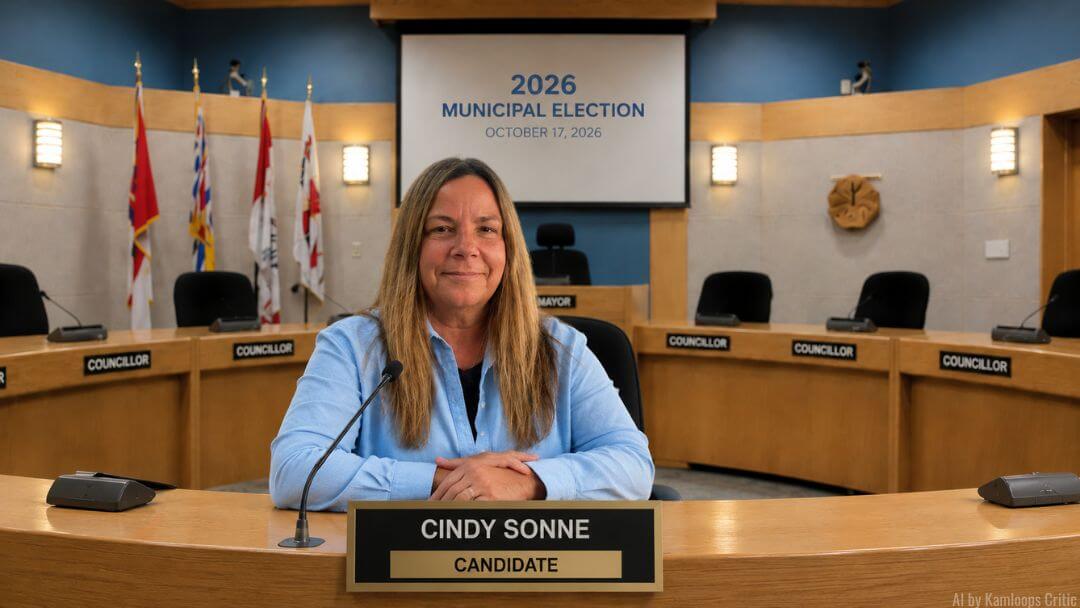
One of the questions I've been asking myself as I meet the people running for Kamloops City Council is pretty simple:
Would I trust this person to make decisions that affect my family and my community?
That doesn't mean I have to agree with everything a candidate says. In fact, I don't think a good councillor should simply agree with me. What I'm looking for is someone who will listen, ask questions, think for themselves and make decisions they believe are right for Kamloops.
I've now had three opportunities to sit down with Cindy Sonne and talk with her. I've also listened to her speak to residents at her August 5 town hall and spent some time looking at her background and public comments. The more I've learned about Cindy, the more I think there is something different she could bring to Council.
It's not just her willingness to speak. It's why she feels the need to speak in the first place.
A career spent listening to people
Cindy has lived in Kamloops since 1978 and says she has spent about 25 years working with seniors, people with disabilities, people experiencing homelessness and people struggling with addiction.
That background gives her a perspective on some of the people and problems we often discuss from a distance.
Most of us don't know what it is like to navigate the systems available to someone dealing with addiction, serious mental-health challenges, disability, homelessness or a combination of those things. We see the person on the street, the disturbance outside a business or the person struggling in a shelter, but we don't necessarily see everything that led them there or everything they are trying to navigate.
That doesn't excuse harmful behaviour. Someone who steals, assaults someone, threatens another person or damages property is still responsible for those actions. Compassion doesn't change that.
What Cindy seems to bring to the conversation is the ability to look at the same person and ask another question as well: What aren't we seeing?
Someone can be responsible for their actions and still be dealing with circumstances most of us don't understand. A person can need accountability and help at the same time.
I think Cindy has the experience to help Council see that part of the picture.
Looking beyond the loudest voices
Cindy's LinkedIn profile talks about her appreciation for hearing people's stories and learning from their experiences. She describes compassion and empathy as guiding principles in both her personal and professional life. I don't think that makes her soft.
Actually, one of the things I've noticed about Cindy is that there is a determination underneath the compassion. She doesn't seem particularly interested in telling people what they want to hear simply because it would make the conversation easier.
She hates injustice. She has told me about times in her life when she felt compelled to stand up for other people, including people who weren't in a position to stand up for themselves. That may be one of the most useful qualities she could bring to Council.
Municipal politics tends to amplify the loudest voices. The people who attend meetings, write emails, post on Facebook and speak at public hearings are important, but they aren't necessarily representative of everyone affected by a decision.
There are seniors who aren't comfortable speaking publicly. There are people with disabilities who have difficulty navigating government. There are people struggling with addiction or mental illness who aren't in a position to make a polished presentation to Council. There are families dealing with problems privately who don't have the time, confidence or resources to make their concerns known.
Cindy's background gives her a reason to notice those people. I don't expect her to automatically agree with them, and I don't think she should. But I do think she is likely to ask whether we've heard the whole story before making a decision.
Compassion doesn't mean a lack of accountability
This is where I think Cindy's approach could be misunderstood. Her concern for vulnerable people isn't an argument for ignoring the effect their behaviour can have on everyone else.
She talks about people who need help getting into treatment and recovery, but she also talks about businesses dealing with theft and vandalism, neighbourhoods dealing with disorder and seniors who may not feel safe in environments designed to serve people with very different needs.
One of the things I found interesting in our conversations was Cindy's support for dedicated housing for seniors. At first glance, that might sound like a completely separate issue from homelessness or addiction. But Kamloops' problems don't always fit neatly into categories.
A senior can be vulnerable because of age, disability, health or financial circumstances. Someone experiencing homelessness may also have mental-health or addiction issues. Someone with a disability may be dealing with housing insecurity. These circumstances can overlap, and putting people with very different needs into the same environment doesn't necessarily solve the problems of any of them.
Cindy is asking whether we're actually designing services around the people who need them, or whether we're putting people into whatever space happens to be available. That's a legitimate question, and it applies to her concerns about shelters and harm reduction as well.
Cindy wants to know whether the system is working
At her August 5th town hall, Cindy told residents about people she says she has encountered through her work and personal experience. Some of the stories were difficult to hear. They involved people struggling to get into treatment, problems within shelters and supportive housing, drug use, violence and families who felt the system wasn't working for them.
Some of the specific claims she made will require further verification before I'd treat them as evidence of a broader systemic problem. That's important because a compelling story can tell us that a question deserves to be investigated without necessarily answering the question.
But Cindy isn't simply saying, "Believe these stories." She's asking for an audit. That has my attention.
I've been following the debate over shelters and related services for some time, and I've never understood why an independent examination of the system has to be treated as an accusation of wrongdoing.
If the system is working well, an audit should help establish that. If there are weaknesses, we should want to know what they are. If different approaches are producing better outcomes somewhere else, shouldn't we want to know that too?
Cindy's idea of success is also worth paying attention to. She talks about outcomes rather than simply counting beds, dollars or programs. Ultimately, she wants to know whether people are getting healthier, getting into stable housing and moving toward recovery rather than simply moving from one service to another.
That doesn't mean her preferred solutions are necessarily the right ones. It does mean she's asking a question I think Council should be willing to answer: How do we know what we're doing is actually working?
She's willing to question Council itself
That willingness to question things came up in another conversation we had about closed Council meetings. I asked her what she would do if she was in a closed meeting and something was introduced that clearly didn't belong there.
Cindy understands that some matters legitimately need to be discussed privately. She also told me that if something came up in a closed meeting that she believed shouldn't be there, she would say so.
I asked her a slightly less glamorous question, too: what happens when Council is dealing with something that doesn't interest her?
Her answer was that she can sit, listen and dig into it. She's willing to learn about something simply because it's part of the job.
As she put it, "I'm just that type."
That's probably more important than it sounds. Council isn't made up entirely of issues that excite us.
A councillor has to be prepared to spend hours on subjects they didn't campaign on, read reports they don't fully understand and ask questions before they're comfortable voting. Cindy seems to understand that.
Her relationship with the Mayor
There's no point pretending the association between Cindy and the Mayor Reid Hamer-Jackson isn't part of this campaign.
The Mayor has publicly supported Cindy's candidacy, and local media have described her as being backed or endorsed by him. Cindy describes the relationship differently. She says they support each other and each other's goals.
I asked her about that directly. I even suggested that a formal endorsement from the Mayor could be useful to her campaign. She was quite firm that this isn't how she sees their relationship.
I actually found that encouraging. Supporting someone doesn't mean agreeing with everything they do. Two people can share goals while still having very different opinions about how to achieve them.
That's the distinction I think Cindy needs to maintain throughout this campaign and, if she's elected, around the Council table.
I've heard someone describe Cindy as potentially being "the Mayor's assistant." I don't think that's an accurate description of what I've seen, but I understand why the perception exists. She and the Mayor have appeared together, he supports her candidacy and they clearly share concerns about some of the problems facing Kamloops.
The real test will come when they don't agree. If Cindy can support the Mayor when she thinks he's right and tell him he's wrong when she thinks he's wrong, I don't see their relationship as a problem. I see it as two people who may share some goals while still bringing their own judgment to the table.
That's the kind of independence I want to see.
A willingness to put herself out there
Cindy told me she was nervous about running for Council.
I don't think she was nervous because she doesn't think she can do the job. She was nervous because she understands the size of the problems Kamloops is facing and knows what happens when you put yourself into the middle of a public argument. She's already experienced some of that through social media.
Candidates get judged by who they know, who they stand beside and what someone else says about them. In a community the size of Kamloops, those relationships can get complicated quickly. Knowing someone doesn't mean agreeing with them, and supporting someone's goal doesn't mean surrendering your own judgment.
Cindy knows she's going to be criticized. She's willing to run anyway. I think that quiet determination is worth something.
What I still don't know
There are limits to what I can know about any first-time candidate.
I haven't seen Cindy sit around a Council table when she's faced with a difficult budget decision. I don't know yet how she'll react when a staff report challenges something she strongly believes. I haven't seen her work through a disagreement with another councillor when neither side is willing to give ground.
Those things matter, and so does the ability to distinguish between something that feels wrong and something that can actually be changed by municipal government. Passion is useful, but Council also requires patience, compromise and a willingness to work through details that aren't always satisfying.
I don't think Cindy has proven all of that yet. But I also don't think she needs to have. The question I'm trying to answer at this stage isn't whether Cindy would be a perfect councillor. It's whether I see enough in her character, judgment and approach to believe she deserves my trust to make those decisions.
I do.
My takeaway
I've come away from my conversations with Cindy with the impression that compassion isn't something she puts on for a campaign. It seems to be part of how she looks at people.
What makes that interesting to me is that her compassion doesn't appear to prevent her from demanding accountability. She wants people who are struggling to get better options, but she also wants businesses, neighbourhoods, seniors and other residents to be able to live without having to absorb the consequences of a system that isn't working.
Her experience gives her a different lens through which to look at some of Kamloops' most difficult problems. I think that could be valuable around the Council table, particularly if she continues to combine that perspective with questions, evidence and independent judgment.
The Mayor's support doesn't change my assessment. Cindy has been clear with me that she supports his goals while maintaining her own, and I think the distinction between the two will be important to watch.
Ultimately, I'm back to the same question I started with:
Would I trust this person to make decisions that affect my family and my community?
For Cindy Sonne, my answer is yes — cautiously.
I don't know yet how she'll respond to every challenge Council will throw at her. But I see someone with a willingness to listen, a willingness to question and, perhaps most importantly, a willingness to speak up when she believes someone is being overlooked or something isn't right.
For now, that's enough for me to give Cindy Sonne a Cautiously Recommended.
More candidate profiles
Municipal Election 2026
October 17, 2026
It's important for all of us to get out there and vote. Please remember to only vote for candidates you truly believe are deserving of a seat at the council table. If that's only one or two of them, that's the only ones you should vote for.
Editorial Disclosure: I met with Cindy Sonne three times while researching this profile. I also watched her Aug. 5 campaign town hall video and reviewed her public campaign statements, background and other publicly available information.
I want to be transparent that I came away from my conversations with Cindy liking her. That personal impression is part of why I decided to recommend her, but it isn't the only basis for my recommendation. I've tried to separate what I personally observed from what can be established through public records and other sources.
Cindy has also been open with me about supporting Mayor Reid Hamer-Jackson's goals. I am not involved in Cindy's campaign or the Mayor's campaign, and I have no financial relationship with either of them.
This is an editorial recommendation, not an endorsement on behalf of anyone else. My recommendation reflects my assessment of whether I would trust the candidate to make decisions that affect my family and my community. Because Cindy has never served on Council, there are things I simply cannot know yet, and I will continue to evaluate the candidates as the campaign progresses.
The following recommendation reflects Kamloops Critic's editorial opinion.
Kamloops Critic Recommendation: Cautiously Recommended
My recommendation isn't based on the fact that I like Cindy, or that she supports some of the same goals as Mayor Hamer-Jackson. It's based on what I've seen so far: someone who appears to genuinely care about people, is willing to stand up for them, asks questions and may bring a different perspective to Council.
I still have questions about her municipal knowledge, independence and ability to withstand the rougher side of politics. Those are things I'll be watching.
Candidate Response: Kamloops Critic welcomes factual corrections from candidates and will promptly correct any verified errors. Candidates who wish to respond to this profile are invited to submit a response of up to 750 words. Responses may be edited only for length, formatting, or legal considerations.
0 Comments