
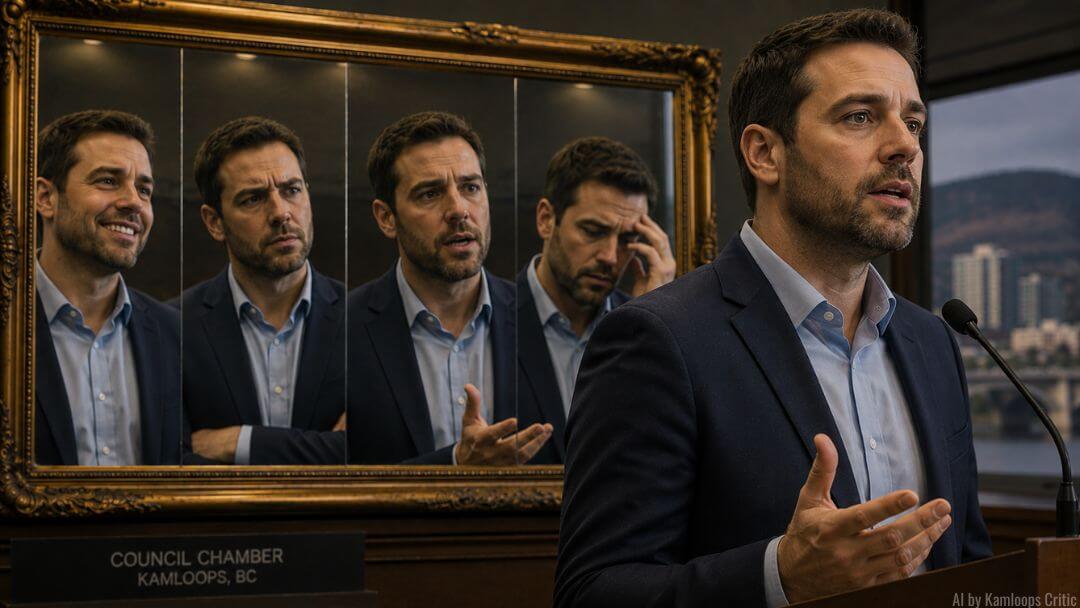
I've seen a word showing up occasionally when people talk about City of Kamloops Councillor Katie Neustaeter.
Narcissist.
In a recent Facebook comment, someone wrote, "She's a narcissist though." Another person suggested that narcissists are never embarrassed because they think they're always right. Those are pretty strong things to say about a councillor (or mayor).
So is Katie Neustaeter a narcissist? I have no idea. Sure, I've seen the occasional "Are You A Narcissist?", or "Are You Dating A Narcissist?" heading in Google's Discovery, but I immediately think "of course not", and scroll on by.
I'm not qualified to diagnose her, or anyone else. But the word got me wondering what people actually mean when they call a politician a narcissist. And maybe even more importantly, does it really matter?
If a politician has some of the traits associated with narcissism, does that make them a bad councillor? Or could some of those same traits actually help someone become a successful politician?
I started looking into it, and found the question was a little more complicated than I expected.
What do we mean by "narcissist"?
"Narcissist" has become one of those words we use somewhat casually. We might call someone a narcissist because they're full of themselves, like being the centre of attention, don't seem to handle criticism well or never seem willing to admit they're wrong.
But that's different from having narcissistic personality disorder.
The American Psychiatric Association describes narcissistic personality disorder as a persistent pattern involving things such as grandiosity, a need for admiration and a lack of empathy. Having some narcissistic traits doesn't automatically mean someone has the disorder.
That makes a difference when we're talking about politicians. Someone can be confident without being narcissistic, and they can be ambitious, competitive, stubborn or even arrogant from time to time without having a personality disorder.
So when somebody calls a politician a narcissist, they're usually not making a clinical diagnosis. They're more likely saying, "I see behaviour that looks narcissistic to me."
Some of those traits aren't necessarily bad
Think about what it takes to run for City Council. You have to believe you can do the job, put your name forward, ask people to vote for you, stand up in public and defend your decisions. You probably need a reasonably thick skin, too.
Confidence isn't a bad thing in a councillor. Neither is ambition or having strong opinions.
Some research into narcissism and leadership has found that narcissistic traits can help people emerge as leaders, even though they don't necessarily make them better leaders. A 2015 meta-analysis found a positive relationship between narcissism and leadership emergence, but no overall relationship between narcissism and leadership effectiveness as judged by others.
Other research has pointed to a possible middle ground, where some narcissistic characteristics such as confidence, charisma and a strong vision may be useful, while more antagonistic traits can create problems.
So I'm not convinced that "narcissist equals bad politician" is a fair assumption. The concern is what happens when those traits start getting in the way of the job.
What happens when you're wrong?
Imagine two councillors who are both very confident. They have strong opinions and both believe they're usually right. Then someone brings them some information that challenges their position.
One listens, asks questions and eventually says, "I didn't consider that. I may have been wrong." The other dismisses the information, attacks the person bringing it forward or finds a reason why the evidence doesn't count.
Both might be confident people, and both might even have some narcissistic traits. But only one has shown the ability to reconsider. That's more important to me than whether we can label them.
A councillor doesn't have to agree with everyone or avoid arguments, and they don't have to be particularly humble. But I do want to know that they can recognize when they might be wrong.
So what about Katie Neustaeter?
I think we should look at some actual examples rather than try to decide what kind of person Neustaeter is.
One example is from February 2025. Neustaeter moved that the Mayor's Report be placed at the the bottom of the Council agenda for 607 days. The motion was approved, and I wrote about it afterwards in Katie Screws the Mayor Again.
When Mayor Reid Hamer-Jackson questioned why that number had been chosen, Neustaeter's response was that it "seemed like a good number."
What I find interesting is the question of how much explanation elected officials give for their decisions. If a councillor makes an unusual decision and someone asks why, I think voters are entitled to hear the reasoning behind it.
That's not a narcissism test; it's a judgment test.
Then there's the lawsuit
The lawsuit between the Mayor and Neustaeter gives us a bigger example.
In a recent Facebook exchange, Neustaeter wrote:
"I don't control who files frivolous lawsuits against me. The judge made it clear the case had no merit before it even went to trial and awarded costs against the mayor."
That wasn't how I recalled the judgment, so I read it again. Justice Jacqueline Hughes dismissed the Mayor's claim under BC's Protection of Public Participation Act, or PPPA. But the judgment doesn't say that the underlying claim had no merit.
In fact, paragraph 54 says that it was undisputed that the underlying claim had substantial merit for the purposes of the PPPA application. Paragraphs 80 to 83 explain that the plaintiff had to establish grounds to believe the claim had substantial merit and that this threshold was met.
That doesn't mean the Mayor won the lawsuit. The judge found that Neustaeter had a valid defence of qualified privilege and that the Mayor had not established grounds to believe she had no valid defence. Justice Hughes therefore dismissed the action under the PPPA.
There's another issue with Neustaeter's Facebook statement. The judgment didn't award costs against the Mayor. It says Neustaeter had claimed damages and costs and that those issues would be dealt with later.
So the written judgment doesn't support the statement that the judge found the case had no merit or awarded costs against the Mayor.
I've written about this before. In Free Speech Won. That's Not the Whole Story, I looked at the way the decision was being described publicly and why the anti-SLAPP dismissal didn't mean the statements had been found to be harmless or true. In Protected Speech Is Not Vindication, I looked at Neustaeter's description of the decision as vindication.
Neustaeter was certainly entitled to be pleased with the result. The court found that her statements were protected by qualified privilege and that the action should be dismissed. The judge also found that the public statement concerned a matter of public interest and that Neustaeter's expression was protected under the PPPA.
But "vindicated" goes further than that. It suggests that the court had established that she was right about the underlying dispute. It didn't.
Hamer-Jackson does it too
It would be easy to put together a list of things Neustaeter has said or done and use them to argue that she has narcissistic tendencies, but the same is true with the Mayor.
In May 2024, former Kamloops mayor Mel Rothenburger wrote about the Mayor's continuing efforts to address an allegation that he had threatened to fire then-CAO David Trawin.
Rothenburger wrote that the issue was important to the Mayor because "he strongly believes that if the truth came out he would be vindicated" on the allegation. The Mayor wanted to put a text message from Trawin on the public record because he believed it cleared him.
There's nothing wrong with wanting to clear your name if you believe you've been falsely accused. But the similarity is interesting: Neustaeter said she had been vindicated by the court, while the Mayor believed that if the truth came out, he would be vindicated. Both were trying to establish that their own version of a disputed event was correct.
When the judgment came out in January 2026, the Mayor told CFJC Today that he was in disbelief. He also acknowledged that he had not yet read the entire 43-page decision and had only looked at the conclusion.
A few months later, during the hearing over costs, the Mayor told Justice Hughes that she had found his claim had substantial merit. She corrected him.
According to CFJC Today, Hughes explained that Neustaeter's lawyer had conceded the merit issue for the purpose of the PPPA application. It was not an admission by the court that the underlying claim had substantial merit. Castanet reported the exchange similarly, including Hughes telling the Mayor, "That's not an admission by the court."
I don't think this makes the Mayor a narcissist. He was representing himself, and the distinction is a fairly technical legal one. It's entirely possible he simply misunderstood what the judge had decided.
What we can say is that he interpreted the judgment in a way that supported his understanding of the dispute, and the judge corrected that interpretation. If we treat that behaviour as evidence of narcissism when Neustaeter does it, we'd have to apply the same standard when the Mayor does it.
Maybe we're seeing something less dramatic than narcissism. Maybe we're seeing something much more ordinary: politicians, like the rest of us, are particularly good at finding the parts of a complicated situation that support the story we already believe.
What about conflicts of interest?
I've questioned Neustaeter's participation in Council decisions involving conflicts of interest, including Council's decision to remove the public's ability to submit Code of Conduct complaints while there was an active complaint involving her. I wrote about some of those concerns in City Council Emails Ignored.
What interests me here is how an elected official responds when someone suggests that their own behaviour may create a conflict. Do they engage with the concern? Do they explain why they believe there isn't a conflict? Do they acknowledge that there might at least be an appearance of one?
Or does the response focus more on the person raising the concern? In this case, I was the person raising some of these concerns, so I'm not pretending to be an outside observer. That doesn't change what the underlying documents say, but it is something readers should know when considering my interpretation.
We saw a similar situation in the Mayor's case, where he was found to have had a non-pecuniary conflict of interest when voting on a temporary use permit. I wrote about that in Shame on Bass.
In that case, despite repeated objections by staff and councillors, the Mayor refused to recuse himself. The Mayor has continued to dispute the results of the Code of Conduct complaint's findings.
My point here is that both have faced questions about potential conflicts of interest and neither accepted the criticism at face value. They each defended their position rather than simply accepting that the criticism might have been justified.
In the Mayor's case, I've also started to question whether I agree with the investigator's finding.
Then there was Kathrine Wunderlich
Another example came during a November 2024 Council meeting when Kathrine Wunderlich raised concerns about whether Neustaeter might have a conflict of interest involving an extension of a temporary use permit. I wrote about that incident in Candidate Profile: Katie Neustaeter — An Open Book?.
Neustaeter said she had obtained independent legal advice and had made sure she wasn't conflicted. She also objected to what she referred to as political persecution and later described public inquiries as "tremendously challenging" and some as "stunts."
It isn't necessarily narcissistic to be defending yourself. If someone questions your judgment, you should be able to explain why you think they're wrong.
What I find more interesting is how the response is handled. When someone raises an uncomfortable question about your judgment, do you mainly answer the question, or do you spend more time explaining why the person asking it is wrong to ask?
Is narcissism more of a male thing?
When I picture a narcissist, I've typically pictured a man. The loud, boastful, self-important guy who thinks he's the smartest person in the room and expects everyone else to know it.
There is some evidence behind that association. A 2015 meta-analysis found that men scored somewhat higher than women on measures of narcissism. The differences were particularly noticeable in areas such as entitlement and leadership or authority.
That doesn't mean narcissism is a male condition, but it did make me wonder whether we interpret the same behaviour differently depending on who's doing it.
A confident man can be seen as strong, while a confident woman can be seen as arrogant. A man who refuses to back down can be called determined, while a woman doing the same thing can be called difficult.
I'm not saying that explains the criticism of Neustaeter. Some of the criticism may be justified, but I think it's worth being aware that the label we choose can be influenced by our own expectations too.
And then there's Donald Trump
If we're looking for an example of how narcissistic traits and political success can coexist, it's pretty hard to avoid Donald Trump.
Whatever you think of Trump, he has demonstrated an ability to maintain a very loyal political following despite behaviour that many people find objectionable. I've often wondered: "Why?"
I don't think the answer is simply that millions of people have been fooled by a narcissist. People don't evaluate politicians in a vacuum. They look at them through their own experiences, beliefs and values, and they also decide which sources they trust.
Confidence can look like arrogance to one person and strength to another. Refusing to back down can look like stubbornness or courage. Even attacking political opponents can look nasty to one person and like evidence that the politician is willing to fight for supporters to another.
Self-promotion can look like vanity or confidence. The behaviour may be the same, but the interpretation isn't.
That's worth remembering when we look at municipal politics too. It might make us think twice before asking how anyone could possibly continue supporting a particular candidate when the evidence seems overwhelming from our perspective.
So what actually makes a good councillor?
Suppose a councillor really does have some narcissistic traits. Does that automatically make them a bad councillor? I don't think so.
I'd be more interested in whether those traits interfere with the job. Can they listen, change their mind, admit a mistake, and give somebody else credit?
Can they disagree without turning every disagreement into a personal battle? Can they compromise when compromise is necessary? And can they stand their ground when compromise would mean abandoning something they genuinely believe is important?
And even more challenging, can they tell the difference between protecting their own reputation and protecting the public interest?
Those seem like much more useful questions for voters. A councillor doesn't need to be perfect or humble every minute of every day. They can have a big ego, be ambitious, enjoy attention and be competitive.
I'd rather have a councillor who is confident enough to make a difficult decision than someone who is so worried about being disliked that they never make one. I also want that confident councillor to be able to say, "I was wrong."
So, is Katie Neustaeter a narcissist?
I don't know, and I doubt most of the people using the word on social media know.
A clinical diagnosis requires considerably more information than watching someone at Council meetings, reading their social media posts and following their political career. I'm not sure we need a diagnosis anyway.
We can watch what a politician actually does. We can look at how they respond when someone challenges them, whether they acknowledge mistakes and whether their public statements accurately describe the evidence available to them.
We can also look at how they treat people who disagree with them and whether they seem more interested in defending their own position or finding the best answer.
Those questions apply not only to Katie Neustaeter, but also to Reid Hamer-Jackson, the other councillors sitting around the Council table and every candidate asking Kamloops residents for their vote this October.
So maybe "Is Katie Neustaeter a narcissist?" isn't really the question we should be asking. A better question might be what happens when a politician's ego runs into evidence that doesn't support their position.
A councillor doesn't have to be free of ego, endlessly agreeable or perfect. They do need judgment, and they need to be able to listen, reconsider and work with people they disagree with.
When the evidence shows that they got something wrong, they also need to be able to say so.
I suspect every person sitting around the Kamloops council table has characteristics that could be strengths in one situation and weaknesses in another. The important thing isn't whether someone has an ego. It's whether they can keep that ego from getting in the way of doing the job they were elected to do.
Food for thought
I'm glad I decided to look into this rather than simply dismissing the word "narcissist" as an insult.
It's given me a better appreciation of why arguments that seem compelling to one person can have very little effect on someone who sees the same politician very differently.
Maybe we can accept that some of the harsh comments we see on social media are not going to change people's minds, and may only serve to insult someone we might otherwise be able to have a reasonable conversation with.
We've all heard the phrase, "You can lead a horse to water." My favourite expression when it comes to differences of opinion is probably this one: "A person convinced against their will is of the same opinion still."

Municipal Election 2026
October 17, 2026
It's important for all of us to get out there and vote. Please remember to only vote for candidates you truly believe are deserving of a seat at the council table. If that's only one or two of them, that's the only ones you should vote for.
Editorial Disclosure: I've written extensively about Katie Neustaeter, Mayor Reid Hamer-Jackson and the disagreements that have taken place between them during this Council term. Some of my previous articles have been critical of Neustaeter, and I have also expressed my own views about the Mayor, Council and the way local media have covered municipal politics.
I've also personally raised some of the concerns discussed in this article, including questions about conflicts of interest and the Code of Conduct complaint process. In Neustaeter's case, I have submitted a complaint to the Ombudsperson's office at her suggestion. I'm therefore not approaching this as a completely detached observer.
The purpose of this article isn't to diagnose Neustaeter or convince readers that she is a narcissist. The question came from comments I've seen on Facebook, but the more I looked into it, the more I thought there was a broader question worth asking about personality, ego and political leadership.
I've tried to separate documented facts from my own interpretation and provide links to the source material wherever possible. Where I haven't been able to establish something conclusively, I've tried to say so.
Readers don't have to agree with my interpretation. I'd encourage them to look at the source material and make up their own minds.

I will NEVER VOTE FOR KATIE NEUSTAETER …. THERE ARE BETTER PEOPLE OUT THERE THAN HER…..
I voted for Neustaeter, but not so she could harass the mayor at every turn. If you can’t find ways to be co-operative instead of confrontational, City council is not for you. I won’t vote for her again.
I agree whole heartedly with Denise. We have had way, way, way too much of Katie.