
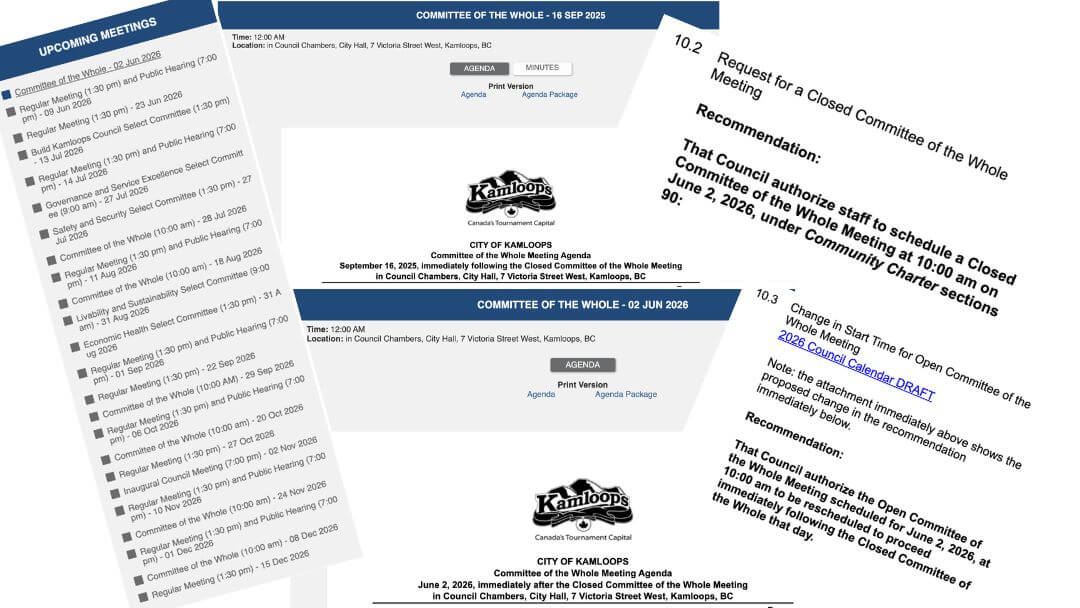
Kamloops residents planning to attend the June 2 Committee of the Whole meeting may be wondering when it will begin.
The better question may be why Council keeps changing Committee of the Whole meetings in the first place.
Over the past year, Council has repeatedly scheduled closed Committee of the Whole meetings during time slots that were already reserved for public Committee of the Whole meetings. Sometimes the public meeting is moved to a new start time. Other times, residents are simply told the meeting will begin once the closed meeting concludes.
The June 2 meeting is only the latest example of a pattern that raises questions about transparency, predictability, and respect for the public's time.
A Meeting Without a Meaningful Start Time
Committee of the Whole meetings are scheduled months in advance through Council's annual calendar. Throughout 2026, those meetings were generally scheduled for 10:00 a.m.
Residents who wish to attend public meetings have every reason to rely on those published times. They may arrange their work schedules, move appointments, arrange childcare, or simply block time in their calendars.
On May 26, Council voted to schedule a Closed Committee of the Whole meeting at 10:00 a.m. on June 2. Council also voted to move the public Committee of the Whole meeting to begin immediately following the closed session.
That decision creates an obvious problem.
Nobody outside the closed meeting knows how long it will last.
The meeting could begin at 10:30 a.m. It could begin at noon. It could begin later.
The City's CivicWeb meeting page currently displays a meeting time of 12:00 a.m., while the agenda itself states that the meeting will begin immediately following the Closed Committee of the Whole meeting. Neither provides residents with a practical answer to a simple question: when should they arrive?
The uncertainty affects more than members of the public who simply wish to observe.
The June 2 agenda includes presentations from BDO Canada and Turnbull Construction Project Managers. Those delegations are expected to attend and present to Council despite having no way of knowing exactly when the meeting will begin.
A Growing Pattern
The June 2 meeting is not an isolated example.
In September 2025, Council approved a calendar update that resulted in a Committee of the Whole meeting beginning immediately following a Closed Committee of the Whole meeting. The City's meeting page similarly displayed a meaningless 12:00 a.m. time while the agenda stated the meeting would begin after the closed session.
Since then, Council has repeatedly approved changes to Committee of the Whole schedules when closed meetings were added to the calendar.
In October 2025, November 2025, January 2026, March 2026, and April 2026, public Committee of the Whole meetings were rescheduled after closed meetings were added to the same day.
In most of those cases, Council at least provided a specific revised start time, often 1:30 p.m.
Residents may not have appreciated the changes, but they knew when the meetings would begin.
The June 2 meeting marks a return to the less predictable approach used in September 2025.
Advertisement

Why Create the Conflict at All?
The larger question is not why a meeting was moved.
The larger question is why these scheduling conflicts keep occurring.
Closed meetings are permitted under the Community Charter for matters such as legal advice, labour relations, land negotiations, and other sensitive topics. There is nothing unusual about Council holding closed meetings when circumstances require them.
What is less clear is why those meetings are repeatedly being scheduled during time slots that were already allocated to public meetings.
If a public Committee of the Whole meeting is already scheduled for 10:00 a.m., why schedule a closed Committee of the Whole meeting at 10:00 a.m. as well?
Why not begin the closed meeting earlier in the morning?
Why not hold it after the public meeting?
Why is the public meeting routinely expected to move while the closed meeting retains priority?
Council has never publicly explained the rationale.
The Cost of Unanswered Questions
The absence of any explanation leaves residents to draw their own conclusions.
Some residents point to the continued practice of providing catered lunches to Council and senior management on days when meetings extend through the lunch hour. Despite public criticism and a motion from Mayor Reid Hamer-Jackson seeking to end taxpayer-funded lunches, the practice continues.
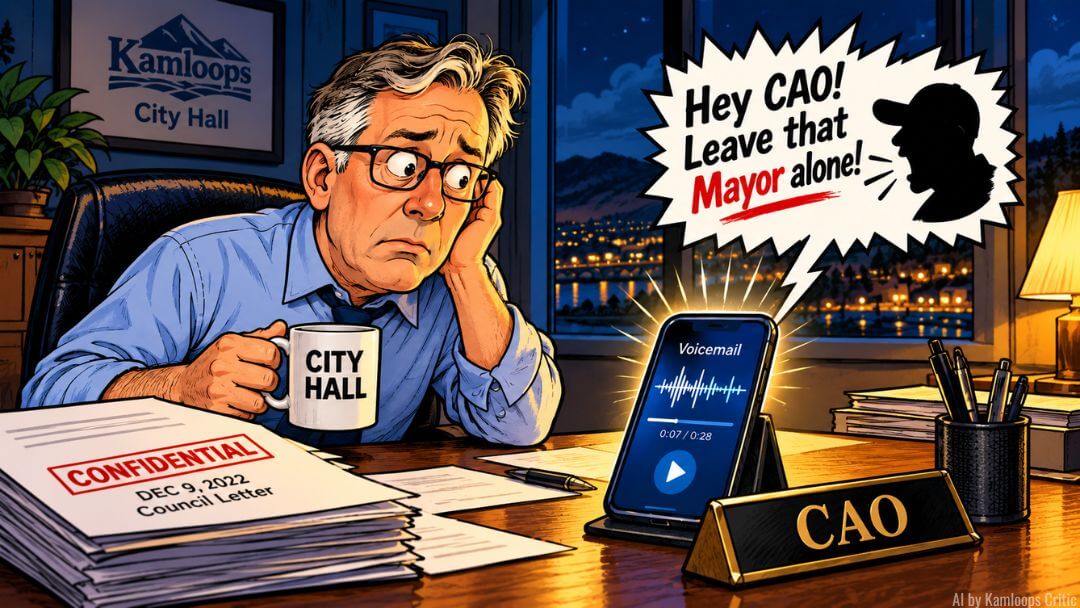
Others recall the agenda review meetings that previously occurred with quorum present before concerns were raised regarding open meeting requirements. Those meetings were eventually replaced by so-called Byron/Council Coffee Meetings.
There is no evidence that the June 2 closed meeting is being used for agenda review purposes, nor is there evidence that catered lunches are driving scheduling decisions.
The problem is that Council has provided no public explanation for the repeated scheduling conflicts.
When governments make decisions that affect public participation without explaining why, residents inevitably begin filling the information vacuum with their own theories.
Most of that speculation could be avoided through greater transparency.
Public Participation Should Not Be an Afterthought
City Hall regularly speaks about public engagement, transparency, and community participation.
Those goals begin with something much simpler than surveys, engagement campaigns, or consultation exercises.
They begin with respecting the public's time.
Residents should not need to attend every Regular Council meeting, monitor last-minute calendar changes, or guess how long a closed meeting will last in order to know when a public meeting begins.
The City has demonstrated that it can provide certainty when scheduling conflicts arise. On multiple occasions over the past year, Committee of the Whole meetings affected by closed meetings were assigned specific revised start times.
The June 2 meeting shows that certainty is a choice.
At a minimum, residents deserve an explanation for why public meetings are repeatedly being scheduled around closed meetings rather than the other way around.
0 Comments