

A simple question about access to a restricted area of Kamloops City Hall has turned into a second defamation lawsuit between Mayor Reid Hamer-Jackson and Councillor Katie Neustaeter.
At the centre of the case is one basic issue: When does “observing” become “spying”? It may sound like a small difference, but In court, it isn’t.
Almost two years ago, the Mayor saw Neustaeter exit an area which was restricted to council members. Later that evening he sent an email requesting clarification on the restricted area's access.
Somehow that simple inquiry rapidly escalated into claims of him spying, monitoring bathroom usage, and engaging in creepy behaviour. In response, the Mayor filed a second defamation lawsuit against Neustaeter alleging her statements falsely portray him as someone who watches or tracks women using the washroom.
What Was Actually Said
Prior to these events, Director of Civic Operations Jen Fretz had provided Council with guidance on access to City Hall. and indicated that any questions or concerns could be sent to her.
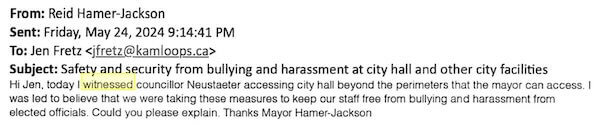
The Mayor sent the following email to Fretz
Fretz replied, cc'ing Council and CAO Byron McCorkell
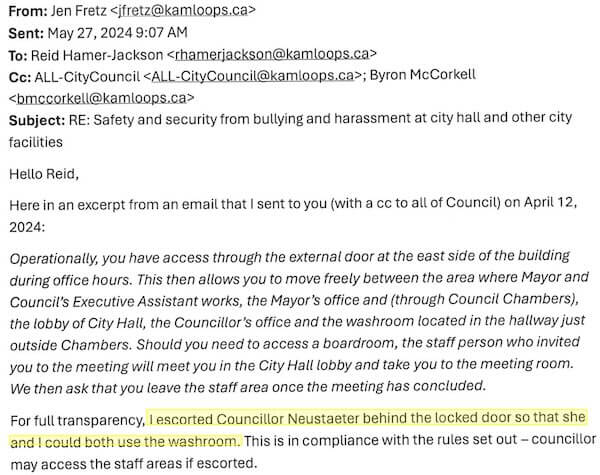
In this initial exchange, we see the Mayor used the word "witnessed", and Fretz was the first to mention the washroom. At that point, the question was asked and answered.
Escalation
Neustaeter replied later that same day
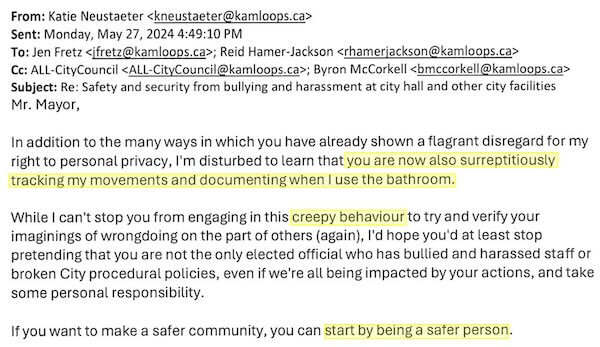
Although the Mayor's question was asked and answered, Neustaeter responded with allegations of "surreptitiosly tracking", documenting bathroom usage, "creepy behaviour", and being an unsafe person.
Clarification
The Mayor asked Fretz why she included Council on the email exchange
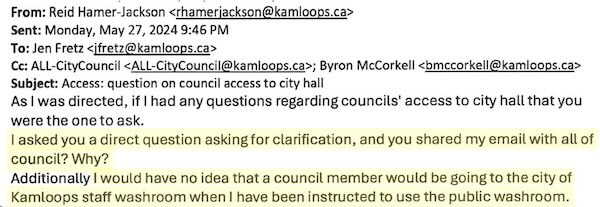
The following day, Fretz replied
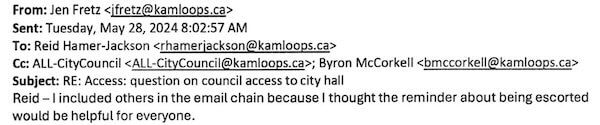
The Mayor then replied
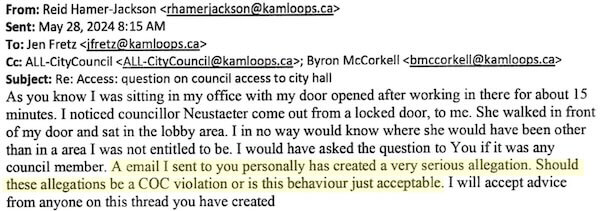
In his reply, the Mayor points out the seriousness of Neustaeter's allegations and questions whether there should be a Code of Conduct complaint against her.
Further Escalation
The next day, Neustaeter replies again
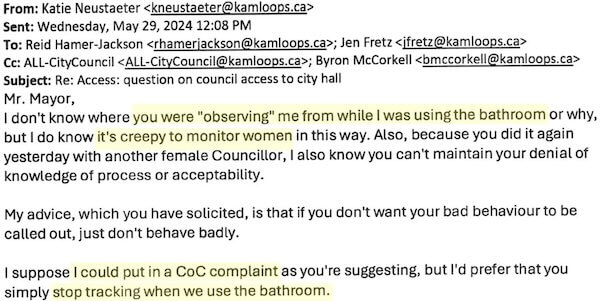
It's at this point the word "observing" is introduced. Neustaeter also indicates that she could submit a Code of Conduct complaint against the Mayor, which is not what the Mayor had suggested.
Neustaeter elaborates on her reference to "another female Councillor" in her Response to the Mayor's Notice of Civil Claim:
On May 28 2024, the plaintiff made verbal inquiries with Christine Cossentine, the Executive Assistant to Mayor and Council of the City of Kamloops, regarding his observing City Councillor Margot Middleton being given access to a locked area of City Hall by City staff. The plaintiff was specifically advised by Christine Cossentine that Councillor Middleton had likewise been given access to a locked area of City Hall with an escort for the purpose of using the washroom.
According to Neustaeter, we again see no mention of the Mayor referencing a washroom. Rather, it is the Executive Assistant who mentions it.
Visibility
During Neustaeter's application to dismiss the Mayor's first defamation claim against her, she submitted to a cross-examination on August 25, 2025. While under cross-examination, she agreed the washroom inside the restricted area wasn't visible from the Mayor’s office.
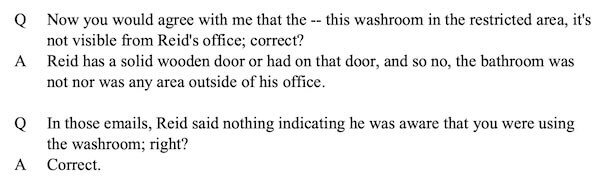
The Mayor saw Neustaeter exit a restricted area. He asked why. Staff replied Neustaeter had used the washroom. She then accused him of monitoring women in the bathroom.
We are left wondering how Neustaeter translated the Mayor witnessing her exit from a locked area into the Mayor monitoring her usage of a washroom. Those are very different things.
Professional Communicator
The Mayor has described Neustaeter as a "professional communicator" in his claim

On the other hand, Neustaeter denies this in her response to the claim, admitting only to being a councillor


To resolve this disagreement, we can look to Neustaeter's LinkedIn profile, which appears to support the Mayor's statement
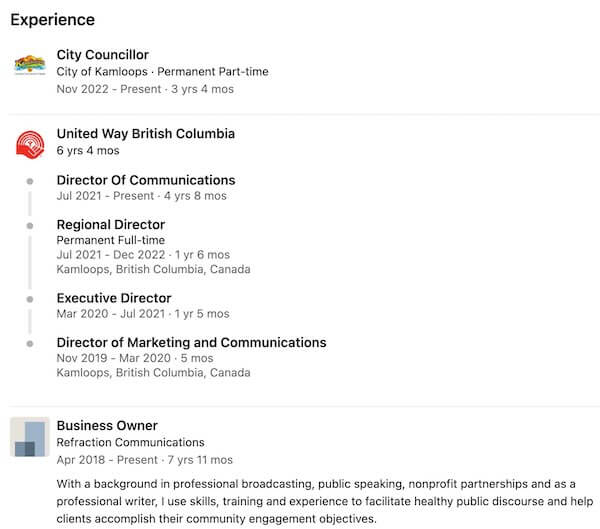
It appears that the Mayor is correct, and according to Neustaeter herself, she is Director of Communications at United Way BC, owner of Refraction Communications, and a professional writer.
We can also look at Neustaeter's bio on one of her "REFRACTION" articles she has written

Neustaeter background as a professional writer and communications consultant matters because this case is entirely about language.
Words Chosen, Not Words Slipped
During her cross-examination, Neustaeter portrayed the Mayor as spying on her
I believe there was a circumstance under which Reid was apparently spying on me while I was in City Hall using the bathroom.
She testified that, to her, observing someone without their knowledge is the same as spying
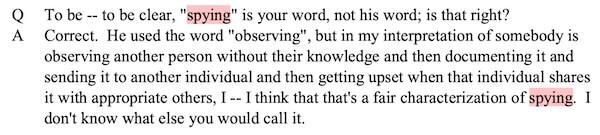
She also testified that “spying” was simply a synonym for “observing”. For many readers, those words do not carry the same meaning.
He sent that email saying that he was observing us. And what we were doing when he was observing us was using the bathroom. So while I use the word "spying" as, you know, just a synonym for what he describes, that -- that's what was happening.
It may seem insignificant, but the Mayor actually used the word "witnessed" as opposed to "observing". There is a bit of nuance between the words in that observing is considered a little more formal and can suggest a more careful scrutiny than witnessed. On the other hand, the Mayor could have just as easily used the word "observed" to indicate he "saw" something.
Neustaeter is described in the court pleadings as a professional communicator. Language is her profession.
The phrases “spying,” “tracking,” and “monitor women in this way” are not neutral. They carry strong implications. Observing someone exit a secured area is not the same as secretly surveilling women in a washroom.
The court will decide what a reasonable reader would understand from the words Neustaeter chose. When the dispute is about wording, the precision of those words matters.
After‑Hours Email and Gender Insinuation
Neustaeter has also pointed to two additional factors to bolster the appearance of impropriety. The Mayor’s email was sent after hours, and the recipient of the email was a female staff member. Neither withstands scrutiny.
During cross-examination, Neustaeter stated
Reid sent a late night email to a female member of staff saying that he observed us while we were using the bathroom.
and also
So when a member of staff receives a late email that says "I was spying on you and Councillor Neustaeter", yes, that is unsettling both for her -- and then when I found out, for me as well.
City business does not cease at 4:30 pm. And the director responsible for a restricted area does not become the wrong person to contact because of her gender. Suggesting otherwise cheapens a serious issue and distracts from the actual facts.
The Anti-SLAPP Strategy
This isn't the first time these two have been in court.
When the Mayor filed his first defamation claim, Neustaeter successfully relied on the Protection of Public Participation Act — commonly referred to as anti-SLAPP legislation, by filing an application to have the case dismissed. Whether that strategy will succeed again is far from certain.
Radio NL reported the court had “tossed” the lawsuit. The judgment itself was more careful. The court accepted the claim met the basic legal test for defamation but dismissed it because political speech is strongly protected and the harm shown didn't outweigh that protection.
That doesn't automatically mean every future statement is protected. Each case depends on the specific words used and the context in which they were said.
Will Anti-SLAPP Work Again?
Anti-SLAPP laws are designed to protect people from participating in, or being silenced, for speaking on matters of public interest. They exist to prevent powerful actors from crushing critics through expensive litigation. They aren't intended to immunize demonstrably false statements of fact that cause serious reputational harm.
Anti-SLAPP doesn't determine who is right. It determines whether a case should proceed. If an anti-SLAPP application succeeds, the dispute may never be tested through a full evidentiary hearing. That’s why the distinction between protected opinion and disputed fact matters.
Anti-SLAPP's purpose is important. But the question here is narrower. This case hinges less on opinion and more on whether an objectively implausible allegation was presented as truth. It involves more direct and specific language. Whether that makes a difference remains to be seen.
If someone accuses another person of stalking or monitoring women in washrooms — and the physical record shows the washroom was not visible, and the original email did not mention it — is that protected public participation? Or is that a factual allegation that should be tested in court?
If as expected, Neustaeter does file another anti-SLAPP application, the court will ask:
- Were the statements about a matter of public interest?
- Does the claim have legal merit?
- Is there a valid defence?
- Does the alleged harm outweigh the importance of protecting political speech?
If a court concludes that equating a brief observation with “spying on bathroom visits” crosses the line into reckless or malicious expression, anti‑SLAPP protections may not apply.
Harm: Reputation in an Election Year
This lawsuit unfolds in a different context than the first one. Accusing a sitting mayor of “spying,” “tracking,” and “monitoring women in the bathroom” is not routine political criticism. Those phrases suggest secretive and inappropriate conduct. Once they appear in pleadings and media headlines, they become part of the public record.
The Mayor is running for re-election in October 2026. Elections aren't decided by transcripts. They are influenced by impressions. Allegations implying inappropriate behaviour toward women carry weight whether or not they are ultimately proven in court.
Reputation in politics is cumulative. A phrase repeated often enough can outlive any later clarification. Even a successful legal outcome can't fully rewind public perception.
At the same time, there's been public speculation about who may seek the mayor’s chair in 2026, including suggestions that Neustaeter could enter the race. No formal campaign has been announced. Still, when political rivals are involved, reputational disputes take on added significance.
None of this predetermines the court’s decision. The court will weigh evidence and apply the law. It'll ask whether the alleged defamatory meaning caused serious harm and whether that harm outweighs the protection given to political expression.
Outside the courtroom, however, harm is not theoretical. When allegations of spying on women in a bathroom enter public discourse during an election cycle, the reputational impact is immediate and potentially lasting.
Whether that impact meets the legal definition of defamation is for the court to decide. Whether it shapes voter perception is for the public to consider.
The Indemnification Question
There is another layer to this story that deserves attention.
As with the first case, Council again voted to indemnify Neustaeter. Many of the councillors who voted on that indemnification were copied on the original email chain. Some may be called as witnesses in the litigation.
Taxpayers are now funding one side of a dispute in which elected officials themselves may testify. That deserves transparency and explanation.
Was there a clear legal analysis before Council voted to cover those costs? Were potential conflicts of interest discussed? Residents have not seen that analysis.
Being a potential witness does not automatically create a legal conflict of interest. Under BC municipal law, the classic disqualifying conflict involves a direct financial interest. But governance is not only about technical legality. It is also about public confidence.
When councillors who are participants in the underlying events vote to fund one side of the dispute, reasonable people may ask whether that creates at least the appearance of bias. This isn't a claim of illegality, but a question about optics and accountability.
If Council determined that Neustaeter’s emails were within the scope of her duties and therefore indemnifiable, the public may reasonably ask whether Council feels it is also her duty to make these allegations against the Mayor.
Why This Case Matters
The Mayor says he witnessed a councillor exiting a restricted area and asked why. Councillor Neustaeter says that amounts to spying on women in the bathroom. Under cross-examination, she agreed the washroom wasn’t visible, that he never mentioned it, and that “spying” was her word. The rest is interpretation.
The court will decide whether that shift from observation to surveillance is protected political speech or a defamatory allegation. Council has already decided taxpayers will fund the defence.
Residents are left to decide whether this level of rhetorical escalation reflects healthy democratic accountability — or a breakdown in how elected officials speak about one another.
Words matter in politics. They matter even more in court.
Anti-SLAPP legislation plays an important role in protecting free expression. It prevents lawsuits from being used as weapons to silence criticism. But it was never designed to eliminate scrutiny of factual disputes before they are examined.
If anti-SLAPP is used properly, it protects democratic debate. If it is used to prevent uncomfortable factual examination, that's something else entirely. Kamloops residents should be paying attention to which it is.
Editorial Comment
Municipal politics isn't meant to be gentle. Disagreement is healthy, scrutiny is necessary, and elected officials should challenge one another, sometimes forcefully. But words are not weightless.
When criticism shifts from “I disagree with your conduct” to “you are spying on women in a bathroom,” the consequences are no longer confined to a council chamber. They enter the public record, shape reputations, and they influence elections.
Courts exist to draw lines, not to referee personality conflicts.
If the standard for political accountability becomes the use of the most damaging possible language that can later be defended as “interpretation,” then the cost will not be paid only by the individuals involved. It will be paid by public trust.
Kamloops deserves vigorous debate. It also deserves precision, fairness, and restraint from those entrusted with public office.
The difference between “observed” and “spied” may seem small, but in public life, it's not.
Questions?
Me too. You can send your questions to citycouncil@kamloops.ca, where they may or may not be ignored. If you do get answers, you are welcome to share them in the comments below.
Editorial Disclosure: This article is based on publicly filed court documents, sworn affidavits, and cross-examination transcripts. The litigation discussed remains before the courts, and no findings have been made in the second defamation action at the time of publication. Readers are encouraged to review the primary source documents where possible and to form their own conclusions.

Dear Kamloops Critic,
Perhaps it is time to bring “religion” into the fray as far as Katie is concerned. She brought the subject of her Christian faith life into her profile when she ran for council. Since she used it first, I think that the subject of her Christian faith is fair game.
Here’s a link to her profile as it appeared on CFJC: https://cfjctoday.com/2022/09/20/candidate-profile-katie-neustaeter
> made mention of Sunnybrae Bible Camp
> made mention of Kamloops Alliance Church
Here’s a link to a Facebook page for Kamloops Alliance Church: https://www.facebook.com/KamloopsAlliance/photos/a.2181315155252756/5280799405304300/
> Katie is seen with eyes closed, raising her hand while singing into the microphone. Does this depict her as being part of the Praise and Worship Team?
If so, it is usual for someone to be considered one of the “selected or chosen” members in the scheme of church hierarchy. People who are providing musical leadership generally are expected to have a mature spiritual life and therefore can hold a position of authority to lead others by example.
>> I certainly hope that Katie remembers the Ten Commandments, especially the commandment which outlines that we are NOT to bear false witness against our neighbour. Please refer to Exodus chapter 20 verse 16: “Thou shalt not bear false witness against thy neighbour” (King James Version.)
Katie brought her Christian faith into the discussion in her candidate profile when she ran for office in 2022. If she is still a member of a church that teaches the Ten Commandments, I certainly hope that her speech is accurate and truthful when it comes to declaring actions such as the Mayor watching her when she goes to the ladies’ bathroom. If not, then might I suggest that Katie takes into consideration her manner of speech and her place of leadership within her church?
What do others think, Kamloops Critic?
When I was a young boy in Kamloops (attending one of the North Shore Elementary Schools -off Windsor Ave.), there was another boy whose father (or someone close to him) had stated, that, years back, the Indian Band across the North Thompson was said to have set a known vexation or of a curse on the Kamloops population (white settlement); set in place from years, forward, from around the time of the Overlanders, forwarded, again so to speak…to destabilize all the people and their endeavors. Well I guess until this day and can/could be seen commencing in these fracas meetings admidst the City Hall, etc. -a raging contracdiction to proper order and government. “He whom laughs last laughs the longest.”
Thank you so much for this article. It pinpoints the exact word spin that I feel has been highly used by our City Council against Mayor RHJ. We have more than one former media person on council and that is a concern. They have all been sidekicked by our local media and that is why you hear more bad than good from the media when it comes to RHJ. KN does have a great deal of experience in word choices and her accusations need to be challenged in court. So far the allegations haven’t been seen by the courts as serious enough to punish but this time, I think KN has crossed the line. This is what the Mayor has had to endure his entire term. He has been treated so disrespectfully this entire term.