
When residents have concerns about taxes, development, policing, homelessness policy, or major capital projects, the advice is almost always the same: email City Council.
In Kamloops, residents are routinely directed to send those concerns to citycouncil@kamloops.ca, the shared inbox used for correspondence with elected officials.
The message is clear enough. If you want your voice heard, send an email.
Yet an internal email from Councillor Margot Middleton suggests that once those emails arrive, they may face a second test — whether they meet a councillor’s personal threshold for being “worthy of response.”
Emailing Kamloops City Council
Emails sent to citycouncil@kamloops.ca are distributed to all members of Council. According to councillors in the thread, however, the Deputy Mayor is responsible for coordinating responses to that shared inbox.
An internal Council email discussion from April 2023 offers a glimpse into how those messages may sometimes be handled.
The Email That Sparked the Discussion
Document: Internal email sent April 12, 2023 to City Council’s ALL-CityCouncil distribution list.
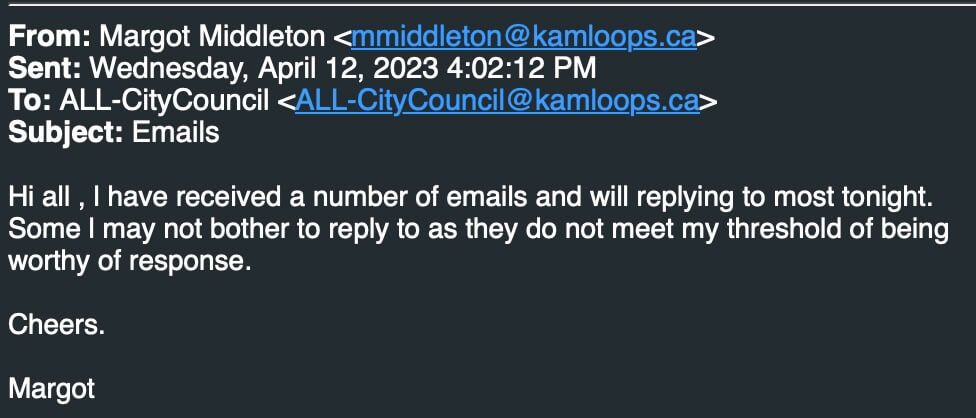
In the message, Councillor and then Deputy Mayor Margot Middleton wrote:
“Hi all, I have received a number of emails and will be replying to most tonight. Some I may not bother to reply to as they do not meet my threshold of being worthy of response.”
The email prompted a short internal discussion among councillors about how resident correspondence should be handled.
Different Approaches to Resident Emails
Councillors Bill Sarai and Kelly Hall briefly supported Middleton’s approach.
Mayor Reid Hamer-Jackson suggested that messages receiving no reply could be forwarded to him so he could attempt to engage with the sender. He wrote that offering to meet with residents can sometimes change the tone of difficult conversations.
The exchange also revealed differing views among councillors about how to handle difficult correspondence, with some supporting the Deputy Mayor’s discretion over whether to reply and the Mayor encouraging engagement with residents whenever possible.
Responding “On Behalf of Council”
Other comments in the thread shed light on how Council responses may be coordinated.
“As council we have decided that deputy mayor has the wherewithal to determine the appropriate response on behalf of council.”
— Councillor Nancy Bepple, internal Council email, April 13, 2023
In the same exchange, Councillor Dale Bass referred to what she described as the “established practice” for handling emails, writing that councillors can respond after the Deputy Mayor replies.
Taken together, the comments offer a rare glimpse into how correspondence sent to citycouncil@kamloops.ca may be managed internally.
What Residents Might Reasonably Expect
Residents sending messages to that address would reasonably assume they are contacting Council collectively.
The discussion suggests that while all councillors receive the emails, the decision about how — or whether — a response is provided may be coordinated by the Deputy Mayor.
“I support Margot (or any DM) to make the decision on how and when (or not) to respond. ”
— Councillor Nancy Bepple, internal Council email, April 13, 2023
Councillors are not required to respond to every message they receive, particularly when correspondence becomes repetitive or hostile.
Still, the language used in the thread highlights a tension between the public invitation to contact council and the internal discretion involved in responding.
A Threshold Residents Can’t See
The April 12 email does not explain how that threshold is defined.
It does not indicate whether the standard relates to tone, relevance, repetition, or disagreement. Nor does it specify whether the threshold applies only to abusive messages—something most public officials would consider reasonable—or to ordinary expressions of criticism.
The absence of definition leaves residents with a simple reality: they have no way of knowing whether their message will be deemed worthy of acknowledgement.
That uncertainty sits awkwardly beside the repeated public encouragement to contact Council directly.
Citizens are directed to email Council. But once they do, the response may depend on an internal standard that exists only in the mind of the recipient.
A Broader Transparency Question
The exchange also raises broader questions about how communications between residents and Council are managed.
How those processes work — and how clearly they are understood by the public — may shape how residents engage with their local government.
Residents are told to email Council. The rest depends on the threshold.
Editorial Note: The email thread referenced in this article was circulated among members of Kamloops City Council. Kamloops Critic has reviewed the full thread.
Election 2026
The next election is October 17, 2026. If you were considering voting for Councillor Margo Middleton, Bill Sarai, Kelly Hall, Nancy Bepple, or Dale Bass, I urge you to reconsider.
It’s critically important for you to get out there and vote. Let’s vote for a Council that actually listens to its electors!



0 Comments