
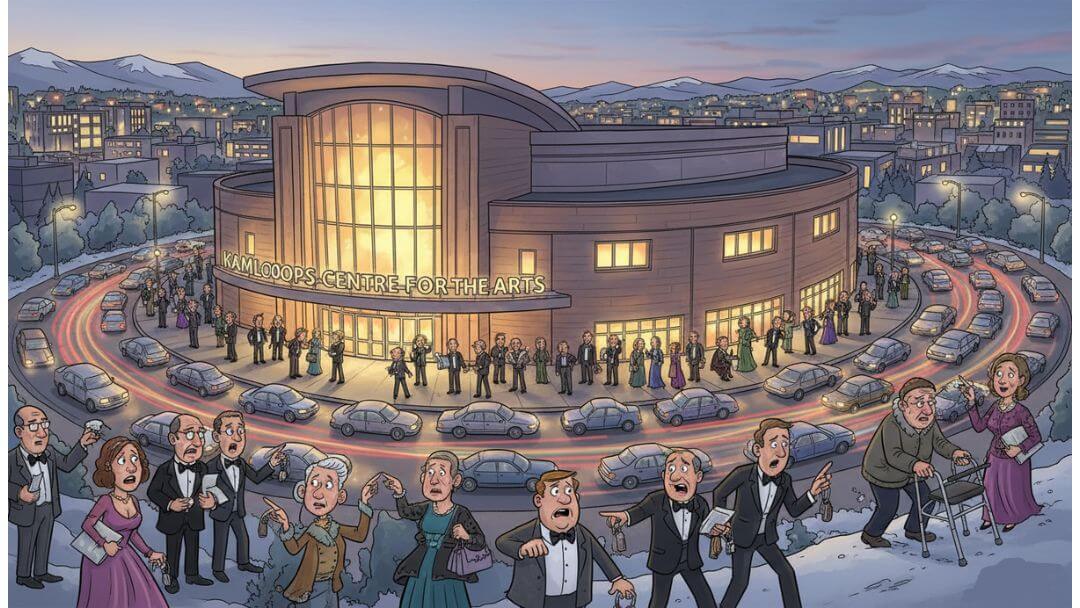
Parking Was Never a Side Issue
The Kamloops Performing Arts Centre (PAC), also known as the Kamloops Centre for the Arts, has been promoted as a cornerstone of downtown revitalization and a cultural legacy project. But from the very beginning, one fundamental issue was minimized, brushed aside, or framed as someone else’s problem: parking.
For a venue designed to attract large evening crowds—often at the same time as other downtown events—parking is not a secondary concern. It is central to accessibility, usability, and public acceptance. The PAC parking problem was not unforeseeable. It was baked into the project.
Downtown Parking Already Stretched
Anyone familiar with downtown Kamloops knows parking is finite and frequently constrained, especially during evenings and weekends. Long before the PAC entered the picture, available parking was already being consumed by:
- Downtown residents and condo owners
- Restaurant and bar patrons
- Hotel guests
- Existing arts, sports, and event venues
Adding a major performing arts centre into this environment without providing adequate new parking capacity guarantees conflict. Every sold-out PAC event adds hundreds of vehicles into a system that was already operating near its limits.
PAC Replaces Parking Instead of Adding It
One of the most overlooked aspects of the PAC parking debate is that the project eliminated surface parking that previously existed on the site. In practical terms, the City removed parking first and then promised that nearby options would somehow absorb future demand.
This results in two simultaneous problems:
- The loss of parking that was already in daily use
- Insufficient replacement parking for large-scale performances
No amount of branding or aspirational language changes that reality.
“Shared Parking” Assumption Doesn’t Match Reality
City messaging around PAC parking frequently leans on the concept of “shared parking”—the idea that nearby parkades, street parking, and private lots will collectively meet demand during events.
In theory, shared parking looks tidy on a planning diagram. In reality:
- Downtown parkades are already partially occupied during evenings
- Street parking availability is inconsistent and enforcement-sensitive
- Private lots are not controlled by the City and are not guaranteed to be accessible
Shared parking works best where surplus exists. Downtown Kamloops does not have a sufficient surplus.
Accessibility Concerns
Parking shortages do not affect everyone equally. Inadequate parking disproportionately impacts:
- Seniors
- People with mobility challenges
- Families attending matinees, recitals, or school performances
- Visitors from outside Kamloops unfamiliar with local parking rules
Telling patrons to “park farther away” ignores hills, winter conditions, safety concerns, and physical limitations. A publicly funded performing arts centre should improve access to culture—not quietly restrict it.
When Everything Happens at Once
The PAC will routinely operate alongside other major downtown events, including:
- Kamloops Blazers home games
- Riverside Park festivals and seasonal events
- Other live music, theatre, or community gatherings
Each concurrent event compounds parking demand. Yet there has been no clear, publicly tested plan explaining how downtown Kamloops is expected to accommodate multiple large crowds simultaneously without spillover chaos.
Costs Shift to the Public
When PAC parking falls short, the costs don’t disappear—they are transferred.
- Patrons pay more for distant or premium parking
- Nearby neighbourhoods absorb congestion and spillover
- Residents face increased competition for street parking and enforcement pressure
These impacts function as a hidden tax tied directly to PAC attendance—one that was never clearly disclosed during the approval process.
What the Public Was Never Clearly Told
At no point was there a straightforward public accounting of the PAC parking reality. Questions that deserved clear answers included:
- How many parking stalls are realistically required for a sold-out PAC event?
- How many stalls are actually available at the same time downtown?
- What happens when those numbers do not align?
Instead, residents were asked to trust assumptions, planning models, and best-case scenarios.
Why PAC Parking Problems Matter Long-Term
Parking challenges do more than inconvenience drivers. Over time, they:
- Discourage repeat attendance
- Undermine accessibility goals
- Increase frustration with downtown events
- Erode public trust in city planning decisions
A cultural venue’s success depends not only on what happens on stage, but on how easily people can get there.
Culture Deserves Honest Planning
Supporting the arts does not require suspending common sense. The Kamloops Performing Arts Centre deserved realistic, transparent parking planning from the outset.
Ignoring the PAC parking problem does not make it go away. It simply pushes the consequences onto patrons, residents, and neighbouring streets—night after night, long before the curtain ever rises.
- Kamloops Council: Amusing Us to Death
- Kamloops City Council: Modern-Day Roman Emperors — But with Ice Arenas and Costumes
What Can You Do?
Sign the Petition
Kamloops Citizens United (KCU) launched a petition to pause the performing arts center (PAC) project, and to hold a referendum during the municipal election Oct 17, 2026.
Sign here: Pause the $211M PAC—No Plans, No Vote—Referendum in 2026
Email City Council
Let Council know what you think. If you’re not in favour of spending $211 million dollars to fund the PAC and the inevitable parking problems that go with it, tell them.
Email: citycouncil@kamloops.ca


0 Comments