
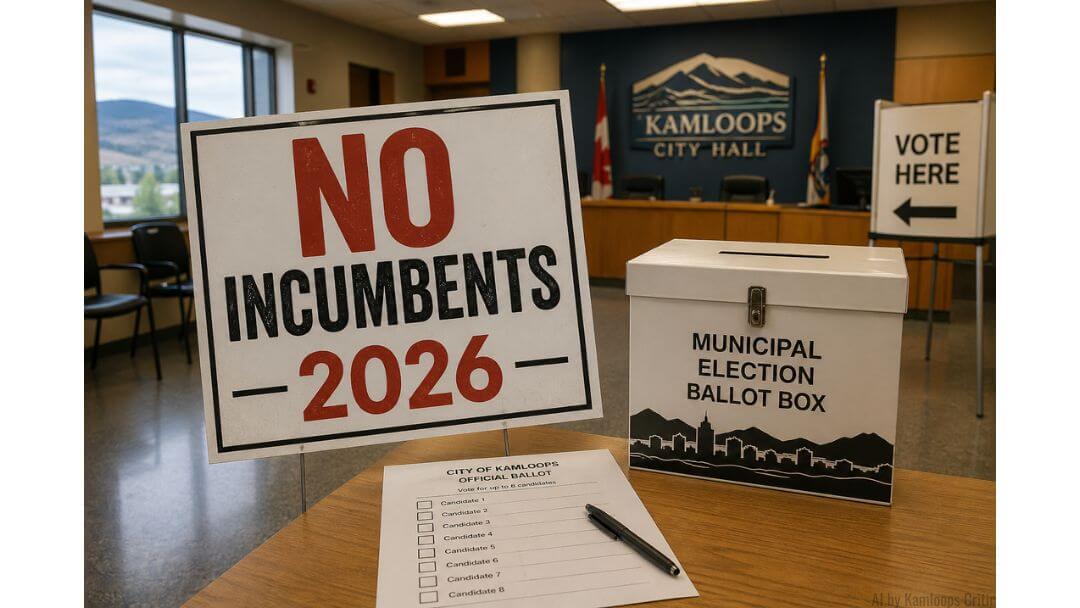
Introduction: A Question Worth Taking Seriously
When local columnist Mel Rothenburger wrote about the idea of a “no incumbents” outcome in the 2026 civic election—an idea already circulating on social media—it struck a chord for a reason. It reflects something that has been building for a while now—a growing unease with how Council has been operating.
That raises a more direct question: should voters return any current members of Kamloops City Council to office?
That’s not just a rhetorical question. It gets at how people feel about decision-making, public input, and the direction the city is taking.
But before turning this into a simple “vote them all out” message, it’s worth slowing down and looking at how municipal elections actually work—and what it would take for voters to get the result they want.
This article focuses on Council, not the Mayor’s race. That’s a separate discussion.
What Rothenburger Gets Right—and What He Leaves Unanswered
Rothenburger’s column taps into something real. People are frustrated. That frustration isn’t tied to just one issue. It shows up across a range of decisions and, more broadly, in how those decisions are made. It spans governance, transparency, and, increasingly, public trust.
Rothenburger does not claim to have originated the “no incumbents” idea, nor does he explicitly endorse it. His column presents it as something already circulating, then places it within the context of past Kamloops election cycles.
Where the column doesn’t go far enough is in explaining what voters would need to do differently if they actually want change.
It’s one thing to say “don’t re-elect incumbents.” It’s another to understand how easily the system can produce the same result anyway.
The Core Position: Incumbency Should Not Be the Default
Let’s be clear.
Based on what we’ve seen over this term, there isn’t a strong case for returning the current group of councillors as a whole.
That doesn’t mean every decision has been wrong, or that every councillor has performed the same. It means the overall pattern—how decisions are handled, how disagreement is treated, and how priorities are set—hasn’t inspired much confidence.
At this point, I don’t recommend supporting any current councillor for re-election.
As the campaign develops, I’ll highlight candidates who show the kind of judgment and independence that has been missing.
What Residents Are Actually Reacting To
It’s easy to say people are frustrated. It’s more useful to ask why.
If you look at public comments, local media, and everyday conversations, the same concerns tend to come up again and again. People don’t always use policy language, but the themes are consistent.
Spending Priorities and Timing
Most people aren’t against projects like a performing arts centre or a multiplex in principle. The concern is about timing and priorities.
Those projects involve significant borrowing, and they’re being pushed forward while pressure on core services—especially policing and fire—remains visible.
That tension became more obvious when the City chose to move ahead using an Alternative Approval Process rather than a referendum.
The question people keep coming back to is simple: why are long-term cultural and recreational investments moving ahead while immediate service pressures appear unresolved?
How Big Decisions Are Being Approved
The AAP process itself is legal, but that’s not really the point most residents are making.
What people are reacting to is the feeling that they weren’t directly asked to approve a major financial decision.
For many, that comes across as the City choosing a quieter path instead of a clearer one.
Public Input That Doesn’t Seem to Change Outcomes
Opportunities for public input exist, but they are often perceived as occurring after key decisions have already taken shape.
That doesn’t mean input is ignored, but it does raise a fair question about how much influence it actually has.
Long-Term Costs and Tax Pressure
Big projects don’t just cost money upfront. They come with long-term financial commitments that extend well beyond a single Council term.
Most residents aren’t tracking municipal debt in detail, but they do notice rising taxes and worry about where things are heading.
A Broader Concern About Confidence
Taken together, these issues point to something bigger.
It’s not just about one project or one vote. It’s about whether people feel confident in how decisions are being made, explained, and aligned with the city’s most immediate needs.
Right now, that confidence looks shaky.
Advertisement

Low Turnout Is the Quiet Driver of Outcomes
Municipal elections in Kamloops don’t usually see high turnout. That matters more than people think.
A low-turnout election rewards:
- name recognition
- slate-style voting
- incumbency familiarity
It does not reliably reward performance.
The Name Recognition Problem
This is simple but important.
People recognize incumbent names. When they’re unsure who to vote for, that recognition often fills the gap.
That alone can be enough to carry incumbents back into office—even if confidence in Council has dropped.
You Don’t Have to Vote for Eight Candidates
In Kamloops, voters can select up to eight councillors.
They don’t have to.
If someone believes only three or four candidates are worth supporting, they can vote for three or four. Adding extra names just to fill out the ballot weakens the impact of the choices that actually matter.
The “Split Vote” Myth
There’s a common idea that voting for fewer candidates somehow helps the wrong people get elected.
That’s not how this system works.
Each candidate’s votes are counted individually, and the top eight are elected. There’s no requirement to spread votes around.
What matters is choosing candidates you actually support—not trying to game the system.
Conclusion: The Question Voters Will Actually Answer
The idea of replacing every incumbent isn’t far-fetched. It reflects concerns that are already out in the open.
But it won’t happen just because people are frustrated.
It will come down to turnout, and to how people approach the ballot.
In 2026, the real question won’t be whether change is needed.
It will be whether voters are willing to make deliberate choices—and follow through on them.
Election 2026
The next election is October 17, 2026. If you were considering voting for any of the current councillors, I urge you to reconsider.
Its critically important for you to get out there and vote. Let's vote for a council that actually listens to its electors!
Editor’s note: This article has been updated to clarify that Mel Rothenberger did not originate or explicitly endorse the “No incumbents 2026” concept. His column discussed the idea as it appeared on social media and provided historical context.

1) The municipal voter turnout in Kamloops is equal to the provincial average over the past 5 elections
2) 3 candidates formed a small slate last election even though they were amongst the top spenders and had significant name recognition and none got in, the last time a large slate ran was 1988 so we haven’t had much experience with slates but I suspect we’ll have a couple this time around
3) the “No Incumbents” push started months before Rothenberger wrote about it, he got the idea of for editorial from “No Incumbents” comments on his blog from the past 3 months
4) incumbents have the advantage of familiarity as you say but the biggest advantage they have is a crowded field, people just don’t want to scour thru a list of 25 names to make their picks that’s why many of us are pushing for a Ward system to make it easier for the voter to engage with a small field
The ward system has pros and cons. While regions may feel more connected to the representative for their area, issues like where division map borders are drawn can become an issue. For those of us who have grown up here, a ward system could further deepen perceived prejudices. The old North Kamloops vs South Kamloops vs Westsyde vs Valleyview vs Brock will become much more entrenched if pushed by politicians and people whose desire is power and control rather than what is best for the whole city. Would wards be based on population or old city borders? Would larger populated “wards” need more than one councillor? What would that mean for the fastest growing, newer areas of the city? What would it mean for more rural, lower-populated areas?
Incumbents can allow for carry-over of knowledge and relationships beyond council and deepen discussions in a new council because of experience. When everyone is new, everything gets rehashed, all relationships have to be rebuilt with outside agencies and takes even more time to move forward. It’s hard work, but everyone needs to look at who has been trying to move things forward with respect and accountability. You also need to ask who is prepared to work with the provincial and federal governments to get the resources Kamloops needs. Everything is about relationship, emotional intelligence, and respect for people doing work for and on behalf of this city every day. We need people who see the broad picture and who actually understand how governments work at all levels and who are prepared to work for ALL Kamloops residents, not just the loud and angry.
With the performance of the present 8 councillors during their term, it’s hard to imagine any of them deserving another term in office.
I’d like to ask them what’s the story behind the construction site where the new PAC is to be built? Some friends of mine have reported seeing “old” parts of wall with rebar attached and one wonders if the basement floor of the former building is still on site. I was under the impression that complete removal of the former building was to have been done when the (KDN) building was demolished. Are the citizens of Kamloops going to face an extra huge invoice for removing and clearing away materials that should have been removed years ago?
Is this the case?