
A formal Code of Conduct complaint has been submitted against Kamloops City Councillor Kelly Hall following the January 13, 2026 Regular Council Meeting, alleging a pattern of conduct inconsistent with Council’s own governance standards while he presided as Chair.
The complaint, filed under the City of Kamloops Council Code of Conduct Bylaw No. 53 (consolidated with Amendment 53-1), does not allege motive or intent. Instead, it relies exclusively on verbatim transcript excerpts, timestamps from the public meeting video, and documented pre-meeting communications.
At issue is not policy disagreement — but whether the Chair met the obligations of fairness, respect, and procedural integrity required by Council’s Code of Conduct.
Mayor’s Virtual Attendance and Pre-Meeting Context
Thirteen minutes before the meeting began, Mayor Reid Hamer-Jackson texted Councillor Hall, who was scheduled to preside as Deputy Mayor, seeking confirmation that Hall would chair the remaining open meetings and requesting a Zoom panelist invitation for his City phone.
The Mayor sent three messages:
- “Just want to confirm you received my email as I know you do not respond most of the time…”
- “Can I get sent an invite to my city phone?”
- “Is you phone working?”
No response was received.
As a result, the Mayor was unable to join the meeting at its scheduled start time and only connected approximately fifteen minutes later after City IT provided the panelist link.
This context forms a central foundation of the complaint.
Opening Remarks and Framing of Absence
Despite knowing the Mayor had been attempting to connect virtually, Councillor Hall opened the meeting by stating:
“The mayor didn’t show up… you guys are stuck with me. And I think that’s a good thing.”
The complaint argues that this remark publicly framed a technical connectivity issue as a personal absence, setting a tone that would continue throughout the meeting.
Pattern of Conduct During the Meeting
The complaint documents a series of incidents, including:
- Repeatedly refusing to use the Mayor’s title after being corrected;
- Interrupting the Mayor mid-sentence during multiple speaking attempts;
- Redirecting discussion away from the Mayor while he was speaking;
- Mishandling a virtual recusal by offering no procedural guidance;
- Publicly calling out the Mayor following the flawed recusal handling;
- Ending discussion while the Mayor was attempting to participate.
Each incident is supported by timestamped excerpts from the meeting video.
The complaint notes that this pattern of treatment was applied selectively to the Mayor and not to other Council members.
Code of Conduct Provisions Engaged
The complaint alleges engagement of several sections of the Code of Conduct, including:
- Section 3.1(d) – Bullying or harassing conduct
- Section 3.2 – Requirement to treat members with respect and dignity
- Section 3.8 – Prohibition on statements attacking other members
- Section 3.14 – Requirement to act with decorum at meetings
The complainant emphasizes that the Code exists not to police opinions, but to protect fair participation, institutional dignity, and public confidence.
Not a Political Dispute
The complaint explicitly avoids attributing motive, intent, or political purpose.
It is framed entirely around observable conduct, procedural fairness, and governance standards.
As the filing states:
“This complaint is submitted in the public interest and is based entirely on the public meeting record and documented communications.”
What Happens Next
Unfortunately, citizens are no longer permitted to submit Code of Conduct complaints. We have to rely on a member of Council, or staff, to submit it on our behalf.
I have asked Corporate Officer Maria Mazzotta to submit the complaint on my behalf. Should she be unwilling to do so, I have also asked that a member of Council, or staff, submit it on my behalf.
Once submitted, CAO Byron McCorkell will have the option of dismissing it if he feels the complaint is vexatious or frivolous.
Assuming, CAO McCorkell agrees that this is a serious matter, he will then need to engage an independent investigator to process the complaint. It is my hope that he will select a more affordable investigator as the continuous use of Reece Harding has had a serious financial impact on the City and taxpayers.
If investigated, findings must be reported to Council.
No disciplinary outcome is requested in advance. Only process.
Why This Matters
Hybrid council meetings place heightened responsibility on the presiding officer. When one member is participating virtually, procedural clarity and respectful accommodation are essential.
The complaint argues that when the Chair fails to meet that responsibility, the issue is not personal — it is institutional.
Public confidence in municipal governance depends on consistent, fair application of Council’s own rules.
Source Material
The full January 13, 2026 Council meeting video is publicly available on YouTube:
The complaint is supported by:
- A formal complaint letter
- Appendix A – Evidence Table
- Appendix B – Transcript
- Executive Summary
All documents rely solely on public record evidence.
Closing
Whether or not the complaint ultimately succeeds, its existence underscores a fundamental principle:
Council members are accountable not only for how they vote — but for how they govern.
And governance, by design, must be fair, respectful, and procedurally sound.
What Can You Do?
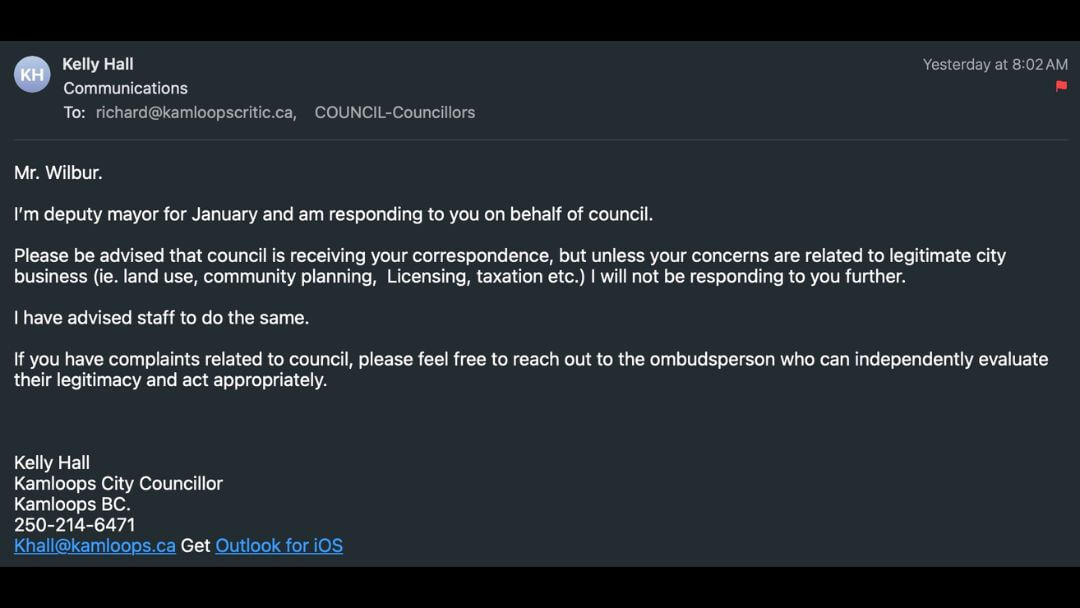
Email City Council
Let Council know what you think. If you're not happy with the targeted mistreatment of the Mayor, and want to see this formal Code of Conduct complaint proceed, tell them.
Email: citycouncil@kamloops.ca
Election 2026
The next election is October 17, 2026. If you were considering voting for Councillor Kelly Hall, I urge you to reconsider.
Editorial disclosure: The author of this article, Richard Wilbur, is also the complainant in the Code of Conduct submission referenced above. The article is based on publicly available meeting records.
I am exhausted by Council’s constant rudeness, bullying, and eagerness to condemn the Mayor at every opportunity. It’s relentless. They have hamstrung him from day one, and it continues daily. He may not be the most polished politician, but we didn’t vote for the status quo—we voted for change. Council never gave him a chance.
In my view, the outcomes of these investigations were predetermined long before any “investigating” took place. The results seem to reflect the wishes of those who commissioned them, not an unbiased process. There should have been at least one or two findings that didn’t place blame solely on the Mayor—or that acknowledged the role of other council members whose dishonesty contributed to these issues. How their behaviour is not considered a workplace problem in itself is mind‑boggling. This conduct would never be tolerated in any public government office.
I genuinely don’t know how any of them can look in the mirror and convince themselves they are “good people.” They have completely destroyed this man’s life as it existed when he took office. Their behaviour has been rude, condescending, and self‑serving. They would do well to remember that taxpayers—not developers or contractors—pay their salaries. They have let us down profoundly.
I sincerely hope none of them are returned to Council in the next election.
And honestly, I’d love to be a fly on the wall on their judgment day.