
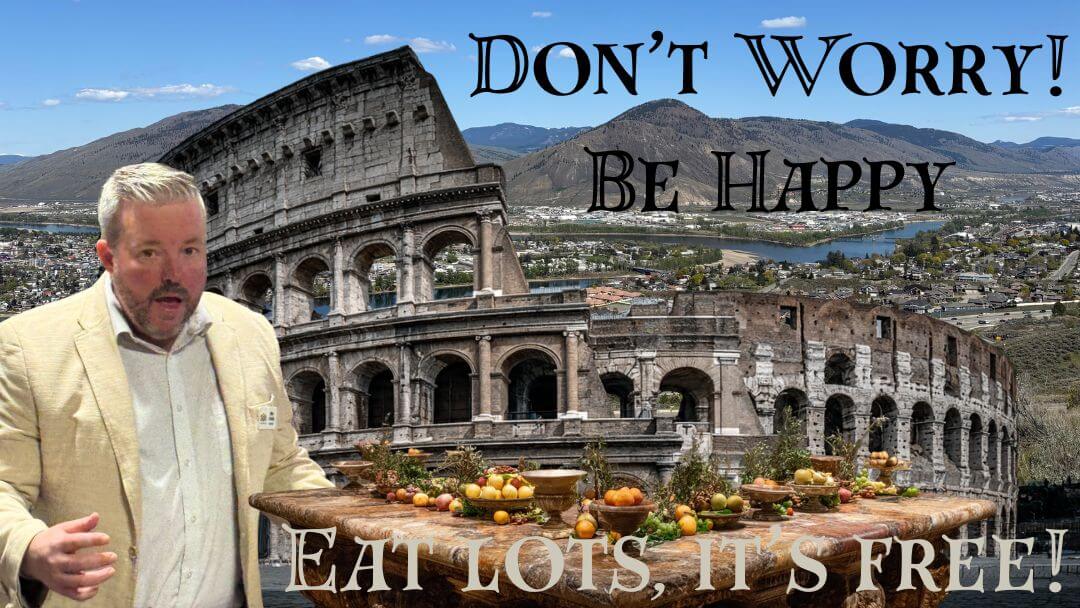
I enjoy watching shows about the Roman empire, Julias Caesar, and of course Sparticus. It’s often played on the back of my mind that there are similarities between the Romans and our City Council. They both seem to focus on entertainment rather than the real problems plaguing us. I decided to dig into this a little deeper.
Are We Repeating Roman Political Strategy in Kamloops?
When we look closely at how Council wants to use public funds, especially on entertainment and leisure, we find familiar patterns—some stretching all the way back to Ancient Rome.
Kamloops is no Rome, of course. Nobody is building a Colosseum near the Tournament Capital Centre or staging mock naval battles in Riverside Park. But the city’s spending priorities—especially around arts, entertainment, and leisure—invite comparison to an ancient political strategy: using spectacle to soothe a restless public.
Is Kamloops City Council investing in cultural enrichment? Or are we dabbling in the Roman practice of mollifying citizen discontent with diversion?
Let’s take a closer look.
The Romans: Keep the Crowds Fed, Busy, and Quiet
Ancient Rome perfected the political use of entertainment. The phrase “bread and circuses” describes a strategy where rulers met citizens’ basic material needs while distracting them with lavish spectacles. Gladiator battles, chariot races, public feasts, theatrical performances, and triumphal parades served a political purpose: divert attention from corruption, inequality, stagnation, and unpopular decisions.
Rome wasn’t alone.
- Aztecs used ritual festivals and bloody displays to maintain social cohesion.
- Medieval monarchies hosted jousts and fairs to secure public loyalty.
- French monarchy used extravagant court entertainments
Public spectacle, throughout history, has often been a pressure valve—an aesthetic sugar-coat for deeper issues that would otherwise ferment into unrest.
Kamloops: Culture Spending Amid Public Frustration
Council has faced persistent criticism in recent years: rising taxes, downtown safety concerns, homelessness and addiction crises, aging infrastructure, uneven economic growth, and high-profile political tensions. These issues weigh heavily on residents.
At the same time, the city invests significant funds into:
- Festivals and cultural events
- Arts grants and performance venues
- Recreation facilities and community programming
- Beautification and “placemaking” projects
- Tourism-oriented events and entertainment infrastructure
Supporters argue that these investments stimulate tourism, enrich community life, and build vibrant neighbourhoods. Arts and leisure spending, in this view, is not a distraction—it’s a foundation for livability.
Critics counter that these expenditures appear tone-deaf when residents feel underserved on core issues like safety, streets, housing, and taxation. When morale is low and frustration is high, celebratory announcements of new events or recreation expansions can feel oddly reminiscent of Roman elites tossing bread to the crowd.
Similar Tactics, Different Motivations?
Let’s compare the two approaches side-by-side:
1. Entertainment as a Morale Boost
- Rome: Keep the masses content despite political turmoil.
- Kamloops: Council often emphasizes “community spirit,” “vibrancy,” and “quality of life.”
There’s nothing inherently wrong with boosting morale—but the timing and transparency matter.
2. Visibility Over Substance
- Rome: Spectacles were highly visible and emotionally powerful, even if structural issues remained unaddressed.
- Kamloops: Festivals and leisure facilities are easy to promote and photograph, unlike slow, expensive infrastructure or policy reform.
Public-facing wins often get priority over behind-the-scenes necessities.
3. A Tool to Shift the Narrative
- Rome: Entertainment diverted attention from inequality and corruption.
- Kamloops: Cultural spending can sometimes overshadow uncomfortable realities—ongoing social disorder, economic stagnation, or political conflict.
This may be unintentional—but the effect is similar.
Where the Comparison Breaks Down
Kamloops is not a dictatorship. The city is supposed to operate in a democratic, transparent system with budgets, committees, public consultation, and provincial oversight. Spending on arts and leisure is normal for modern municipalities, and local officials are neither emperors nor scheming Roman elites.
A key difference is intention. Most city investments in arts and entertainment are motivated by:
- community development goals
- recreational access
- mental and physical well-being
- tourism and local business support
- cultural enrichment
These functions are legitimate and beneficial—when core civic responsibilities are also being met.
The Real Issue: Priorities and Optics
The comparison to Rome becomes most compelling not in the spending itself, but in how it is perceived during times of hardship.
When residents feel unheard, unsafe, or overburdened by taxes, high-profile spending on cultural events can look performative. It can feel like an attempt to “distract” rather than to govern.
This doesn’t mean the spending is wrong—but it highlights how governments must align entertainment investments with public sentiment, not against it.
The problem isn’t bread and circuses. The problem is bread and circuses offered when people are asking for safe streets, affordable housing, and financial relief.
A Balanced Path Forward
Kamloops doesn’t need to abandon arts, entertainment, or leisure. These are essential ingredients of a healthy city. But the key is balance—and communication:
- Tie cultural spending directly to measurable community benefits.
- Be transparent about costs, tradeoffs, and long-term returns.
- Prioritize core services first, so entertainment never feels like a distraction.
- Engage residents in deciding what events and amenities matter most.
- Avoid the temptation to highlight “fun wins” when the public is frustrated about serious issues.
Rome fell, but not because of too many chariot races. It fell because its leaders failed to maintain trust, infrastructure, and stability while distracting the public with spectacle.
Kamloops has a chance to learn the lesson without repeating the history.
What Can You Do?
Sign the Petition
Kamloops Citizens United (KCU) has launched a petition to pause the performing arts center (PAC) project, and hold a referendum as part of the municipal election on Oct 17, 2026.
Sign here: Pause the $211M PAC—No Plans, No Vote—Referendum in 2026
Email City Council
Let Council know what you think. If you’re not in favour of the City using reserve funds for purposes other than their intended use, tell them. If you didn’t get an opportunity to oppose the alternative approval process (AAP) they used to gain approval for borrowing $275 million dollars to fund the PAC and the arena multiplex, tell them.
Email: citycouncil@kamloops.ca

I’m not for the PAC and MULTI PLEX…… Over priced. Not paying the higher tax increase.
I am NOT in favour of the PAC at this time,the proposed 10% increase in taxes is beyond common sense, unions are getting increases in the 3% range and Kamloops council is seeking three time that in taxes, absolutely unacceptable.
we as kamloops people should do a law suit against city of kamloops to put a stop to these idiotic projects and get a audit done on the city of kamloops find out wheres all the cash is going really in there pockets i bet …